
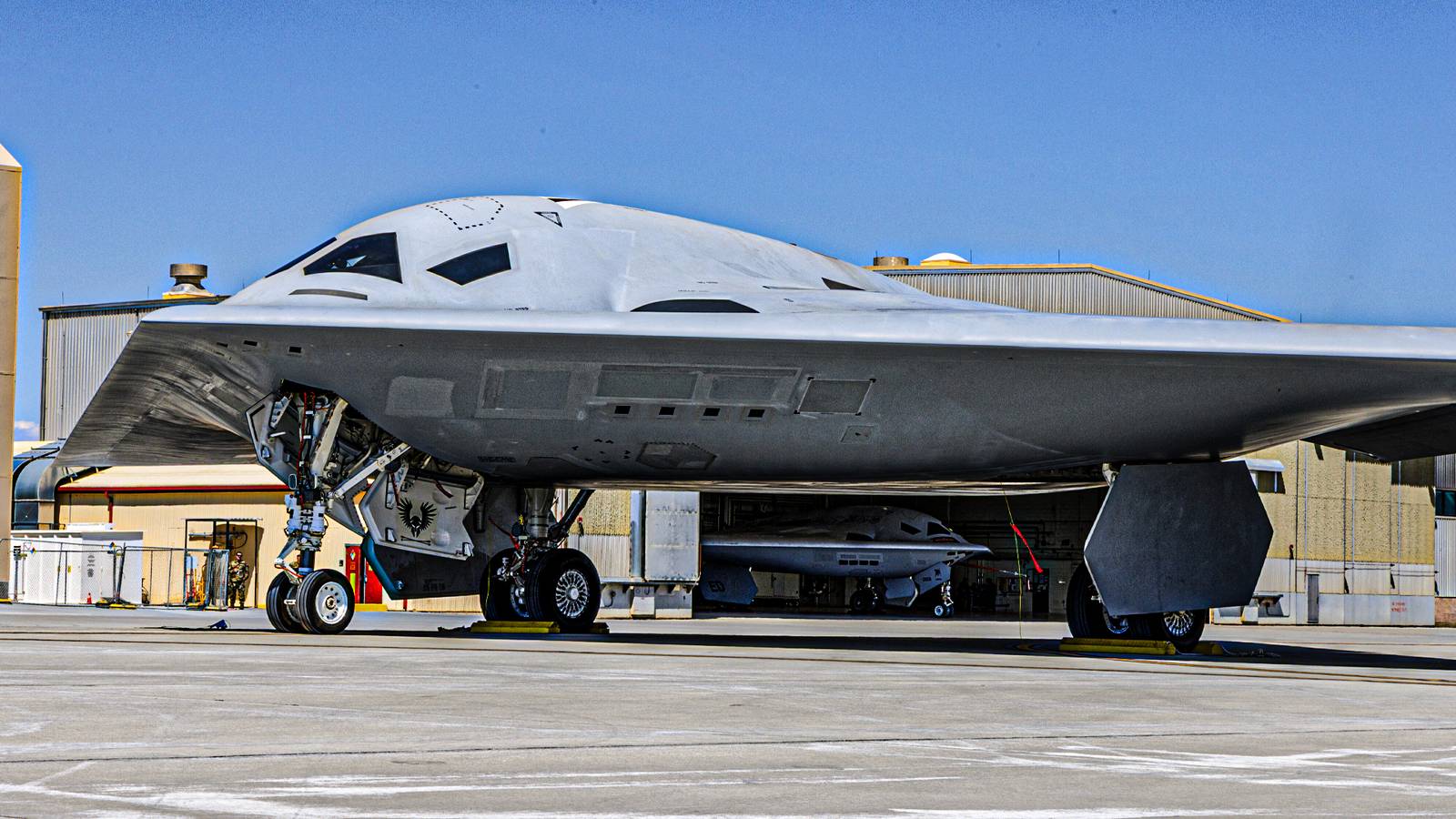
Published Oct 30, 2026, 10:00 AM EDT Luke Diaz is a freelance military writer with experience with active duty experience in the US Navy as well as defense and industrial engineering. He is a former Naval Flight Officer who performed tactical air control on the carrier-based E-2 Hawkeye. Facing the dual-pronged pressure of asymmetric warfare in the Middle East and rapidly advancing near-peer adversary technology in the Western Pacific, the US Air Force is going all in on the world's first sixth-generation bomber. Even though the final fleet count is yet to be decided, top brass at the Pentagon have already decided to fund a 25% production increase for Northrop Grumman to ramp up deliveries of its B-21 Raider flying wing stealth bomber. The urgency to deliver new strategic strike aircraft is more than simply perceived threats and a very real shortage of combat-ready airframes, given the historic low that the USAF inventory recently hit. As the Air Force presses ahead with its divest-to-invest fleet recapitalization strategy across the board, the total number of available aircraft has dipped below 5,000 for the first time since WWII. While the 140-strong flight line of the Air Force Global Strike Command is only a tiny sliver of that count, each one of its strategic bombers has an outsized impact on every conflict that the United States has engaged in for decades. It remains to be determined if 100, 145, or even as many as 200 of the B-21 will eventually roll out the doors of Northrop's Plant 42 in Palmdale, California, but the USAF is wasting no time in getting every one of those stealthy 'Flying Doritos' on the front line as soon as possible. What's Driving The Urgency On The Flightline Credit: US Air Force Even expanded plans for the B-21 Raider would have its numbers at a tiny fraction of most other types in the USAF. Yet every single airframe is designed to replicate the exact same lopsided, high-value tactical value as its predecessor, the Northrop B-2 Spirit. The Raider will be the backbone of the US bomber fleet and deliver a massive percentage of strikes during air campaigns. Moreover, the B-21 will be equipped to devastate both asymmetric, low-end enemies and high-end, near-peer-adversaries. During the opening hours of a high-end Pacific conflict, the Raider’s primary role is to fly directly into the teeth of China's air defenses to systematically dismantle them. The B-21 will also leverage its 'Arsenal ship' capability to crush drone swarm attacks and destroy high-value targets in scenarios as seen during Operation Epic Fury. On top of integrating with collaborative combat aircraft, or loyal wingman drones, another massive shift from legacy bomber doctrine coming with the introduction of the B-21 is long-range air-to-air capabilities. In the Middle East, the strategic problem isn't high-end stealth jets; it is an unsustainable cost-to-kill ratio. Adversaries deploy thousands of $20,000 to $50,000 one-way attack drones, like the Iranian-designed Shahed-136. The US is currently forced to expend multi-million-dollar Patriot or THAAD interceptors to shoot them down, draining advanced missile stockpiles. The B-21 will not necessarily directly shoot down these drones but rather cut through enemy jamming to coordinate electronic attacks or directional strikes directly at the launch source. At the same time as the Raider and its crew are hunting for the underground command bunkers, manufacturing plants, and mobile launch platforms, the pilots can issue directives to CCAs to counter-attack inbound enemy drones. Each of those 'loyal wingman' uncrewed aircraft can carry its own missiles to shoot down multiple targets and, if necessary, even collide with hostile drones as a sacrificial shield for friendly forces. All of these same technologies are equally important for missions on the other side of the globe as well. The Raider's Shadow Over The Pacific Credit: US Air Force The Indo-Pacific region is characterized by a prominent anti-access/area-denial (A2/AD) strategy, primarily due to China's People's Liberation Army Air Force (PLAAF), which has deployed a substantial fleet of Chengdu J-20 stealth fighters. The rapid development of more and more capable early-warning radar systems and long-range hypersonic anti-ship missiles, such as the DF-21, is also becoming a greater concern for US and Allied Naval vessels as well as air bases throughout the region. The Air Force’s long-term fighter force structure reports explicitly evaluate assigning air-to-air missions to its bombers. In a high-end conflict over the First and Second Island Chains, even fifth-generation jets like the Lockheed F-35 Joint Strike Fighter or F-22 Raptor run into a severe range and magazine depth problem. Their unrefueled range makes their combat radius a limitation, and in engagement they are likely to run out of missiles too fast during large-scale aerial battles. Aircraft Platform Unrefueled Range Combat Radius Total Payload Capacity B-21 Raider 6,000 miles (9,650 km) Est. 3,000 miles (4,830 km) Est. 20,000–30,000 lb (9,072-13,608 kg) Est. F-35A Lightning II 1,380 miles (2,220 km) 680 miles (1,090 km) 18,000 lb (8,160 kg) Max F-22 Raptor 1,840 miles (2,960 km) With Tanks 515–610 miles (830–980 km) 18,000 lb (8,160 kg) Max Standard fighters cannot make the flight across the vast ocean without heavy reliance on non-stealth aerial tankers, which Chinese J-20s are explicitly intended to hunt down and destroy. The B-21 can cross an ocean or a continent unrefueled and make a strike deep behind enemy lines completely undetected by even the most advanced adversary's integrated air defense system. This makes it a vital deterrent and power projection platform for the entire Joint Force of US Armed Forces in the Pacific. Breaking Down The Raider's Arsenal Credit: US Air Force In a shooting fight, the B-21 can act as a giant, low-observable airborne arsenal. Positioned safely inside contested airspace, it can carry deep inventories of ultra-long-range air-to-air missiles, like the AIM-174. Frontline CCAs or fighters can push forward, spot J-20s or command-and-control planes, then send target data over the 'combat cloud' back to the B-21. The Raider then fires from its deep internal bays without ever exposing friendly aircraft or itself by turning on its own active radar. On the ground, China’s military strategy relies on targeting US aircraft carriers and non-stealth forces thousands of miles away using long-range ballistic and hypersonic missiles like the DF-21D and DF-26. This creates a buffer zone where conventional platforms cannot penetrate. The B-21 bypasses this A2/AD ring with highly advanced cruise missiles like the AGM-158 JASSM-ER and the AGM-181 Long Range Stand-Off, and upcoming hypersonic attack weapons to dismantle these networks. Weapon Category B-2 Spirit Arsenal B-21 Raider Expected Arsenal Air-to-Ground Conventional Mk 82, Mk 84, CBU-87, CBU-89, Mk 62 Mk 82, Mk 84, advanced sea mines Air-to-Air None AIM-174B, long-range air interceptors Air-to-Ground Precision GBU-38, GBU-31, GBU-57 MOP, JSOW JDAM family, optimized penetrators Standoff Cruise AGM-158 JASSM, AGM-158 JASSM-ER AGM-158 JASSM-ER, LRASM, AGM-181 LRSO Hypersonic None HACM, stand-off hypersonic weapons Drone Integration None CCA drone control, uncrewed mothership The true operational game-changer for the B-21 in the Pacific is how it scales across Agile Combat Employment. Legacy stealth bombers like the B-2 Spirit are massive logistical anchors, requiring specialized, climate-controlled hangars. The B-21 is roughly 10% to 20% smaller than the B-2. It is engineered with ruggedized, next-generation stealth coatings that can withstand austere, humid Pacific environments. Because it can be sustained at any airfield built for Cold War fighter jets, the Air Force can disperse B-21s across a massive web of small bases. Furthermore, by consuming a fraction of the fuel required by older heavy bombers or short-range fighter packages, it drastically reduces reliance on highly vulnerable aerial refueling tankers. The strategic value of the B-21 Raider is so immense that a larger fleet has been championed by top brass for multiple services, not just the USAF, as well as numerous lawmakers on Capitol Hill. A Number Many Officials Want But None Has Approved Credit: US Air Force High-ranking officials have put forward specific numbers. Admiral Correll, former STRATCOM head, has heavily endorsed a fleet size of 145 airframes. Meanwhile, organizations like the Mitchell Institute and Admiral Samuel Paparo, overall commander of USN forces in the Pacific, have argued for an even larger force of up to 200 Raiders. Combining the upgrade program for the Boeing B-52J Stratofortress with a fleet of 145 B-21s would ultimately allow for the long-sought total requirement of 220 bomber airframes in the total inventory. Northrop has already been approved for a 25% production increase, which has been fully funded to expedite deliveries and allow the first B-21 to arrive on the ramp at Ellsworth Air Force Base early next year. That capacity expansion that is happening already would be instrumental in increasing annual production to deliver a larger total fleet as well, if approved. To officially alter the program of record, the Air Force must first secure formal validation from the Joint Requirements Oversight Council. Northrop CEO Kathy Warden stated that the company is actively working through analysis with the Air Force to accommodate a larger program. The Air Force expects to present a revised force structure plan during the Fiscal Year 2028 budget cycle, which is expected in Spring of 2027. In addition to the game-changing tactical and strategic performance of the B-21, Northrop's execution of the procurement program with the USAF has been almost perfectly on schedule and budget. Congress sees the program as a model of Defense procurement which will greatly aid the USAF's bid to increase the final fleet count.
Why The US Air Force Is Paying For 25% More B-21 Production Capacity Before Anyone Has Approved 145 Bombers
Full Article
Original Source
Read the full article at Simpleflying →KhanList aggregates and links to publicly available news content. We do not host full articles from third-party sources. Always verify important information with original sources.