
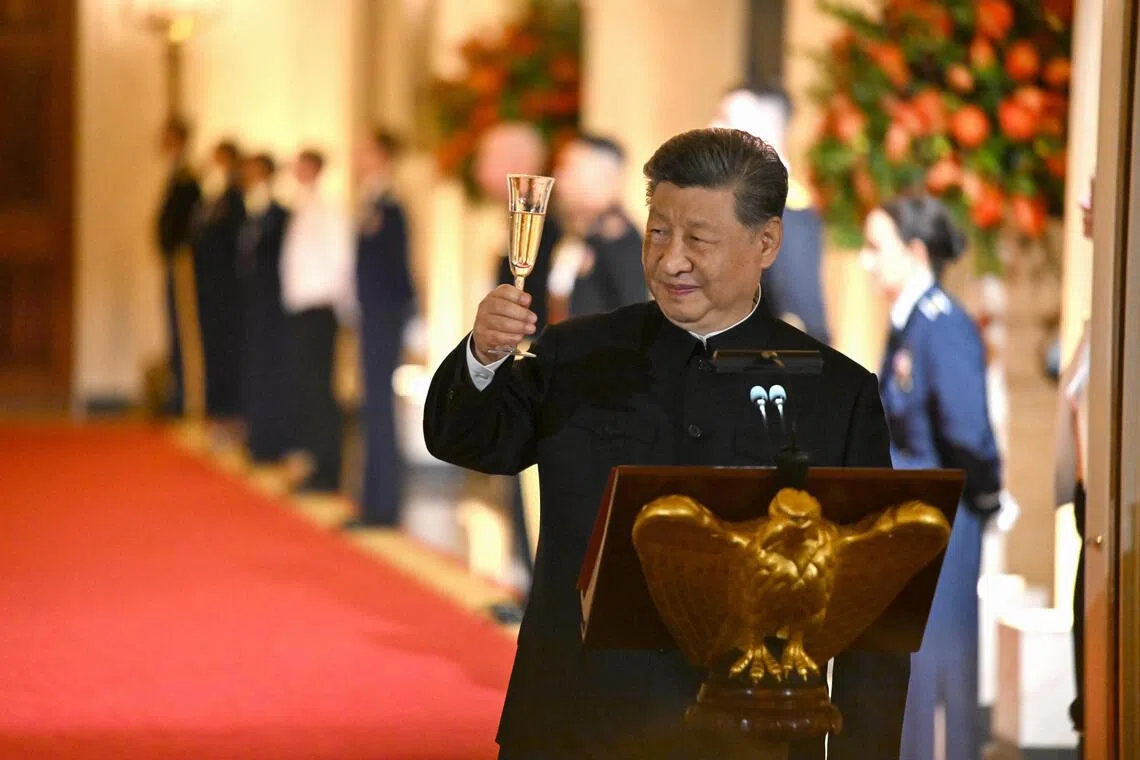
SINGAPORE - The one-day summit between US President Donald Trump and Chinese President Xi Jinping – which some observers have criticised as being heavy on optics but light on substance – showed little headway in the resolution of core Chinese concerns.After the meeting, the US did not immediately express opposition to Taiwan independence, which China has been pressing Trump to do. Washington has long maintained that it does not support independence for the self-governing island.Neither did the US raise the prospects of easing semiconductor export controls, another sore point for Beijing.Still, the fact that there were no further US actions to rock the “ship” of bilateral relations could be considered a win for Beijing, said analysts, with China being realistic about how many concessions can be achieved given pressure from the US Congress to be tougher on China.Analysts also believe that the growing personal rapport between Trump and Xi could limit unpredictability in American restrictions on China.In his remarks at the White House on Sept 24, Xi said he has a “good relationship” with Trump and is ready to work with the US President “to steer the giant ship of China-US relationship on a steady course towards the future”.“Our competition should be a healthy one and should be kept within bounds. It should be a race of catching up with one another, not a wrestle in which one either wins or loses,” Xi added.Jia Qingguo, a professor and former dean of the School of International Studies at Peking University, told The Straits Times that formality is important and carries real weight.“By reciprocating the friendly and generous hospitality that President Xi extended to him in Beijing, Trump demonstrated goodwill. This may appear superficial, but in reality, it is something concrete,” he said.Jia also had praise for what he said was Trump’s positive role in maintaining rapport with Xi despite resistance from China hawks in Washington.Asked about claims that the September summit lacked real substance, Jia said he believes China is realistic and pragmatic about the potential outcomes.He added: “China does not expect drastic changes to happen. The focus is more on steadily stabilising the bilateral relationship and, building on that foundation, steering the relationship in a more constructive direction… We are essentially still in the process of establishing that stability.”He was referring to how, at their last summit in May, Trump and Xi agreed to define the US-China relationship as one of “constructive strategic stability”.US-China relations expert Hoo Tiang Boon said China’s strategy is to ride out Trump’s term, which ends in 2029, unscathed as far as possible, as Beijing is well aware of the US President’s unpredictability.“China is under no illusions that having a few summits with Trump will make fundamental disagreements and structural issues disappear,” said the associate professor from the Nanyang Technological University in Singapore.He noted that despite the feel-good summit in May, the US has continued to impose restrictions on China. For instance, in July, the Federal Communications Commission banned imports of new foreign-made humanoid robots on national security grounds.“What China means by stability is to have a certain understanding of what to expect, in order to minimise the potential damage of any American policy during Trump’s term,” said Hoo.But he added that the US remains in the driver’s seat, as the prospect of arms sales to Taiwan and further tariffs have not gone away. A tariff truce expiring on November 10 was extended by just two months, shorter than the extension to the end of Trump’s term that China reportedly sought.“I’m sure the Chinese will be disappointed that the extension (of the tariff truce) is only for two months,” he said.Huang Chin-Hao, an associate professor of political science and director of the Centre on Asia and Globalisation at the Lee Kuan Yew School of Public Policy, believes that further breakthroughs could come in the form of the US lowering sector-specific trade barriers or making the tariff truce more permanent.But in order for Washington to do that, it would probably want to see more trade concessions from China, such as giving the US greater access to rare earth materials and making sure there is no disruption to the supply, said Huang, who studies US-China ties.This is the more consequential part of the negotiations which officials will have to work out after the summit, he said. “At least there’s a positive indication and signalling from the senior-most level that both sides want to work something out pragmatically.”China's President Xi Jinping and US President Donald Trump on the steps of the White House ahead of a state dinner in Washington on Sept 24. PHOTO: AFPWhile China is unlikely to achieve any breakthroughs on Taiwan, Shanghai-based international relations scholar Shen Dingli believes China did not walk away empty-handed.He believes the growing personal rapport between Trump and Xi will be key in ensuring the Taiwan issue does not boil over.Shen noted that Trump has repeatedly delayed signing off on a proposed US$14 billion (S$17.9 billion) arms package to the self-governing island.“With a potential visit to the Asia-Pacific Economic Cooperation summit in Shenzhen coming up in November, Trump is unlikely to sign in the interim. In December, he hopes President Xi will do him the favour of attending the G-20 summit in Miami, so he won’t sign then, either,” Shen told ST.To Shen, the logic here is simple: “Relations between nations hinge on personal affinity. When two leaders meet frequently, it becomes awkward to engage in hostile acts.”Shen hopes this bonhomie and pragmatism can extend until the end of Trump’s term. “I hope that over the next two years, President Xi visits the US annually and Trump visits China annually. That way both sides will strive to eliminate obstacles to facilitate these exchanges.”
Why the Trump-Xi summit in Washington could be considered a win for Beijing
Full Article
Original Source
Read the full article at Straitstimes →KhanList aggregates and links to publicly available news content. We do not host full articles from third-party sources. Always verify important information with original sources.