
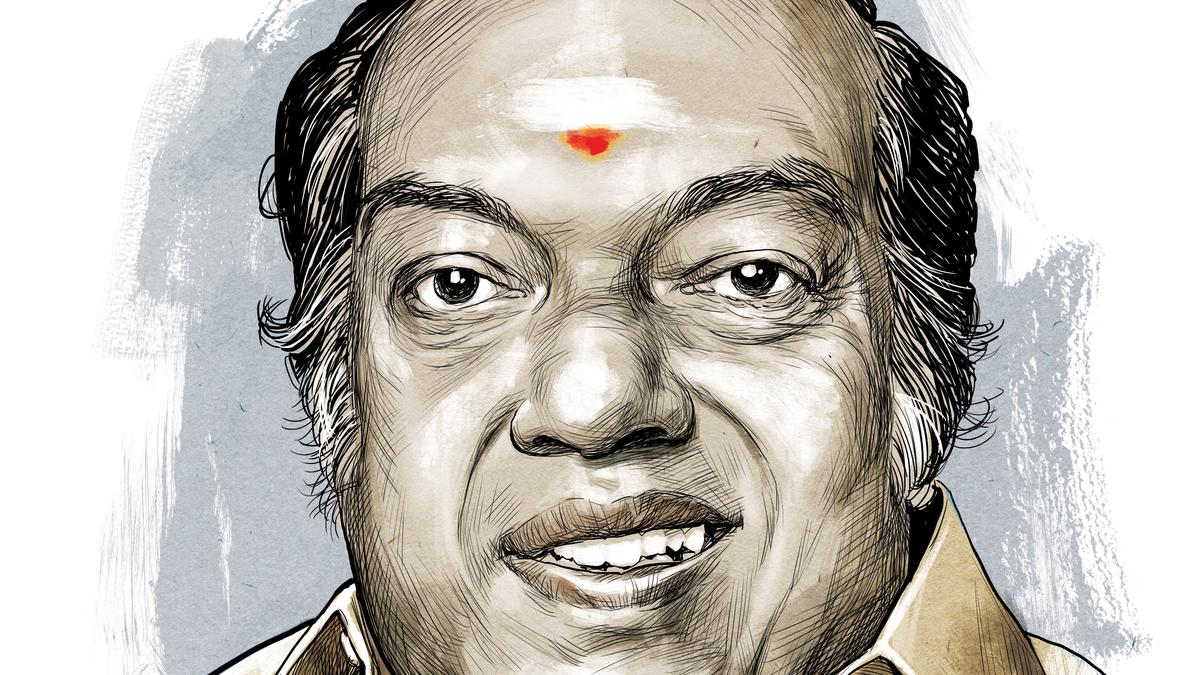
There are songs we return to time and again, drawn by their melodies or lyrics. Sometimes, a single line can capture an emotion so perfectly that it lingers long after the music ends. Years later, we may still remember it, finding new meaning in it as life changes. This is the enduring power of a lyricist’s words.Between 1950 and 1981 emerged one such colossal poet and writer whose works continue to be analysed, cherished, quoted and celebrated. Kannadasan penned more than 5,000 film songs, and an equal number of poems, wrote screenplays for more than a dozen films, authored over 200 books, and edited several Tamil magazines. Yet, his significant contribution to modern Tamil literature and public discourse, cannot be measured by statistics alone. There is now a flourishing cultural industry built around Kannadasan and his works – with speeches, competitions, debates and book commentaries, keeping his words alive for successive generations. Kannadasan possessed the rare skill to express expansive ideas in a few concise lines without diluting their impact. | Photo Credit: The Hindu Archives Born in a small village of Sirukoodalpatti near Karaikudi, Muthiah, was the eighth child of a family that had fallen on difficult times. His formal education stopped after the eighth grade. Yet, lack of schooling was not a barrier when he moved to Chennai seeking writing opportunities. His love for Tamil was nurtured by his mother’s lullabies. He rechristened himself as Kannadasan before one of his early breakthroughs in films. By the time he turned 30, Kannadasan became renowned in his field.His lyrics brought out vital emotions, philosophical ideas, relationship conundrums and worldly matters into the most succinct and impactful phrases. With just 10-lines in a film song, he could move effortlessly from happiness to sorrow, love and intimacy to questions of morality and existence, often using a language that was both sensitive and accessible. The lyrics of ‘Mayakkama kalakkama’ (Sumai Thangi) can lift a desperate mind towards hope, while ‘Manithan enbavan deivamagalam’ from the same film extols the virtues of those who do societal good. ‘Ninaippathellam nadanthu vittal’ from Nenjil Oar Alayam reminds us that there is a higher force that guides our lives, and ‘Aru maname aru’ from Andavan Kattalai, prescribes a code of conduct. These are merely a few examples of Kannadasan’s extraordinary ability to weave philosophy into cinematic narratives. Songs such as ‘Malargalai pol thangai’ from the film Pasamalar show how Kannadasan could pack an entire story into one song. | Photo Credit: The Hindu Archives Kannadasan was known to pack an entire story into a song – much like a ballad. ‘Malargalai pol thangai’ from the epochal drama of Pasamalar and ‘Ore oru oorile’ from Padikkatha Medhai are inimitable examples. His ability to write lyrics instantly to a tune gave the impression that words came to him effortlessly. Brevity and simplicity were the hallmarks of his writing. He also possessed the rare skill to express expansive ideas in a few concise lines without diluting their impact.Kannadasan’s encapsulation of the core elements of the Bhagavad Gita, which runs into 18 chapters and 700 verses, in 18 lines in ‘Ullathil nalla ullam’ (Karnan) deserves a special place in the world of literature. In fact, he bequeathed a whole new genre of simple tamil poetry that could convey profound ideas. In the song ‘Ullathil nalla ullam’ Kannadasan encapsulates all the 18 chapters of the Bhagavad Gita in just 18 lines. | Photo Credit: The Hindu Archives Kannadasan’s spiritual journey is equally interesting. As a young man, he spent most of his time in his village’s Malai Arasi temple. His early political allegiances subsequently guided him towards atheism. But soon he became a believer again and went on to write the 10-volume magnam opus Arthamulla Indhu matham (Meaningful Hindu Religion), that has so far sold a million copies and continues to be reprinted.Many of Kannadasan’s film songs would include cryptic lines from ancient texts such as Kamba Ramayanam, Periyapuranam and Silappadikaram. They showed his deep understanding of these works. In one song, he wrote, ‘Pesa maranthu silayaai ninral athu than deivathin sannidhi’, the line bore resemblance to Kamba Ramayanam’s verse on Rama and Sita meeting each other for the first time. ‘Thol kanden thole kanden’ is another pick from Kamba Ramayanam.Similarly, ‘Sivalingam satchi sonna kadaiyum poyyo’ in a song from the film Tiruvilaiyadal refers to Shiva appearing as a witness to save a woman from her suspicious husband. The song, ‘Attuvithal yaaroruvar aadathare’ leans on Appar’s Tevaram hymn with the same starting words.He is said to have written songs based on interesting wordplay, particularly alliterations, wherever he found them, even on scraps of paper. ‘Atthan ennatthan’ (Pava Mannippu) and ‘Atthikkai kai kai’ (Bale Pandya) best illustrate this. Kannadasan with MSV and Sridhar composing songs for Sumaithangi. | Photo Credit: The Hindu Archives Kannadasan established a remarkable creative partnership with music composer M.S. Viswanathan. Together, they created songs that have become immortal in Tamil cinema. Their professional and personal bond lasted for over two decades until Kannadasan’s untimely death in 1981.Writing took Kannadasan to politics, film-making and philanthropy. He did not quiet succeed in the first two ventures. He had once remarked that “he earned like a king but borrowed like a nation”. His years in the celluloid world, exposed him to deception, envy, ill-will, betrayal and ingratitude. Yet his works suggest, he retained a moral compass that kept him out of all complexities.In his autobiographical account in Vanavasam, written in the third person, Kannadasan indulges in self-criticsim and opens up on his personal life and vulnerabilities. He mentions being married more than once and having 15 children. Kannadasan with Chinnappa Devar. | Photo Credit: The Hindu Archives This honesty may be the reason why his lyrics have transcended their time and continue to connect with the same felicity across social and intellectual stratas — scholars and commoners, believers and sceptics, and the young and old.Top 10 songsVandha naal mudhal (Paava Mannippu)Paramasivan kazhuthil (Suryakanthi)Varavu ettana (Bama Vijayam)Deivam thantha veedu (Aval Oru Thodar Kadhai)Kaettadhum koduppavane (Deiva Magan)Ponaal pogattum (Paalum Pazhamum)Mayakkamenna (Vasantha Maligai)Samsaram Enbadhu Veedu (Mayangugiral Oru Maadhu)Thangathile Oru Kurai Irundhalum (Bhaga Pirivinai)Naalam Naalam Thirunaalam (Kadhalikka Neramillai)
Why the legendary lyricist Kannadasan’s words still resonate
Full Article
Original Source
Read the full article at Thehindu →KhanList aggregates and links to publicly available news content. We do not host full articles from third-party sources. Always verify important information with original sources.