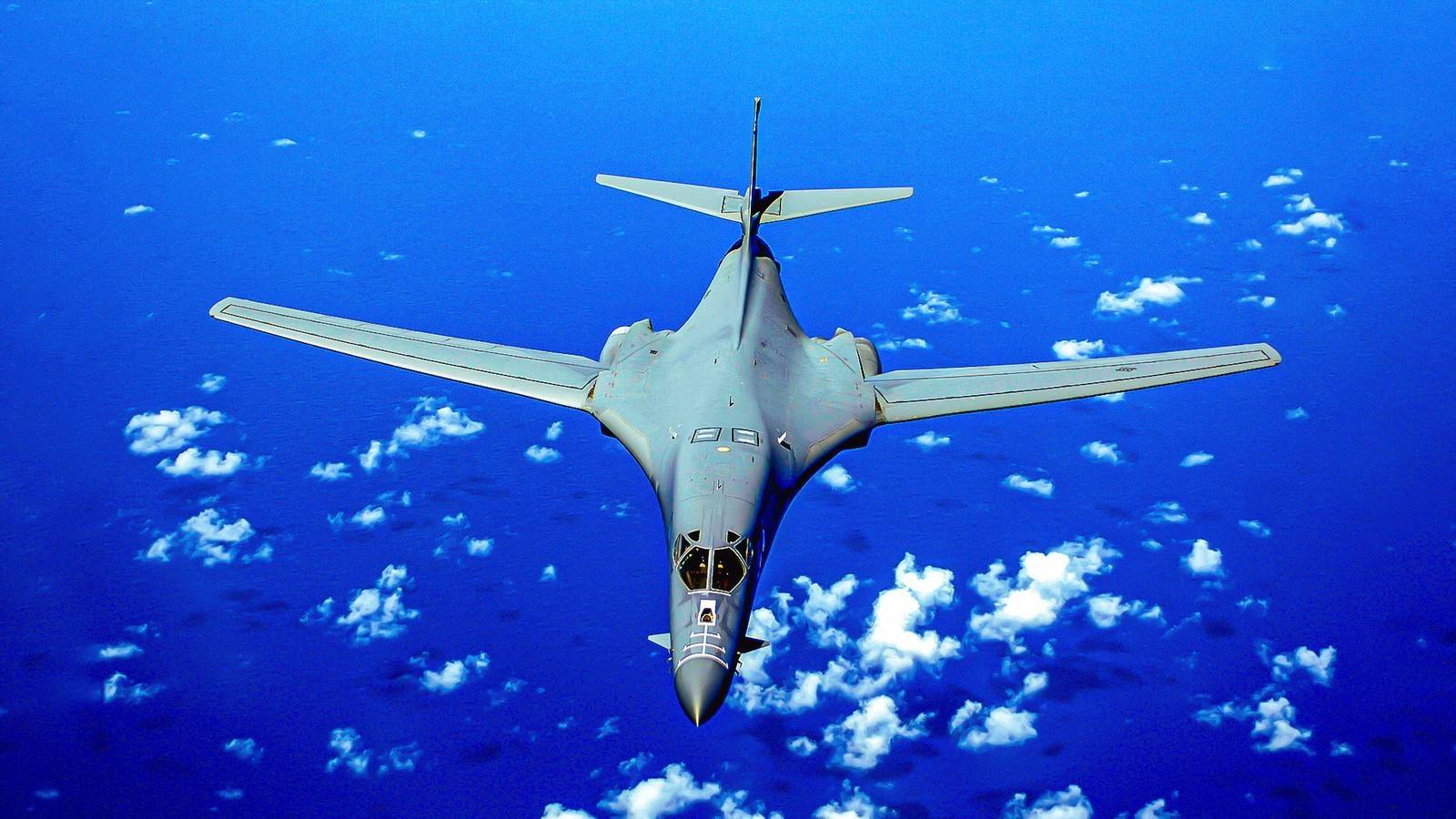
Published Aug 15, 2026, 4:00 PM EDT Aaron is an aviation enthusiast and world traveler with a deep interest in aerospace history and technology. He has traveled around the world numerous times, often incorporating visits to aviation museums and historic aircraft collections into his journeys. A native of New Zealand, he is an expert in aviation and maintains a broad interest in a variety of other subjects. Sign in to your Simple Flying account The Rockwell B-1B Lancer is the largest United States Air Force bomber by unclassified payload and also the only supersonic strategic bomber in the world outside of Russia. However, it is only capable of sustained supersonic flight under favorable flight conditions, primarily at high altitude. The bomber represents a transitional stage between the era when the USAF regarded speed as the primary means of bomber survivability and the modern era of stealth. It was built as a bridge aircraft at a time when the USAF already had ambitions for a stealth bomber that would lead to the B-2 Spirit. The Air Force has been moving away from supersonic bombers since around 1979. Indeed, that was when the Air Force launched its Advanced Technology Bomber program, which would eventually lead to the B-2 Spirit. The B-1B's development as a supersonic interim bomber in the 1980s, and its expected service until around 2037, means the Air Force's transition from speed to stealth will have taken almost six decades. Let's examine why the B-1 can't fly supersonically with external stores and why it's not really built around speed anyway. The USAF's Second World War & Early Cold War Heritage Credit: USAF The mighty B-52 Stratofortress can be thought of as a transitional bomber from the B-17, B-24, B-29, and B-36 bombers of World War II and the supersonic bombers of the Cold War. The Second World War bomber lineage was designed to survive penetration of enemy airspace through a combination of formation flying, defensive gun armament, high altitude, and large numbers. However, even by the end of the Second World War, the US was transitioning away from this model. The B-36 Peacemaker is the largest bomber ever built, and it entered service too late to take part in the Second World War. However, the massive bomber quickly struggled with remaining relevant. Later B-36 variants added four jet engines alongside the six piston engines to improve dash speed. Still, the Air Force looked for other solutions that would be more survivable, provide intercontinental range, and be able to deliver nuclear weapons. At that time, aircraft were the only practical means of delivering nuclear weapons. The United States Air Force designed bombers like the Boeing B-47 Stratojet and the B-52 Stratofortress. The B-52 was a hybrid of what was and what was to come. In basic form, it resembled a Second World War-era bomber, and it came with machine guns for defense. It was also built in large numbers (722) with the intention of sustaining damage and attrition. However, it was also designed to be survivable for the era, was designed around a nuclear payload, and was jet-powered. The Need For Speed Credit: US Air Force The B-52 has become iconic for its longevity, and some airframes have a chance of serving 100 years in the US Air Force. However, many may be surprised by the fact that efforts to develop a successor to the B-52 trace back to when it was still in production. Improvements in fighter jet interceptors, radars, radar-directed air defense, as well as improving jet engine technology, were already making the aircraft vulnerable. Improvements in jet engines and other aerospace advancements allowed the US Air Force to build supersonic bombers. It was thought these would be more survivable as they could fly high and fast and outfly enemy air defenses. The US Convair B-58 Hustler was the first operational supersonic bomber capable of Mach 2 and was designed for high-altitude (maximum altitude 64,000 feet, or 19,500 meters) nuclear strike missions. Believing this was the way forward, the USAF then set out to design the North American B-70 Valkyrie bomber. This was to fly at Mach 3+ at an altitude of 70,000 feet (21,336 meters). While two prototypes were built and flew, the program was canceled in 1961 due to the development of high-altitude surface-to-air missiles making it vulnerable, along with the emergence of intercontinental ballistic missiles making it less important for the nuclear strike role. Low(er)-Level Flight Credit: NASA The B-70 had been built for high-altitude supersonic dashes, but the development of surface-to-air missiles, highlighted by the downing of a Lockheed U-2 spy plane in 1960, pushed a major rethink. The Air Force investigated flying the B-70 low, below radar, to reduce interception times. However, the B-70 had been designed for high-altitude flight and was ill-suited to low-level penetration, sacrificing much of the performance that justified its design. Separately, it was found that the B-52 performed acceptably at low-level flight. This was a contributing factor to it remaining in service. Post-Second World War USAF bombers (per USAF) First flight/introduction Max speed Max payload Convair B-36 Peacemaker 1946/1949 Mach 0.58 86,000 lb (39,000 kg) Boeing B-47 Stratojet 1947/1949 Mach 0.82 25,000 lb (11,300 kg) Boeing B-52 Stratofortress 1952/1955 Mach 0.86 70,000 lb (31,750 kg) Convair B-58 Hustler 1956/1960 Mach 2.0 19,450 lb (8,820 kg) North American XB-70 Valkyrie 1964/na Mach 3+ 50,000 lb (22,700 kg) Rockwell B-1A 1974/na Mach 2.2 75,000 lb (34,000 kg) Rockwell B-1B Lancer 1984/1985 Mach 1.25 75,000 lb (34,000 kg) Northrop B-2 Spirit 1989/1997 Mach 0.95 40,000 lb (18,100 kg) Northrop Grumman B-21 Raider 2023/expected 2027 Likely Mach 0.95 30,000 lb (13,100 kg) The Air Force turned to develop supersonic low-level bombers able to fly under the radar. This led to the development of the B-1A Lancer. Four prototypes were built and used for testing, but the type never entered service and was canceled. One factor for the B-1A's cancellation was the development of lookdown radars, which negated much of the advantage of flying low. Other factors included improving air defenses coupled with the B-52's ability to launch cruise missiles as a stand-off capability. Next, the Air Force turned to stealth and started the Advanced Technology Bomber program that would eventually lead to the B-2 Spirit. Ultimately, the B-2 entered service in 1997, and the Air Force needed another bomber to bridge the B-52 with the future bomber. This led to the Air Force returning the canceled B-1 program. Reviving The B-1 Lancer Credit: US Air Force The B-1A program had been canceled in 1977, but the Air Force soon dusted off those designs, and in 1981 the B-1B was approved. This bridge bomber was intended to prevent a capability gap between the B-52 and the future B-2. One of the advantages is that the Air Force was able to bring it into service in 1984, just three years after it had been approved. However, it also came with significant redesigns relative to the original B-1A. The B-1A was designed primarily as a high-altitude bomber capable of Mach 2.2, while also possessing a secondary capability for high-speed low-level penetration. The B-1B emphasized low-level missions, and the speed was reduced to just Mach 1.25 for the B-1B. While preserving some speed advantages, the B-1B also pivoted to a lower radar cross-section. The B-1B is not a stealth aircraft, but it does have some early low-observability features designed to help it delay detection times. For instance, its radar cross-section was drastically reduced in the B-1B variant compared to the original B-1A prototype. Indeed, while the B-1A had an unoptimized high-speed radar signature, the B-1B is estimated to have reduced its frontal radar cross-section to roughly one to two square meters. This is about 1% of a B-52 and roughly an order of magnitude lower than the B-1A. The B-1B Is Really A Subsonic Bomber Credit: US Air Force The B-1B has a maximum speed of Mach 1.25, but that is at high altitude. It can reach these speeds, likely at around 35,000–45,000 feet (10,500–13,700 meters) or so. At that altitude, the aircraft benefits from lower air density while its engines still produce sufficient thrust. However, this is not the speed it will typically fly at during low-level combat missions. It is optimized for sustained low-level penetration. It is capable of supersonic flight, but that is not the same as saying it regularly flies supersonic, including on combat missions. At low altitudes, the air density is three to four times thicker, the drag is more intense, fuel consumption skyrockets, and aerodynamic heating increases significantly. During low-level penetration missions, the speed is likely around Mach 0.85 to 0.95, depending on various factors. In practical terms, the B-1B can be thought of as a subsonic bomber capable of low-end supersonic dashes in the right conditions. The B-1 doesn't primarily rely on speed to survive. It sacrificed almost half of its originally intended speed for a small radar cross-section, better electronic warfare, a bigger payload, and a stronger structure for low-flying terrain-following missions. Exceeding Mach 1 likely requires the aircraft to have a moderate fuel state, be at high altitude, engage afterburners, and be carrying weapons internally. Supersonic Bombers Are A Dying Breed Credit: Shutterstock While the Rockwell B-1B Lancer, Tupolev Tu-22M3, and Tupolev Tu-160 are all capable of supersonic flight, in practice they typically cruise and conduct strike missions at subsonic speeds, generally within the Mach 0.75 to 0.95 range. They are also a dying breed and are Cold War relics: within a decade, most will be gone. The US Air Force now plans to extend the life of its remaining 46 B-1B Lancers to ensure it bridges the gap until the B-21 Raider is mature and available in large enough numbers. The B-21 is expected to enter service in 2027, and the B-1B was planned to be phased out by around 2032, but this is being pushed back to around 2037. Russia's Tu-22M3s are also likely reaching the end of the road, as the fleet has sustained high attrition rates in the conflict with Ukraine, with mishaps claiming one each year for the last three years. Some estimates suggest the number in operational condition may be in the single digits, with Russia struggling to service its other airframes. The Tu-160 is in low-rate production at a rate of 0–2 per year. Past 2037, a few prestige Tu-160s may be all that's left of the Cold War's supersonic bombers.
Why The B-1 Lancer Can't Fly Supersonic At Every Weight
Full Article
Original Source
Read the full article at Simpleflying →KhanList aggregates and links to publicly available news content. We do not host full articles from third-party sources. Always verify important information with original sources.