
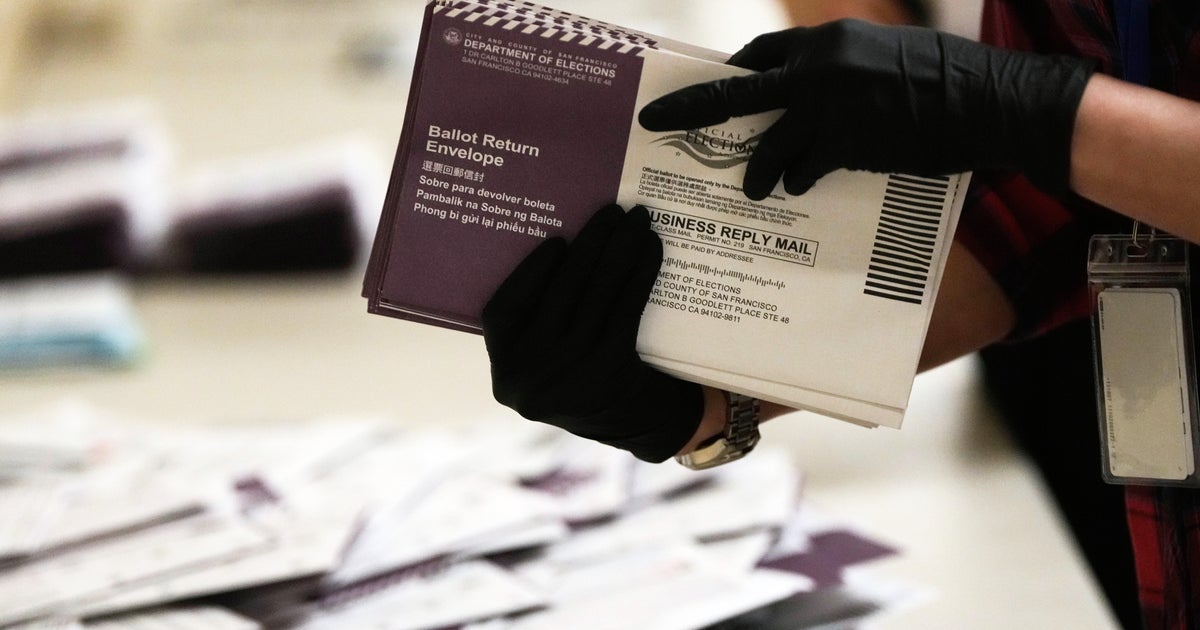
November 3, 2026 / 6:00 AM EST / CBS News Add CBS News on Google Washington — Control of the House and Senate may not be immediately clear on election night, and some of the 2026 midterm election calls will take longer than others. But that's not unusual or an indication of fraud, as some candidates may claim.As the nation watches to see how the elections unfold on Tuesday night, election experts advise voters against listening to politicians who cry foul without offering evidence of fraud as ballots are being cast or counted. Many key races will be close. And when they're close, the results are likely to come later. David Becker, executive director and founder of the Center for Election Innovation & Research and a CBS News contributor, says he has some doubts about whether Americans will even know who controls the House or Senate on election night. "If we do, then there's a very big wave going on," Becker said.Candidates "who think they're doing poorly are going to be spreading lies and disinformation about it"Becker says there is a type of candidate who's likely to complain early and often about the integrity of the election."It's almost certain that the candidates who think they're doing poorly are going to be spreading lies and disinformation about it, trying to fill that vacuum," Becker said, adding that he believes President Trump "will probably spread lies and disinformation about the election on election night because he did it in 2020."When the president was asked last week if he would accept the results of the midterms, whatever the outcome, he responded, "I will if they're honest elections." Lawrence Norden, vice president of the Elections and Government Program at the Brennan Center for Justice, is concerned about the spread of misinformation on election night and afterward. He says it "flourishes in that period of time between voting and getting the results" and suggests that "period of time" will be longer when the race is close."When it's super close, it's not going to matter how fast you are counting the ballots," Norden said."Our perception of counting speed is not related to actual counting speed"Becker points out that "our perception of counting speed is not related to actual counting speed." Election officials "are racing to unofficially count as many ballots as possible and report them out," he said, "but our perception is largely driven by when the media calls elections."News outlets, including CBS News, project election winners based on their analysis of the ballots that have been counted, and this is partly driven by the margin of victory. The bigger the margin of victory, the more quickly a winner can usually be projected, though this also depends on the determination by news outlets of the amount of the vote that remains outstanding and the character of those votes. California, the nation's largest state, is likely to have both races that are called very quickly and others that could take days or even weeks to call. William Gates, executive director of the Arizona State University's Mechanics of Democracy Laboratory, noted that for some California contests, "they call the race at 8:01 (p.m.) because we all know the Democrat's going to win." Those races don't attract much notice.But he added that "we had some primaries that people were paying a lot of attention to — mayor of Los Angeles, the California governor's race." It took several days to finalize who would move on to the general elections in both those races. Part of the reason it took so long to determine the outcome of those closely watched primaries is that mail ballots — which can be received until a week after Election Day if they are postmarked that day — took longer to be counted. All registered voters in California may vote by mail and are sent ballots.Mail ballots must undergo signature verification, and those received before Election Day can be processed beforehand, but they are not counted until after polls close. Mail ballots received on Election Day or later end up being counted more slowly since they must undergo the signature verification process before they can be counted. Gates, a former member of the Maricopa County Board of Supervisors, knows what it's like to live under a microscope. Arizona's Maricopa County endured intense scrutiny over the 2020 presidential election when Joe Biden won the Republican-leaning state, the first Democrat to do so since Bill Clinton in 1996. Though Fox News called Arizona for Biden on election night, CBS News and other networks did not project him as the winner for nine more days, until Nov. 12, 2020. Gates said his family received threats over that election."The reality is that Arizona doesn't really take any longer to count the votes than other states," Gates said. "But the reason that they can attack us while they, you know, don't receive any comments is because we have very close elections," Gates said. "We are one of the few swing states left, and Maricopa is sort of the quintessential swing county." Becker said all the ballots simply can't be counted on election night. "Election officials have never completed counting on election night," he said. "It can't be done. Our ballots are way too complex. So it's going to take some time, and every state takes weeks to certify the election."Mail voting and counting the ballotsStill, some states do take longer than others to count votes, especially states with high numbers of mail-in ballots. In Pennsylvania and Wisconsin, the counting is also slowed by the fact that state law prevents election officials from even processing mail ballots until the morning of Election Day. In addition to California, Colorado, Hawaii, Nevada, Oregon, Vermont, Utah, Washington and the District of Columbia automatically send mail ballots to all active registered voters.And the voter composition for mail-in votes, early-in-person votes, and Election Day votes can look different, meaning numbers can appear to shift suddenly throughout the night and days after, as ballots are processed and counted. "The votes are already in," Norden said. "They just all aren't counted at the same time."He used a basketball game to illustrate the counting process: "It's like you are watching a recording of a game that already happened, right? So the game is over. But we don't know what's in those ballots, and we find out over election night, but it's already done." "The fact that you know the Knicks come back against the Lakers at the end of a game when you're watching on the videotape of the game doesn't mean that the Knicks got to add points after the game was over," Norden said.Mr. Trump has called mail-in voting "mail-in cheating" and knocked it as a fraud carried out by Democrats. But mail-in voting didn't skew Democratic until 2020, Becker said, when Mr. Trump railed against mail voting that increased during the pandemic. "Since mail ballots, especially those that are delivered late, are among the last reported, you do see this 'red mirage,' 'blue wave' effect in some places," Becker said. "It's moderated, I think, since the 2020 election, but you do see (it) because those mail ballots are being reported out late." The "red mirage" effect describes how early results of in-person voting may show a Republican leading, but batches of mail-in votes that are processed and counted later in the evening could swing the election to the Democrat in the race. For example, Becker pointed to Pennsylvania in 2020, where mail ballots weren't reported publicly for days because unlike California, election officials couldn't begin processing them until Election Day. "So the Election Day votes came out first," Becker said. "Those skewed Republican." Then, the mail votes were processed. "And those were overwhelmingly Democratic, but the batches of those were getting reported out much later, because that's what was required under Pennsylvania law."Becker offered one more thing to remember Tuesday night: "If you hear candidates complaining about the process, I don't know whether they won or lost, but I can tell you that they think they lost, because the winners do not complain about the process," Becker said. "The winners let the process play out."
Why some key races won't be decided on election night
Full Article
Original Source
Read the full article at Cbsnews →KhanList aggregates and links to publicly available news content. We do not host full articles from third-party sources. Always verify important information with original sources.