
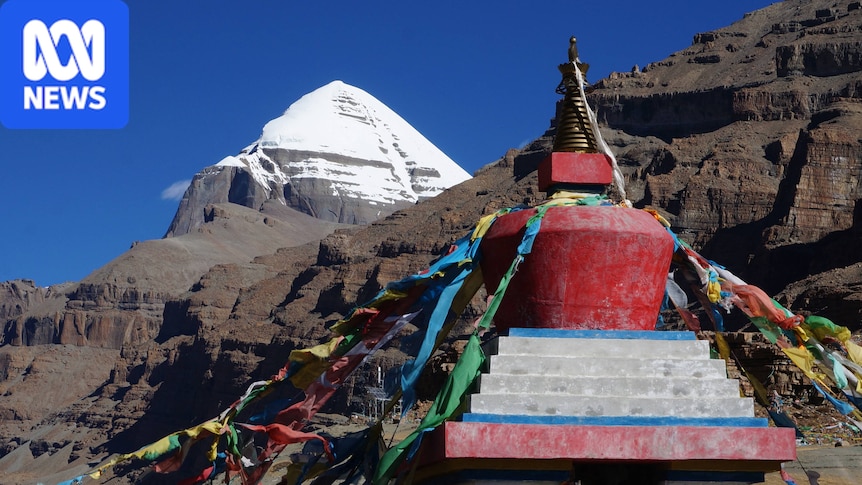
Most of the Australians missing after the flash flood that struck the Himalayas on the border of Nepal and Tibet were pilgrims to a spiritually important mountain known as Kailash.While the identity of many of the 38 missing Australians has yet to be formally confirmed, three tour companies have reported that at least 32 were on trips to visit the remote peak.Thousands of people from all over the world visit the mountain in south-western Tibet each year, with many travelling via the major highway destroyed on Wednesday by the catastrophic wave of water, mud and rocks.Mount Kailash holds significance for Hinduism, Buddhism, Jainism and the Tibetan Bon tradition. Each associates the mountain with different beliefs and sacred histories.Geographer Emily Yeh, a professor at the University of Colorado Boulder, who has conducted research in Tibet, wrote in 2017 that Kailash is associated with the mythical Mount Meru, considered the centre of the world in Hindu and Buddhist cosmology.According to the International Centre for Integrated Mountain Development, the mountain is considered the home of Shiva, the Hindu god of destruction, and Parvati, a Hindu goddess associated with marriage, fertility and motherhood.Followers of the Tibetan Bon tradition regard it as a seat of spiritual power and associate the region with Tonpa Shenrab, the tradition's founder.Mount Kailash is a significant site for Hinduism, Buddhism, Jainism and the Tibetan Bon tradition. (AFP: Michael Runkel/Robert Harding Premium)Pilgrims travel to the mountain for purificationIndia's government operates an official Kailash Manasarovar pilgrimage from June until August or September each year, with routes through the states of Uttarakhand and Sikkim.Private operators — including several Australian tour companies — also organise pilgrimages via Nepal.The peak rises more than 6,400 metres above sea level and close to Lake Manasarovar, which is also a significant spiritual site. Pilgrims traditionally walk around the mountain rather than climb it, completing a roughly 53-kilometre circuit.The circuit is believed to cleanse pilgrims of their sins and can take about three days to complete. Hindus and Buddhists traditionally circle the mountain clockwise, while followers of Bon travel counterclockwise.At nearby Lake Manasarovar, some Hindu pilgrims bathe in its waters as a ritual of spiritual purification.Yeh wrote that Tibetan pilgrims stop at monasteries and other sacred sites along the route, touching prayer beads or their foreheads to features believed to bear sacred imprints. Other rituals are meant to test a pilgrim's merit, sin or fortune.Australians on pilgrimageHundreds of people were killed in the disaster and many more remain missing. Of those missing, at least 540 are foreigners, many of them Hindu pilgrims from India headed to Kailash and Lake Mansarovar.Sadhguru, a hugely popular Indian guru who organises trips to Mount Kailash, released a video in which he said 11 Australians were in a larger group of pilgrims at the immigration centre at Gyirong on the border between Tibet and Nepal when it was destroyed.He said the group had already visited Kailash and were checking back into Nepal.A guide sent a message that the group had arrived at the facility only moments before the flash flood struck, he said."Literally the entire group was there in the building," he said, fighting back tears.Queensland woman Kanagamah Sundrasan was on a pilgrimage in the region when the flood hit. (Supplied)Queensland woman Kanagamah Sundrasan was reportedly on her way to Mount Kailash when she went missing.She was one of six Australians who were part of a group organised by tour company Kailash Journeys.Her daughter Swaatika Kanniah told the ABC her mother was due to arrive the day after the flood hit."According to her itinerary, [Thursday] was supposed to be the day she was getting there, basically," Ms Kanniah said."It's a very sacred spot, so it was one of her dreams to fulfil."She doesn't really go on trips like this. That's why it was very exciting for her to travel and do this thing that she always wanted to do," she added.Himalayan Glacier, a tourism agency operating in the area, said 15 of the missing Australians were on a religious tour to Mount Kailash it was organising. The group also included people from India, the US, Canada and Singapore."They were on a pilgrimage. They were planning to enter China Tibet and go to the Mount Kailash and (Lake) Manasarovar, which is one of the holiest landmarks on earth," chief executive Sagar Pandey told Reuters.All 15 were Indian Australians, with the youngest an 11-year-old boy, he said.Mr Pandey said he had flown over the flood zone by helicopter after the disaster and believed there was only a "1 per cent chance" of survival."There are no human-made things, no human settlement left. Everything is just flat … I believe that everybody is gone."A devotee takes a plunge in the holy lake of Gosaikunda. (Wikimedia Commons: Marija Grujovska, CC BY-SA 4.0)Holy day celebrationsIt's not just pilgrims to Mount Kailash who were caught up in the disaster.At least some of those missing were on their way to Lake Gosaikunda for a Hindu holy day, Janai Purnima, celebrated yesterday.Utsav Aryal, from the Nepalese Australian Welfare Society, said 5,000 to 10,000 mostly Nepali people took the pilgrimage each year for ritual bathing and prayers.Hindus take holy baths and change their sacred threads, also known as janai, for protection and purification during the Janai Purnima festival. (Reuters: Navesh Chitrakar)During the festival, devotees take holy dips and participate in religious ceremonies, while shamans perform traditional rites. Hindu men renew the Janai, or sacred thread, worn diagonally across the chest, while priests tie sacred protective threads, known as doro or raksha sutra, around devotees' wrists.Mr Aryal said many attendees drove on the Pasang Lhamu Highway to the towns of either Dhunche or Syabrubesi before trekking north-east for about three days to the lake.Local media reported that a bus carrying about 40 passengers headed to Gosaikunda was swept away by the flash flood, with only five managing to jump from the bus and survive.An Australian colleague's sister, mother and father attended the festival before the flood struck and were stuck, he said."They are currently waiting to be rescued but are safe and sound," he said.Mr Aryal said the highway between Nepal and Tibet had become an increasingly popular trade route and destination for domestic tourists."It's not that far from Kathmandu," he said. "It's like two hours' drive. So they very often drive to this place, have a drink next to the towns nearby the river. It was getting more popular."Even my parents were there not too long ago, a couple of months ago, travelling to enjoy. [My father] described it as very pretty."ABC/wires
Why so many Australians missing in Nepal-Tibet disaster are pilgrims
Full Article
Original Source
Read the full article at Abc →KhanList aggregates and links to publicly available news content. We do not host full articles from third-party sources. Always verify important information with original sources.