
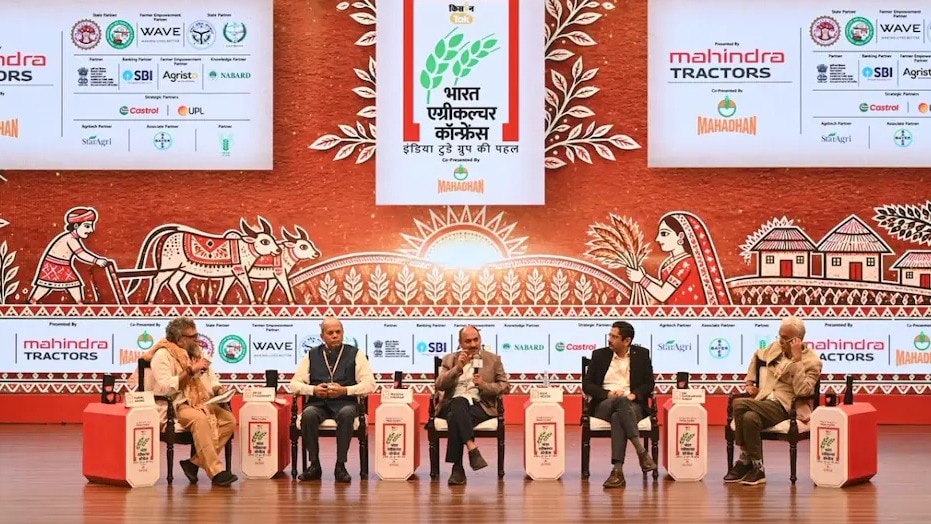
A farmer flicks a handful of urea across the field, and within days, the leaves turn a deep, hopeful green. It feels like proof that more is better. At the Kisan Tak Bharat Agriculture Conference in Delhi, scientists and industry leaders said the real story lies beneath the surface, where much of that nitrogen quietly escapes.HOW MUCH FERTILISER ACTUALLY REACHES THE CROP?Mahesh Girdhar, president of agriculture solutions at MAL, spoke of nutrient use efficiency, the share of an applied nutrient that the plant actually takes up. For nitrogen it is 30 to 45 per cent, for phosphorus 15 to 25 per cent and for potash about 50 per cent. The rest locks into the soil, escapes into the air or seeps into groundwater as pollution, he said.Dr Sudhanshu Singh, South Asia regional director at the International Potato Centre (CIP), said rice in eastern Uttar Pradesh, Bihar and Bengal manages about 30 per cent. Of every 100 kg of nitrogen applied, 70 kg is lost. He said placing urea briquettes near the roots could raise this towards 70 per cent.IS CHEMICAL FERTILISER BAD FOR SOIL?Dr SK Chaudhary, director general of the Fertilisers Association of India, said the culprit is imbalance, not fertiliser. He cited a long-running Indian Council of Agricultural Research (ICAR) project on long-term fertiliser use, which he said has run for about 70 years. Its data show that balanced nitrogen, phosphorus and potassium, with secondary nutrients, micronutrients and organic matter, is "not a curse but a boon", he said. Organic carbon does not fall; yield and quality rise.Girdhar explained balance with a thali: a body needs rice, vegetables and salad in proportion, and so does a crop. A good plan starts with a soil test, the crop's needs at each stage and the target yield.WHY DO FARMERS OVERUSE UREA? Because it is cheap and always available, Chaudhary said. A sprinkle turns the crop green. He suggested the government bring urea under the nutrient-based subsidy scheme, which pays per nutrient for other fertilisers while urea's price is controlled, and reward farmers who use balanced nutrition.He also said newer products, such as biofertilisers, biostimulants (substances that help plants absorb nutrients), liquid and nano fertilisers, could reach 60 to 70 per cent efficiency. Those are the industry's figures, so independent field data will matter.Girdhar put it plainly, "We need nutrition, we do not need a seller." The industry, he said, sells a product, not advice on soil and crop.ARE PESTICIDES SAFE FOR FOOD?Moderator Panini Anand noted that some Indian produce is rejected abroad over residues. Ravi Hegde, head of global regulatory at UPL, said every crop-protection product is first tested to fix the correct dose and timing, then faces strict scrutiny by regulators.Like medicine, it is meant to be used as directed. Farmers need information, he said, through pest surveillance and integrated pest management, which uses chemical and biological tools only when a field needs them.Panini Anand closed with an old radio jingle, the farmer who applies the right fertiliser at the right time is the right farmer.- Ends
Why more than half of India's fertiliser never feeds the crop, and how to fix it
Full Article
Original Source
Read the full article at Indiatoday →KhanList aggregates and links to publicly available news content. We do not host full articles from third-party sources. Always verify important information with original sources.