
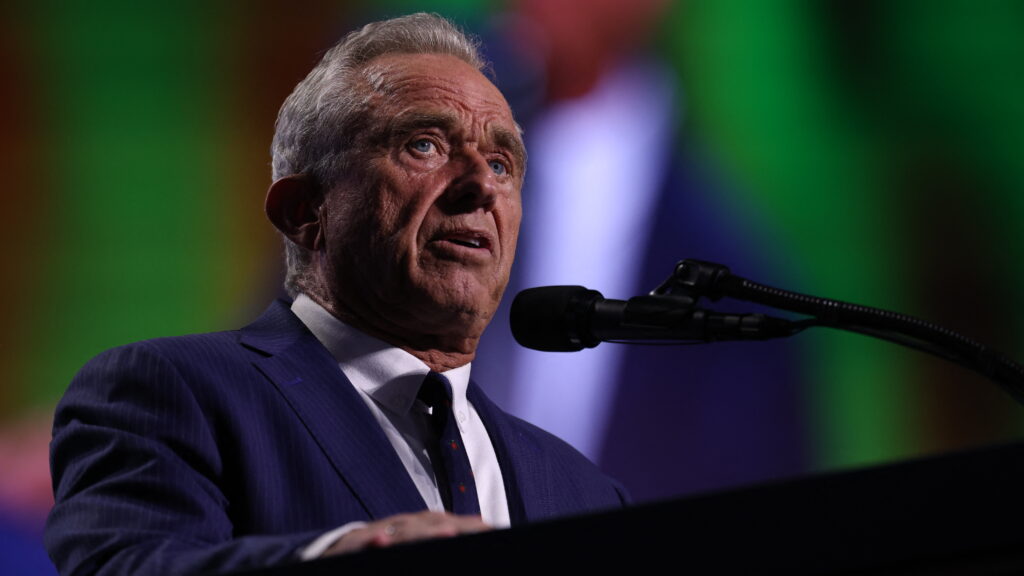
WASHINGTON — The Make America Healthy Again movement wants your health data. The MAHA Institute, a think tank formed by allies of Robert F. Kennedy Jr. after his appointment as health secretary, held an event on Monday that emphasized the benefits of opening up health data sharing in the United States. In particular, the event highlighted how sharing patients’ health records with federal researchers could benefit the study of the origins of chronic diseases. In a speech at the event, Kennedy said that user agreements restrict access to data, giving “institutions that control important health data the power to decide who can study it and what questions they’re allowed to ask, and that creates protectionism in science and it leads to the politicization of science.” “A qualified researcher with legitimate hypotheses should not need permission from a gatekeeper to test it, particularly from an industry gatekeeper,” he said in his remarks, which began and ended with a standing ovation. The idea of using data from health information exchanges for research is controversial because of privacy concerns. Speakers throughout the day brought up the state of Nebraska’s partnership with the federal government. As reported earlier this year by KFF Health News, Nebraska’s health information exchange network, called CyncHealth, is sharing patient data with the federal government to enable studies on vaccines and autism. Kennedy said Monday he wants to aggregate “immunization records, clinical data, laboratory results, pharmacy information, and claims to create a more complete picture of a patient’s health over a long period of time.” That data would come from state health information exchanges, EHRs, laboratories, Medicare, Medicaid, and commercial health data platforms like HealthVerity. “We’re already using all these data to answer some of our most important questions. Too much remains fragmented, vulcanized, difficult to link, and inaccessible to researchers,” he said, citing a desire to aggregate the data and make it available to all researchers. While KFF reported Nebraska’s partnership was with the Centers for Disease Control and Prevention and focused on vaccines and autism, MAHA Institute President Mark Gorton said a partnership between Nebraska and the National Institutes of Health “has successfully produced data for the study of chronic disease and serves as a proof of concept for the state-federal hybrid model.” Neither partnership seems to have been publicly announced, though the NIH has already stood up an effort to build Medicare and Medicaid databases within the NIH in an effort to better understand autism. Nebraska’s CyncHealth was, until the end of last year, led by Jamie Bland, who became chief data strategist of the MAHA Institute in April. At the time of KFF’s reporting, leaders of other state health information exchanges decided not to share information with the government. Using such data for research could run into patient privacy, ethics, and legal issues. For example, Jonathan Ketcham, who was chief health care economist at the White House until earlier this year, when he moved back to his economics professorship at Arizona State University, said on Monday that Arizona’s health information exchange data “cannot be used, even de-identified, for researcher grants without individual consent” from providers. “The issue is not a technical limitation,” Andrew Kress, CEO and founder of data company HealthVerity, told STAT last year. “It’s really been more around data governance, data ownership, data privacy. Those are the reasons that these things have not worked, more so than you can’t find the right data to do it.” Hospitals, for example, sometimes sell their patients’ de-identified data, or carefully grant access under data use agreements that spell out what purpose the data can be used for. Patients also normally have to consent to their information being used for research. Gorton said that the partnership with Nebraska has only worked “because of the investments that Nebraska has made in data governance.” “If this model is going to expand, we will need to see other states make similar investments in the mundane yet crucial function of data governance,” he said. The administration has sought to give patients more control over their own data through initiatives like the CMS Health Tech Ecosystem. “Liberate patient records,” said top HHS official Chris Klomp at a STAT event in March. “Let us be very clear on CMS’ official position on this: The record belongs to the patient. It goes everywhere the patient needs to go. We’re serious about this.” But the improved health data infrastructure from these and other Trump administration efforts would help standardize health data, making it ripe for helping answer research questions. “We’ve had a lot of public controversy about vaccine safety,” said Donald Rucker, chief strategy officer at 1upHealth and national coordinator for health IT during the first Trump administration. “Many of the [health information exchanges] could answer these questions right now if the immunization registries weren’t actually unlinked to the HIEs,” he said. Gorton said at the event that the partnership with Nebraska is a model for state-federal cooperation on health data, and that all 50 states will try different approaches to “growing America’s health data infrastructure.” “With these successes, residents will experience health data record portability and a better healthcare experience. Once citizens experience what is possible in one state, other states will rush to follow,” said Gorton. “This pilot is just one small step on a long journey, and we are excited to be part of this adventure.”
Why MAHA wants to make health data much more accessible
Full Article
Original Source
Read the full article at Statnews →KhanList aggregates and links to publicly available news content. We do not host full articles from third-party sources. Always verify important information with original sources.