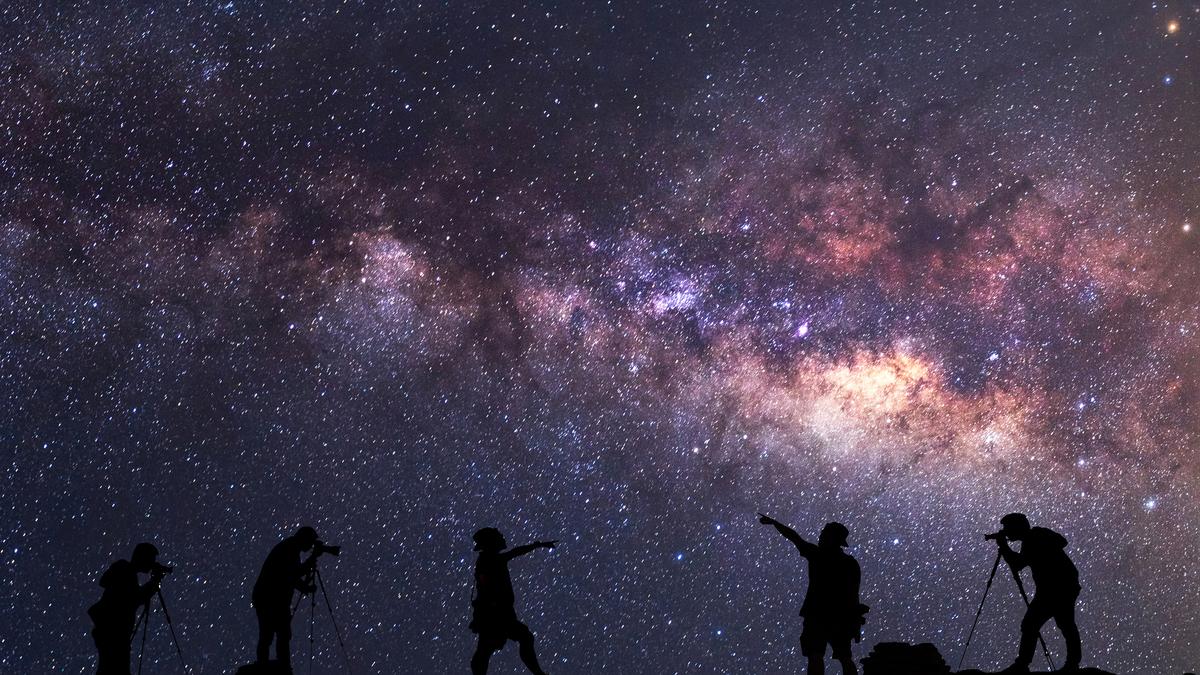
A national telescope programme could give students across India remote observing access. | Photo Credit: Getty Images/iStockphoto A modern astronomer is as much a physicist as a programmer. Research in Astronomy relies equally on observations and computer clusters for data processing, simulations and data analysis. Tools like Python, IRAF, AstroPy, and machine learning pipelines are basic skills in global observatories and research groups. Yet Indian undergraduates arrive at postgraduate programmes having never run a script or ever heard about a FITS file. Most students at universities never get any exposure to actual research practices in Astronomy. Orbital mechanics is taught through equations on paper, and stellar evolution from textbooks. This structural handicap in Astronomy education is entirely preventable through curriculum reform.Modern astronomy research is based on three founding pillars: observations (data collection), computation (data processing and modelling), and data analysis (physical interpretation of trends in statistical datasets such as SDSS, GAIA, or India’s own AstroSat). At Australian and British universities, it is common for students to run simulations on GADGET, MESA or custom Python frameworks. Data from most large surveys such as the SDSS are publicly available to be used for such projects. Experiential learning, which strengthens intuition, requires familiarisation with the sky and the machine.At many universities around the world, students can choose a dedicated B.Sc. Physics with Astrophysics specialisation from year one or a standalone B.Sc. Astronomy programme featuring mandatory observation projects, computational labs, and supervised research theses. The pedagogy is learn-by-doing, and theory is taught through practice.Problems in IndiaIndia, however, does not have a standalone undergraduate degree in Astronomy. The closest approximation is the BS-MS programme at IISERs and NISER, but these are broadly Physics degrees with an optional Astrophysics specialisation in the final years. The University of Delhi, Pune University, and Osmania University offer Astrophysics electives but without a structured, progression-mapped pathway. Therefore, students aiming to become astronomers must first obtain a Physics degree, qualify for a national entrance exam such as JEST or CSIR-NET and then enter an Astronomy-specific programme. The current system treats Astronomy as a postgraduate specialisation rather than a foundational discipline because of the belief that Physics is the foundation of Astronomy.While not completely false, it has become a rigid policy position, leading to astronomy enthusiasts studying subjects like solid-state physics and quantum mechanics, whether these serve their aspirations or not. A progressively designed undergraduate astronomy programme could give students an opportunity to study subjects like stellar spectroscopy, galaxy dynamics and cosmology, which are better aligned with their choices.India’s dedicated astronomy research institutions such as IUCAA and NCRA-TIFR (Pune), ARIES (Nainital), TIFR (Mumbai), IIA, HRI and RRI (Bengaluru) are excellent by global standards, but undergraduate access to this infrastructure is almost nonexistent. ARIES conducts occasional workshops. IIA has a summer school for advanced undergraduates. Only around 100 students across the country get meaningful exposure to frontier astronomy research before their postgraduation. This creates a profound inequality. Students from big cities, with better faculty networks and information access, fill these slots while others are left out. The talent pool is being culled even before it is formed.Way forwardA credible reform agenda has several components. The IISERs and central universities should launch B.Sc. Astronomy programmes with Maths, Physics, and Computing taught together at the foundation level. India’s existing telescopes — the 2m HCT at Hanle, the 1.2m MIRO in Gujarat, Devasthal Observatory in Uttarakhand — can be networked into a national telescope programme, giving students across the country remote observing access. Researchers from institutions like IIA and IUCAA can anchor open online courses in Indian languages to lower the access barrier. Public data archives of missions like AstroSat could be integrated into the undergraduate curriculum, transforming students from consumers of knowledge into producers of it. Industry partnerships with ISRO and HEIs could fund new positions, instruments, and student slots, imparting requisite skills from early days.Currently, India’s scientific ambitions, evidenced by Chandrayaan, AstroSat, and the forthcoming NLST, do not have a matching educational pipeline. Building it is crucial for our future space aspirations.The writer is Director of Educational Partnerships at Starscapes. Published - August 16, 2026 10:00 am IST
Why Indian Astronomy education needs a makeover
Full Article
Original Source
Read the full article at Thehindu →KhanList aggregates and links to publicly available news content. We do not host full articles from third-party sources. Always verify important information with original sources.