
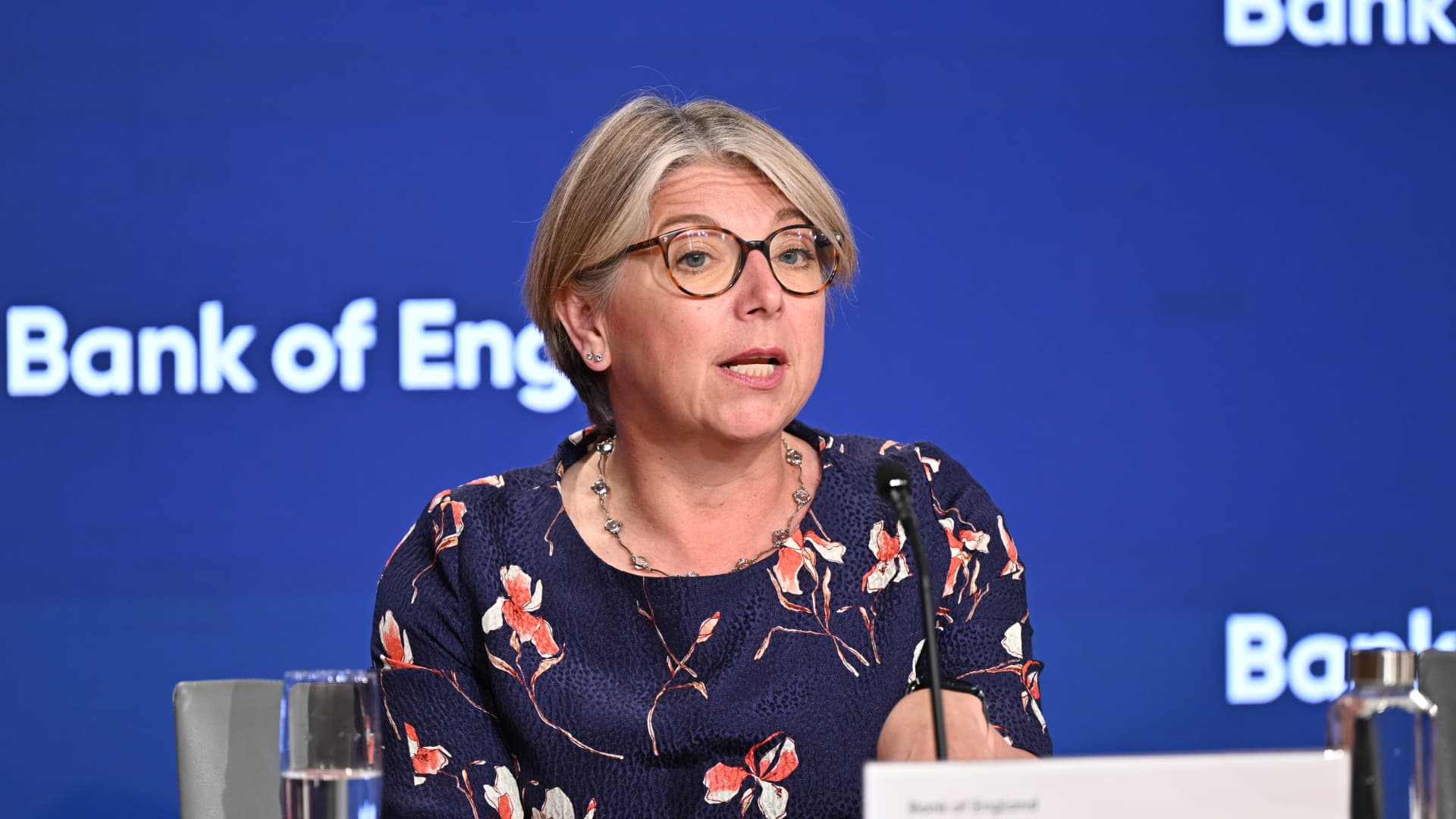
LONDON, ENGLAND - JULY 7: Deputy Governor for Financial Stability, Sarah Breeden, attends the Bank of England financial stability report press conference at Bank Of England on July 7, 2026 in London, England. (Photo by Doug Peters - WPA Pool/Getty Images)Wpa Pool | Getty Images News | Getty ImagesHedge funds' increased presence in global bond markets makes the likelihood of a broader market shock "greater than what it was," Bank of England deputy governor Sarah Breeden told CNBC Thursday.Breeden — the central bank's deputy governor for financial stability, and a member of its rates-setting Monetary Policy Committee — said the changing mix of bond market investors, and their increased use of leverage, raises the risk of localized market turbulence turning into broader financial stress."One of the things that has become increasingly apparent over the last several years is that the investors in our core government bond markets globally have changed," Breeden told CNBC's Sri Jegarajah in an interview Thursday."It's not the real money investors, the insurance companies and pension funds, in the way it used to be. It's increasingly hedge funds, and those hedge funds are price-sensitive, leveraged, international. That, of course, means that the likelihood of a shock in one market transmitting to another is greater than what it was."Breeden was speaking on the sidelines of the International Monetary Fund-World Bank annual meetings in Bangkok, Thailand.Stock Chart IconStock chart iconU.S. 10-Year Treasurys.Hedge fund assets swellWith gross assets now standing at about $13 trillion, hedge funds have become an increasingly important part of the global investor landscape, the IMF said on Tuesday. In its latest Global Financial Stability Report, published Tuesday, the IMF acknowledged hedge funds' role in supporting market liquidity and efficiency.But it also warned that the hedge fund industry's use of leverage to boost returns, and its tendency to pursue crowded trades, could turbo-charge market stress in times of turmoil. That, in turn, could spill over into broader financial markets, and areas such as banks' prime brokerage businesses, according to the IMF. "The source of the shocks are bond markets, and the likelihood of a spillover is higher than it was," Breeden said.Hedge funds' presence in the global government bond market — particularly their use of so-called "basis trades" — has come under sharper scrutiny this year, following the sharp sell-off in sovereign debt. Hedge funds held a record 7% of the $30 trillion Treasury market at the end of 2025, according to U.S. Office of Financial Research data published on Aug. 19. Basis trades are an arbitrage bet in which hedge funds are positioned long in cash Treasurys while shorting their corresponding futures contracts, with the aim of profiting from the price gap. While the price differential between the two is relatively small, hedge funds often employ large amounts of leverage to further inflate returns.Stock Chart IconStock chart iconFrance 10-Year OATs.Earlier this month, 10-year and 30-year Treasury yields hit their highest levels since 2002. Across the Atlantic, yields on 10-year U.K. government bonds, known as gilts, also touched multi-decade highs.Yields on France's government bonds, known as OATs, have moved sharply higher in recent weeks amid rising concerns about the country's fiscal outlook — fueling fears of a fresh sovereign debt crisis impacting the euro zone.
Why hedge funds could be making a bond market shock more likely
Full Article
Original Source
Read the full article at Cnbc →KhanList aggregates and links to publicly available news content. We do not host full articles from third-party sources. Always verify important information with original sources.