
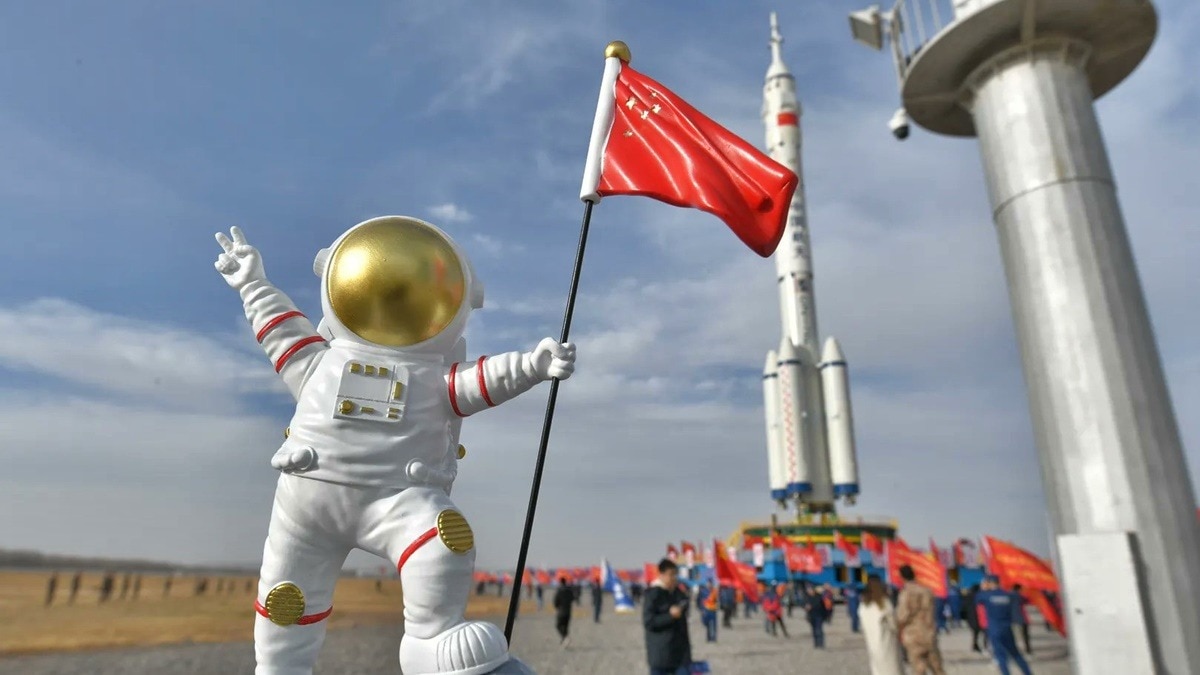
China postponed the Chang'e-7 Moon mission by a year after weather and launch timing turned unfavourable. The delay underlines how crucial a precise south pole landing is to its wider lunar plans.Chang’e-7 is headed for one of the most extreme locations in the Solar System, the Moon’s south pole. (Photo: Representative/AP)China’s ambitious Chang’e-7 mission was ready for launch. The spacecraft had been rolled out to the launch pad atop a powerful Long March 5 rocket, with liftoff planned for Monday morning. Yet, just before launch, China postponed the mission by an entire year.The reason highlights one of the most difficult realities of lunar exploration: being ready to launch is not enough. You also need the Moon, the weather and orbital mechanics to cooperate.Chang’e-7 is headed for one of the most extreme locations in the Solar System, the Moon’s south pole.Its primary objective is to investigate permanently shadowed regions where water ice may have survived for billions of years. But reaching and landing near these regions requires an extremely precise trajectory. WEATHER DISRUPTS LAUNCHThe immediate problem was weather around the Wenchang Space Launch Site in southern China. Unfavourable atmospheric conditions can pose risks during the ascent of a heavy-lift Long March 5 rocket. Strong winds, thunderstorms and other adverse conditions can force a launch scrub even when the rocket and spacecraft are technically ready.However, the bigger challenge was the launch window.HIDE AND SEEK WITH THE MOONUnlike missions heading into Earth orbit, Chang’e-7 cannot simply launch on any convenient day after the weather improves. The spacecraft's journey to the Moon and its eventual landing must be timed to ensure the correct lighting conditions at its intended landing site.The lunar south pole is particularly challenging because sunlight arrives at extremely low angles. The mission must ensure that its lander has sufficient illumination for solar power while also allowing instruments to investigate nearby permanently shadowed areas believed to contain water ice.A delay of even a few days can therefore disrupt the carefully planned sequence of Earth departure, lunar arrival and landing conditions. Missing the optimum window may mean waiting for another suitable combination of orbital geometry and illumination.China appears to have decided that forcing the mission into a less-than-ideal opportunity was simply not worth the risk.THE ABSOLUTE NEED TO BE SUCCESSFULThe stakes are especially high because Chang’e-7 is a major part of China’s rapidly expanding lunar programme. The mission is expected to pave the way for future south-pole exploration and eventually support plans for more advanced robotic and human activity on the Moon.It also comes amid an intensifying lunar race with the United States.Nasa's Artemis programme is targeting the lunar south pole, where multiple nations see potential access to water ice, a resource that could eventually support human settlements and produce rocket propellant.For China, a failure could mean more than the loss of a spacecraft. It could delay its broader lunar ambitions at a crucial moment.That makes the one-year postponement easier to understand: when the mission is this important, waiting may be safer than gambling with success.The Chinese space agency is yet to announce a new launch date for the mission in 2027.- EndsPublished By: Sibu Kumar TripathiPublished On: Aug 26, 2026 11:00 IST
Why has China postponed the launch of Chang'e-7 to the Moon by a year?
Full Article
Original Source
Read the full article at Indiatoday →KhanList aggregates and links to publicly available news content. We do not host full articles from third-party sources. Always verify important information with original sources.