
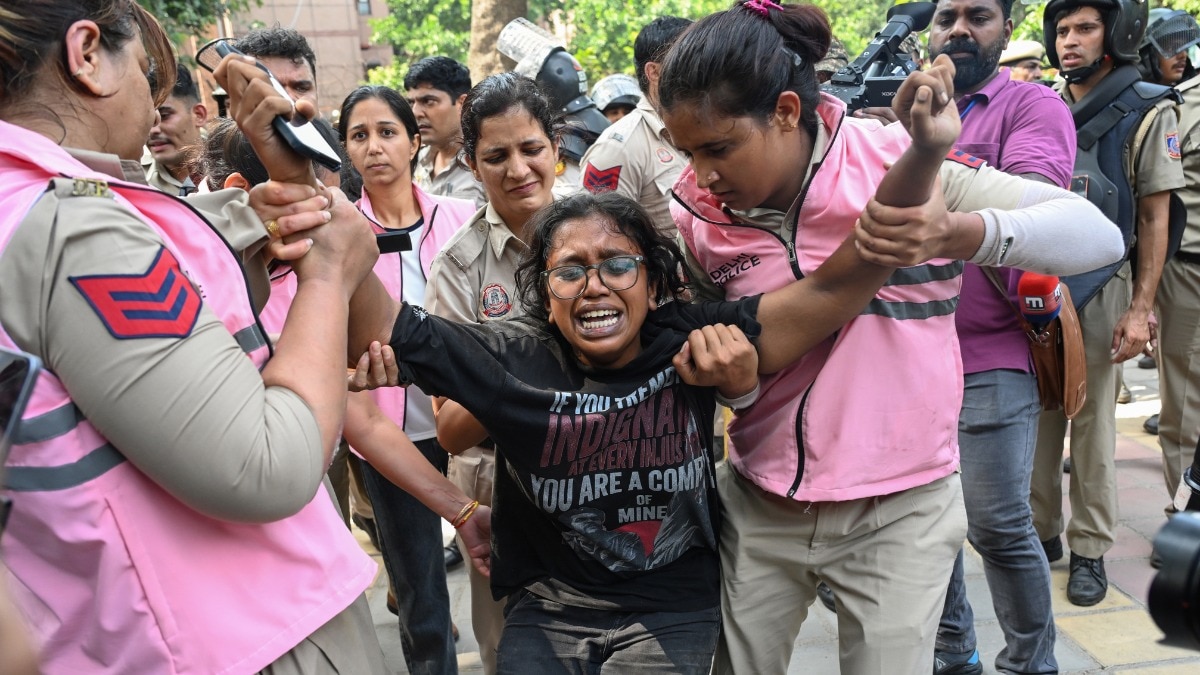
By de-notifying Jantar Mantar, the Centre is effectively saying protests aren't allowed in India, claims CJP, sticking to its demand to hold stir at the venueLess than 24 hours after the Centre declared Delhi’s iconic Jantar Mantar as a “no-go area” for protests by overturning a two-decade-old rule, members of the Cockroach Janta Party (CJP), on October 13, brazenly defied the order and marched into the barricaded area carrying the national flag, before being detained by Delhi police.The CJP step was in response to the denotification of Jantar Mantar as a protest site and the offering of three alternative venues for holding demonstrations: Ramlila Maidan, Burari Ground and CBD Ground in Shahdara.“You cannot de-notify the resistance,” said Abhijeet Dipke, CJP’s founder and national convenor. “Jantar Mantar is not merely a location on a map. It is where citizens have gathered to question those in power, and no administrative order can erase that democratic impulse.”On the morning of October 13, CJP co-convenors Ashutosh Ranka and Saurav Das, along with CJP national organisation in-charge Ajinkya Shinde and other members of the organisation, walked into the Jantar Mantar area and were detained. The de-notification is especially important since Jantar Mantar had turned into the main protest venue in Delhi after demonstrations were barred at the Boat Club lawns near India Gate over 30 years ago.For decades after Independence, the Boat Club Lawns, along Rajpath (now Kartavya Path), were one of the most recognisable sites for political protest in India. They were important not only for their historical significance but their geographical setting (protesters were virtually at the doorstep of the Union government).The lawns hosted some of India’s biggest political mobilisations. Bharatiya Kisan Union leader Mahendra Singh Tikait had taken farmers to the heart of Delhi in 1988 for a days-long agitation. The area was also a frequent venue for political parties, trade unions, farmers and other groups to hold rallies.That changed in 1993. The P.V. Narasimha Rao government imposed a ban on demonstrations at the Boat Club lawns against the backdrop of increased security concerns after the demolition of Babri Masjid in Ayodhya and a proposed mobilisation by the BJP in Delhi. The protests thereafter slowly moved towards Jantar Mantar.In the next 30-plus years, Jantar Mantar became a citadel of protest, such as the anti-corruption agitation, One Rank One Pension protests, numerous farmers’ protests, women wrestlers’ agitation and the countless student and workers’ protests.In addition to major news-making actions, Jantar Mantar became a near-permanent protest point. On a typical day, you could find small groups of pensioners, dismissed workers, farmers, activists and families calling for government intervention, in various parts of the road. Some stayed for weeks or months in makeshift shelters.Jantar Mantar’s compactness was one of the reasons it was effective. It didn’t take thousands of people to make a protest visible. The Parliament and buildings housing the government’s ministries were close by. That is why the alternatives now being provided by the government not necessarily hold the same value for protesters.Ramlila Maidan is a traditional political gathering place, and has a history of large-scale protests, but it is primarily a venue for large events. It is not free, involves fees and provides religious, cultural and other activities. It’s very different when it comes to 50 students or a few hundred workers wanting to protest on the spur of the moment.Burari Ground is the other challenge to deal with in terms of scale and location. The massive arena could host tens of thousands of people, but is far from Parliament and the administrative hub. A few hundred demonstrators who would make a spectacle of themselves at Jantar Mantar could get lost in the huge space at Burari.The CBD Ground in Shahdara is also not part of places where protesters would normally come to Delhi to make themselves seen and heard. It is also surrounded by residential and commercial areas.Why does where people protest matter? CJP national policy lead and national spokesperson Mehr Pasricha said it is important because a protest is meant to be seen and heard, especially by the institutions against which it is being made. She said that taking demonstrations several kilometres away from centres of power takes away a lot of the meaning from the protests.“If no one is affected by the protest, if protests are to take place several kilometres away from the centres of power, then we might as well protest sitting in our homes,” Pasricha said.Ranka concurred, remarking: “You cannot ask citizens to approach the authorities for permission to protest and then change the rules while they are seeking that permission.”According to CJP, it had on October 12 written to the Parliament Street Police Station for a date and time for a peaceful protest to seek the resignation of chief election commissioner Gyanesh Kumar. It had requested for a reply within 24 hours. The de-notification was revealed the same day. The next day, CJP members hoisted the Tricolour at Jantar Mantar to show it is still a space “of the people”.The government and police have legitimate roles with regards to security, traffic and competing uses of public space. The Supreme Court had earlier ruled on similar issue of balancing the right to protest at Jantar Mantar with the rights of residents.But what makes Jantar Mantar special is that its presence in the first place was close to power, and that even a few citizens could be noticed—something that the other venues simply can’t replicate by offering enough acres.So there’s a historical symmetry to the new conflict. Protesters in Delhi were shifted from Boat Club to Jantar Mantar during the 1990s. Now, over 30 years later, they are on the move again, but this time, it’s further away from the political centre.The CJP vows to oppose the move. As Pasricha said: the government “should not be under any illusion that we will back down”.Subscribe to India Today Magazine- Ends
Why CJP vows not to back down from protesting at Jantar Mantar
Full Article
Original Source
Read the full article at Indiatoday →KhanList aggregates and links to publicly available news content. We do not host full articles from third-party sources. Always verify important information with original sources.