
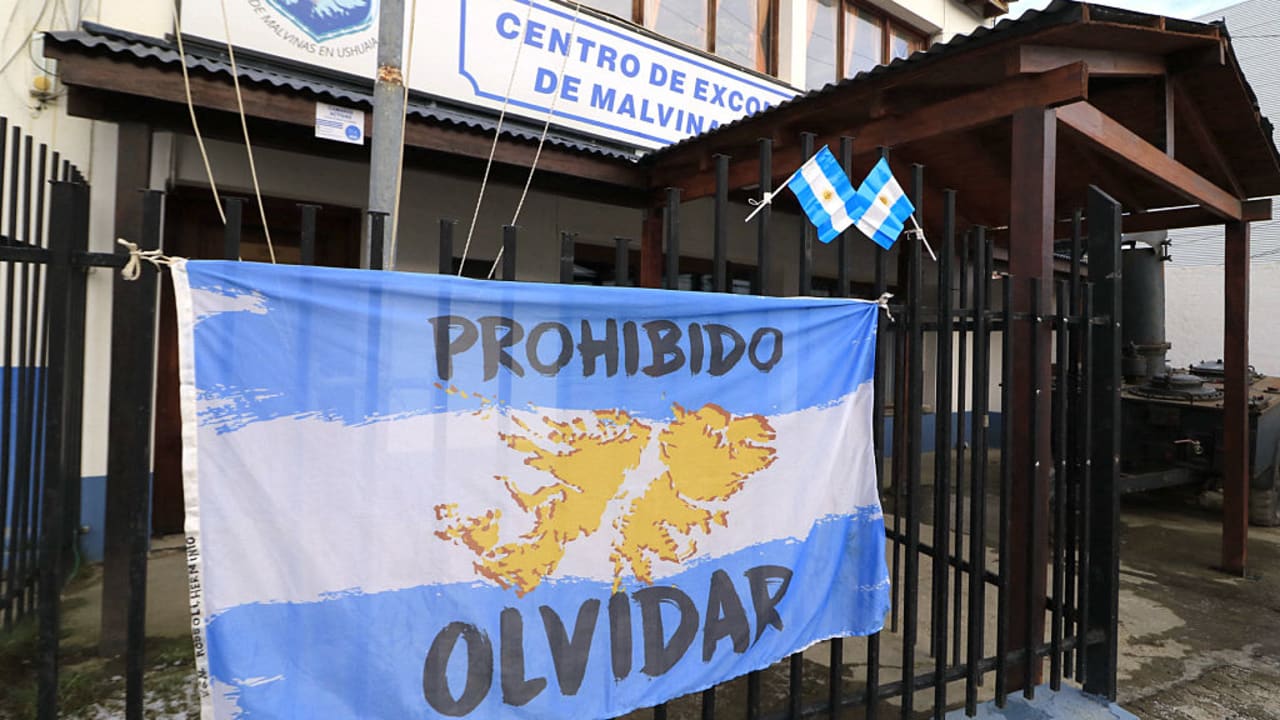
NOVEMBER 23, 2026 22:19Sovereignty over the Malvinas Islands, known in English as the Falkland Islands, is a national cause for the Argentine people. Our Constitution and the sacred place this cause holds in our history demand that we defend it with determination. Today, Britain’s Rockhopper Exploration and Israel’s Navitas Petroleum plan to extract oil from the North Malvinas Basin through their Sea Lion project. They hold licenses issued under the United Kingdom’s de facto authority over our islands, licenses Argentina considers illegal and illegitimate.Argentina has repeatedly protested these activities. In recent months, the companies’ announcements, contracts, and drilling schedule have brought closer the start of a project that calls for 23 wells and 35 years of production. The oil beneath our continental shelf, once extracted, is gone forever. Those reserves belong to all Argentines.In a nationwide address on September 3, President Javier Milei announced a strategy to defend our rights. He instructed us to use every diplomatic and legal tool available. Our goal remains to regain the full exercise of our sovereignty over the Malvinas, South Georgia, and the South Sandwich Islands, as well as the surrounding waters.Our request to the International Tribunal for the Law of the Sea has a specific and immediate aim. We are seeking provisional measures to halt oil production under the Sea Lion project before it begins.Argentina is grateful for the broad international support it has received. The United Kingdom’s repeated unilateral actions have aggravated the dispute, and it continues to refuse to negotiate. The international community has called for negotiations and a peaceful settlement that respects sovereign rights and protects natural resources.Argentina's flag in Buenos Aires (credit: CREATIVE COMMONS)The UN General Assembly and its Special Committee on Decolonization, known as the C-24, have expressed that position, as have the Organization of American States, Mercosur, the Community of Latin American and Caribbean States, the Latin American Integration Association, and the Group of 77 and China. At the Ibero-American Summit in Madrid on November 4 and 5, participants again called for negotiations and urged both countries to refrain from unilateral action. As the project advances, the risk of irreversible harm has led us to pursue legal remedies alongside our diplomatic efforts.The Foreign Ministry initiated these proceedings as part of a strategy we are also pursuing in talks with individual countries and in international forums. Preparing the case against the United Kingdom took months of coordinated work. Our legal team included Ambassador Mario Oyarzábal, the Foreign Ministry’s legal adviser, and María Ibarzabal Murphy, legal and technical secretary to the presidency. Deputy Treasury Attorney General Santiago Castro Videla represented his office. Juan Ignacio Stampalija, the Economy Ministry’s legal secretary, and legal experts Marcelo Kohen, Nico Schrijver, and Agustín Giustiniani also served on the team.Acting in time to defend our interestsOn September 28, we initiated arbitration against the United Kingdom. Both countries are parties to the UN Convention on the Law of the Sea and have accepted its procedures for settling disputes. Annex VII sets out how to form a tribunal of five independent arbitrators. They will hear the case and issue a decision binding on both parties.We chose arbitration to require the United Kingdom to meet its obligations regarding natural resources in the disputed waters and to refrain from making unilateral changes there.What happens if work continues while the arbitral tribunal is being formed? The convention allows either party to ask the International Tribunal for the Law of the Sea, based in Hamburg, for provisional measures to prevent irreparable harm in the meantime.We took that step on October 13, after the United Kingdom declined to adopt the measures we had requested. Once the arbitral tribunal is in a position to act, it can confirm, modify, or revoke any measures the Hamburg tribunal has ordered.The United Kingdom must answer for its actionsAt the November 10 and 11 hearings, we explained which rights were at risk, why the tribunal could protect them, and what harm might be irreversible by the time the arbitrators could intervene. The United Kingdom challenged the tribunal’s jurisdiction, arguing that the case would require it to decide who holds sovereignty over the islands.This distinction matters to all Argentines. We are asking what obligations the convention imposes on both countries in the disputed waters. Sovereignty itself falls outside the scope of these proceedings. UN General Assembly resolutions 2065 (XX), 3160 (XXVIII), 31/49, and 37/9 call on Argentina and the United Kingdom to negotiate a peaceful settlement of that dispute.Must we settle the question of sovereignty before either country can be prevented from permanently altering the resources at issue? Our position is that the convention allows us to protect those resources while the dispute remains unresolved. It recognizes rights over the seabed and subsoil and requires states to act in good faith, settle their differences peacefully, and protect the environment.General Assembly Resolution 31/49 also calls on both countries to refrain from making unilateral changes while decolonization is under way. The United Kingdom disregards that call and refuses to negotiate over sovereignty. It is pursuing what we regard as the unlawful exploitation of our resources as though the dispute had already been settled in its favor.A community hall flies a Union flag on November 12, 2026 in Goose Green, Falkland Islands. (credit: Dan Kitwood/Getty Images)The British government argued that the islands’ current inhabitants have a right to self-determination. Our delegation disputed that argument. The Malvinas remain on the UN list of non-self-governing territories. We argued that the General Assembly has determined that decolonization requires the two countries to settle the sovereignty dispute and that the referendum organized by the islanders in 2013 did not change that position.The United Kingdom also argued that there was time to wait. It gave March 21, 2027, as the earliest date for new drilling and March 2028 as the earliest date for oil extraction. In its view, the arbitrators could act before those operations began. We pointed to other cases in which it took months to form an arbitral tribunal and put it in a position to act.Drilling a well leaves a permanent mark on the subsoil, even if oil production is still some way off. Provisional measures would allow the arbitrators to hear the case while there is still time to protect what a later ruling could no longer restore.The risk extends to the marine environment. One company’s own contingency plan says a spill from a well could reach Argentine waters outside the disputed area within 30 days. Argentina would have to deal with the consequences and coordinate the response to an operation it had never authorized. That is why we demanded the information and cooperation we need to fulfill our obligations to protect the marine environment.The United Kingdom also argued that the companies would suffer financial losses and the islanders would lose future income. The companies assumed those risks with full knowledge of the dispute and of Argentina’s protests. The islanders’ public services and current living conditions do not depend on production from Sea Lion. We asked the judges to weigh those economic interests, insofar as they are relevant, against the risk of irreparable harm to Argentina’s rights.What Argentina has asked the tribunal to doWe requested four provisional measures. First, we asked the tribunal to require the United Kingdom to take all necessary steps to prevent further drilling for production or the installation of production infrastructure for Sea Lion in the North Malvinas Basin. This would cover work by the United Kingdom itself and by any person or legal entity under its jurisdiction or control.Second, we asked that the United Kingdom refrain from using information gathered during exploration in the disputed waters to the detriment of Argentina’s rights. Third, we asked that it stop obstructing Argentina’s efforts to meet its obligations to protect and preserve the marine environment there. Fourth, we asked that it refrain from any other action that might aggravate the dispute, particularly the granting of new authorizations to exploit resources on the disputed continental shelf.The tribunal has set November 28 for its decision on our request for urgent protection. We hope for a favorable ruling, confident in our arguments and with full respect for the judges’ independence. Whatever they decide, the arbitration is already under way, and Argentina will continue to pursue every legal and diplomatic avenue available.In the meantime, we will continue to warn companies and governments, pursue sanctions, and bring criminal proceedings against the companies and their executives. Congress should give priority to the National Sovereignty Defense Bill and move swiftly to debate and pass it. The bill would strengthen the government’s ability to defend the rights of all Argentines.Respect for our laws and Argentina’s legitimate authorities also underpins our invitation to invest in mainland Argentina. The growing value of our country’s strategic assets offers investors opportunities under clear and predictable rules.For the first time in the history of the Malvinas dispute, Argentina has faced the United Kingdom directly before an international tribunal. We will act to prevent others from appropriating our natural resources. Our respect for the law and our willingness to negotiate distinguish our approach from that of those who would settle the issue by proceeding unilaterally. That is the instruction our president gave us and the commitment we have made to our country.I am deeply grateful to the legal team that represented Argentina in Hamburg on November 10 and 11. They worked tirelessly, with courage, legal rigor, and an extraordinary commitment to our country. In Hamburg, they showed how Argentina can honor the legacy of the Malvinas cause through the peaceful means that international law provides.We will pursue this defense through every avenue the law provides. The Argentine people have the law on their side and a government determined to uphold it.By history and by law, the Malvinas belong to Argentina.The writer is Argentina’s foreign minister. This article appeared in Spanish in La Nación on November 14, 2026. The English translation is dated November 17, 2026.Follow us on Google
Why Argentina is asking a tribunal to halt oil drilling off the Falkland Islands - opinion
Full Article
Original Source
Read the full article at Jpost →KhanList aggregates and links to publicly available news content. We do not host full articles from third-party sources. Always verify important information with original sources.