
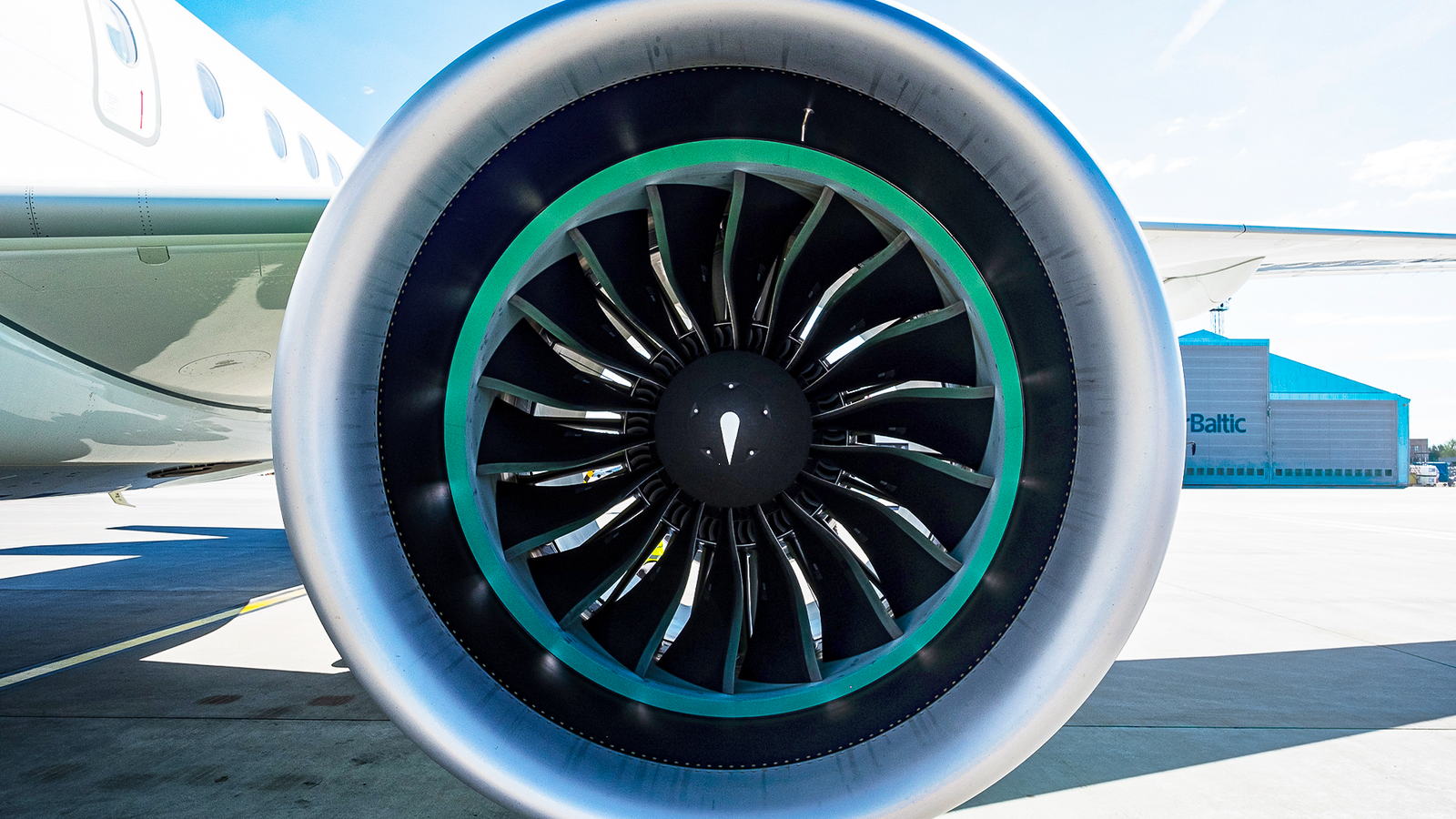
Published Nov 20, 2026, 8:00 PM EST Jack comes to Simple Flying with a lifelong interest in all things aviation. He holds a degree in Aerospace Engineering from Georgia Tech, and is a certified private and remote pilot. Beyond these experiences, Jack previously worked for a corporate flight department where he gained first-hand experience in the world of business aviation. Currently, Jack works in the professional services industry and continues to build his flight hours outside of work. Passengers boarding an Airbus A320neo or an A220 who glance at the engine intake from the jet bridge often notice something unusual. Inside the nacelle, ahead of the fan blades, a ring of teal green lines the casing of the Pratt & Whitney Geared Turbofan, whether the aircraft carries the PW1100G of the A320neo family or the PW1500G of the A220. The color is consistent enough across the fleet that spotters and online aviation communities have debated its purpose for years, with explanations ranging from branding to corrosion protection. The more convincing answers sit in materials science and maintenance practice. Two separate components contribute to the green appearance, each with its own function and its own reason for the shade it carries, and a third factor, the practical needs of the people who inspect the engines, explains why the color has persisted. Examining those components in turn clarifies how a modern geared turbofan manages noise, tip clearance, and inspection, and why a seemingly cosmetic detail reflects engineering decisions made well before the engine reaches an airline. The Acoustic Liner Behind The Teal Ring Credit: Coby Wayne | Shutterstock The broad green band lining the inner surface of the fan case is the engine’s acoustic liner, a panel built from a perforated skin bonded over a honeycomb core. The perforations admit sound waves into the cells of the honeycomb, where each cell behaves like a small resonant chamber that absorbs acoustic energy and converts a portion of it into heat. By sizing the cells and the perforated face sheet for particular frequencies, designers tune the panel to dampen the tones that dominate fan noise. The geared architecture makes this component especially relevant. Because a reduction gearbox lets the fan turn more slowly than the turbine driving it, the engine produces a different acoustic signature from a direct-drive fan of similar size, with more of the energy at lower frequencies. Low-frequency sound is harder to absorb than high-frequency sound, since longer wavelengths need deeper cavities to dissipate effectively, which is why the liner occupies a generous stretch of the inlet. Pratt & Whitney has promoted the engine’s reduced noise footprint as a headline benefit, and the liner is one of several features that contribute to it alongside the slower fan itself. Construction follows a sandwich principle common to aerospace structures. A solid backing sheet closes one side of the honeycomb, and the perforated face sheet closes the other. The arrangement delivers acoustic performance with very little weight, a priority in any component carried on an engine hanging from the wing, where added mass raises fuel burn. The panels are also designed to withstand airflow, vibration, temperature swings, and minor debris impacts throughout a long service life. Why The Color Comes From The Material, Not The Paint Credit: RTX The teal shade is generally attributed to the composite itself rather than to a decorative coating. According to descriptions of the construction, the resin and epoxy matrix that bind the liner’s layers carry a natural pigmentation that shows through on the finished surface. Engineers have a practical reason to avoid covering it. A thick film of paint would partially fill the microscopic perforations in the face sheet, reducing the open area through which sound enters the cavities and degrading the attenuation the panel was designed to achieve. However, this explanation should be treated with some caution, because there has not been a published manufacturer statement regarding the color. As a result, the exact origin of the hue remains an informed inference rather than a documented fact. The uniform result across A320neo and A220 installations nonetheless suggests a controlled material choice instead of an incidental one. The Turquoise Rub Strip Behind The Liner Credit: Pratt & Whitney Directly aft of the acoustic ring sits a slightly lighter blue-green band, the abradable rub strip, which technical literature also calls a fan outer air seal. Its job is to control the gap between the fan blade tips and the surrounding case. Any air that leaks across that gap represents lost work, so engine makers want the clearance as small as practical without allowing the blades to strike a hard surface. The abradable material solves that problem by being softer than the blade tips. During break-in, the tips cut a shallow groove into the strip, producing a seal matched to the actual shape of that particular fan, including any slight growth caused by heat and centrifugal loading. The strip wears while the blades and the case remain intact. A paper from the 2003 NASA Seal/Secondary Air System Workshop, which covers Pratt & Whitney abradable seals, documents the broader engineering approach behind such materials. The color of this strip carries its own explanation. The compound is supplied as a two-part epoxy and hardener, and the components are mixed to a defined turquoise shade so that a uniform color confirms the two parts were blended properly before application. Streaks or patches of a different tone would signal incomplete mixing, and with it a risk that the cured strip will not abrade predictably. The compound’s behavior over time matters as much as its initial performance. As the engine accumulates cycles, the strip gradually erodes from airflow, particles, and repeated light contact, and clearance grows accordingly. Operators therefore monitor the condition of the strip during scheduled inspections and restore it when wear exceeds published limits, a process that depends on repeating the same mixing and curing steps, and the same color check, each time the material is applied. Visibility For Technicians On The Ramp Credit: Airbus Beyond material chemistry, the saturated green interior gives maintenance crews a practical advantage during walk-around checks. The fan case sits in a shadowed cavity, and the blades, the hub, and any dark residue around the casing can blend together in poor light. A bright, uniform background makes departures from normal appearance easier to see. Ramp inspectors look for several conditions in this region. Foreign object debris, such as fragments of tire, packing material, or bird remains, stands out against the green surface. Erosion of the liner or the rub strip shows as lighter patches or exposed honeycomb, and abnormal wear on the blade tips appears as unusual rub patterns where the strip has been cut. Because these checks often occur between flights under airport lighting and on tight schedules, a background that makes anomalies obvious reduces the chance of a missed finding. The choice of green also reflects how the human eye distinguishes color. Green sits near the middle of the visible spectrum, where daylight vision is most sensitive, and it contrasts strongly with the reds, browns, and oranges typical of oil, hydraulic fluid, and corrosion products, so a stain or deposit on the liner is easier to notice than it would be on a gray or white surface. Aerospace’s Long Association With Green Credit: Coby Wayne | Shutterstock The GTF is far from the first aircraft component to appear in this color. Aerospace suppliers have long finished parts in green, and BMT Aerospace notes that the shade is often traced to protective primers applied to metal surfaces to resist corrosion. Zinc chromate primer, widely used for decades on airframes and components, has a distinctive yellow-green tone, which is why green surfaces are a familiar sight inside wheel wells, wing bays, and equipment racks. Public discussion has also linked the GTF’s green interior to Pratt & Whitney’s environmental positioning, since the engine is marketed on lower fuel burn, reduced emissions, and quieter operation. This reading is plausible as a secondary benefit but lacks documentary support, and the engineering explanations above are sufficient on their own. A color that doubles as a reminder of the engine’s efficiency claims costs the manufacturer nothing, which may be why no one has felt a need to change it. Looking Ahead: Color As Data Credit: Mario Trusch | Shutterstock The green interior of the GTF is a small example of a larger trend in which material properties are doing more of the work that markings once did. As engines move toward larger, slower fans housed in shorter nacelles, liners will have to absorb more sound from less surface area, which pushes designers toward more sophisticated core geometries and multilayer constructions. Pratt & Whitney’s improved GTF Advantage variant retains the same gearbox architecture, so the existing liner conventions should carry forward into the newer engines. Inspection practice is also changing. Airlines and maintenance providers are adopting borescope automation, drone-assisted visual checks, and machine-vision software that compares images against a reference baseline. A controlled, repeatable color simplifies that comparison, because software can flag deviations in hue or texture more reliably when the underlying surface is uniform. Should manufacturers publish color tolerances for liners and rub strips, the green interior could evolve from an informal convention into a formal measurement reference, with deviations scored automatically before a technician reaches the engine. Material choices will also respond to environmental scrutiny. Chromate-based primers are under regulatory pressure in several jurisdictions because of worker exposure and disposal concerns, and the industry is moving toward alternatives. Any substitute for current coatings will need to preserve acoustic openness, bonding strength, and the visual contrast that crews rely on, which may lead suppliers to add deliberate pigments where natural color once sufficed. For the existing fleet, the near-term picture is straightforward. With a large and growing fleet in service, the teal ring is likely to remain a recognizable feature for decades, and its meaning will rest on data as much as on appearance. Operators who record inspection images consistently over an engine’s life will build a visual history of wear that could support condition-based maintenance, replacing fixed intervals with decisions informed by measured trends in clearance and liner condition. In that sense, the color’s greatest value may lie ahead of it, as a standardized backdrop for the analytics that will govern how these engines are maintained.
Why Are All Pratt & Whitney's GTF Engines Green On The Inside?
Full Article
Original Source
Read the full article at Simpleflying →KhanList aggregates and links to publicly available news content. We do not host full articles from third-party sources. Always verify important information with original sources.