
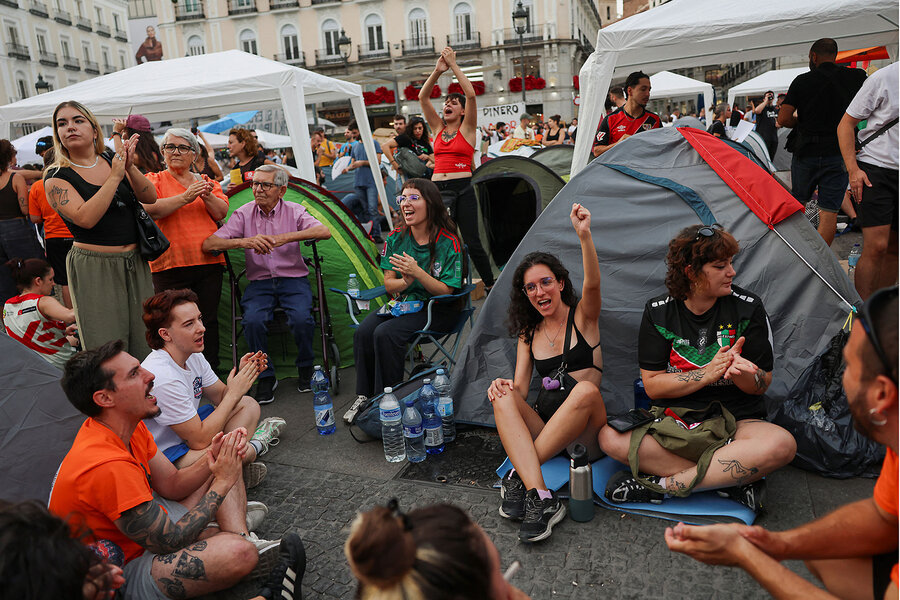
Madrid | Oct. 02, 2026, 4:33 p.m. ET | 5 min read Evictions are a daily occurrence across Spain, rarely drawing much public attention. Until last week, that is.The entire population watched in shock as an elderly woman was pulled out of the Madrid apartment where she had lived since 1956 on a stretcher. Police beat protesters attempting to stop the eviction of María del Carmen Abascal, now known countrywide as Maricarmen.What began as one woman’s story quickly morphed into something much bigger. Protesters took to the streets in Madrid and beyond, their anger fueled not just by Ms. Abascal’s treatment, but by the skyrocketing housing prices that many cannot afford themselves. Over a thousand people are now camped in Madrid’s most central square in a scale not seen since 2011, in the aftermath of the financial collapse. In addition to an end to evictions, they are demanding lower rental prices, indefinite leases with significant protections for renters, and the expropriation of properties owned by “vulture funds.”“Maricarmen was the straw that broke the camel’s back,” says student protester Noha Hamdoun. “But this has been building for years. We should have started protesting long ago.”Expensive housing markets are notoriously difficult to tackle, be they in Madrid or Amsterdam or San Francisco. Whether these demonstrations will really be an inflection point, as protesters suggest, depends on the degree to which they can generate a movement with real teeth. Erika PageStudent protester Noha Hamdoun sits outside her tent at a protest encampment at Puerta del Sol in Madrid, Sept. 30, 2026. "We can’t let landlords make housing into a business," she says. “Just because you have a viral protest doesn’t mean that change actually happens,” says Hahrie Han, a political science professor at Johns Hopkins University in Baltimore and expert on social movements. “We’ve come to misunderstand protest as expression, when historically protest has really been a combination of both expression and negotiation.” And as always, negotiation means compromise. The same reason why this particular case has exploded over the past week could also make compromise more difficult to achieve: More Spaniards than ever are finding themselves in the same hot water as Ms. Abascal.The burden of rentThat’s what pulled Nacho Martín into the fold.The electrician knew little about the housing market, let alone his own rights, until he received his own eviction notice in 2023. That’s when a rental company bought the apartment complex where he lives with his partner and two teenage sons in the gentrifying neighborhood of Lavapiés, not far from where he is now camped in protest.He and his neighbors have been fighting the case with the support of the Sindicato de Inquilinas de Madrid, the renters union leading the current protests, but he is not hopeful about the verdict he expects in the coming months.“We’ll probably all be evicted, because the laws favor landlords, not us,” Mr. Martín says.When Ms. Abascal was evicted Sept. 23, Mr. Martín spent the afternoon crying, seeing in her his own reflection. Courts had ruled that the rent-controlled lease she inherited from her parents had expired, and a new owner wanted to raise her rent from about €500 to €1,650 a month. Since then, the company has agreed to let her stay in her apartment at her original rate. But the protests have only intensified, tapping into a much deeper discontent over housing prices. Around a third of Spaniards overall spend 30% or more of their income on rent, compared with 13% in Germany. The number is closer to 50% in Spain’s largest cities.But no one can seem to agree on how exactly to make decent housing accessible to all. Erika PageCarmen Oliver protests by wearing a sign with a photo of Maricarmen Abascal, reading, "It could happen to you, too." She says Ms. Abascal is an "example for her perseverance and courage – we have to carry her torch." Little agreement on solutionsOn the fourth morning of protest, a week after Ms. Abascal’s eviction, the encampment at Puerta del Sol is running smoothly despite the rain pattering on the tarps overhead. Volunteers hand out cookies and sliced oranges for breakfast, while organizers run a workshop on collective action and others hand out pamphlets.Ms. Hamdoun sits on a fold-out chair outside her new temporary home, which someone jokes would go for €1,000 ($1,120) a month. Those around her unzip their tents after a night of little sleep on a square normally crowded with tourists.Unlike the last protests in 2011, Spain is not in financial crisis. In fact, its economy is growing faster than that of Germany, France, or Italy, and it is one of the world’s top destinations for new foreign investment projects.Originally from Morocco, Ms. Hamdoun grew up in Ibiza, where foreigners often buy up properties locals can’t afford. “I don’t know if I can stay in this country, given how things are,” the first-year university student says. “I don’t want to have roommates into my 30s and 40s.”The left-leaning government has proposed a series of fixes in response to the protests, including prohibiting evictions of vulnerable residents until 2030, preventing “vulture funds” from buying property until 2028, and extending current rental agreements for two extra years. A separate decree would make rental agreements indefinite, forcing landlords to compensate renters if they break a contract. Both sets of proposals were voted down Friday in Congress.Protesters deemed the reforms insufficient regardless. A basic tenet of the movement is that housing should be a right, not a business. Just 39% of Spain’s rental homes are owned by individuals with a single rental property, according to a government-backed study. The rest belong mostly to rental companies, investment funds, and landlords with multiple properties.Yet others say neither supply-side measures that regulate landlords nor demand-side approaches that protect renters have made a lasting difference on costs in cities like London and Paris.“In countries where economic activity is very concentrated in a few cities, it’s utopian to think housing prices will come down in those urban centers,” says Iñaki Aliende, an economist at the Complutense University of Madrid.In the short term, he recommends incentivizing wary homeowners to put empty apartments on the market. Longer term, he suggests easing pressure on the housing market in major cities by investing in job growth in smaller cities, allowing more remote working, and improving public transport to less competitive areas. Deepen your worldviewwith Monitor Highlights.Politics with respectGet political stories with respectful analysis.There‘s a world of new ideas in everyBooks newsletter.There‘s more to life, enrich yours withCulture & Learning weekly.Follow humanity‘s discoveries withScience & Nature stories in your inbox.Gain a spiritual perspectivefrom the stories in your inbox.Want to understand the deeper impact of critical events? Learn the Monitor‘s insight.Already a subscriber? Log in to hide ads. That is unlikely to sound like enough to someone like Ms. Hamdoun. For now, she is holding onto hope that the collectivism and solidarity she’s found in this new makeshift plastic encampment will ripple out into the thousand-year-old city around her.“It’s more comfortable than it looks,” she assures me, proud of the tiny tent she is sharing with a friend. “At least I’m not paying rent.” ALREADY A SUBSCRIBER? LoginReal news can be honest, hopeful, credible, constructive.The Christian Science Monitor was founded in 1908 to lift the standard of journalism and uplift humanity. We aim to “speak the truth in love.” Our goal is not to tell you what to think, but to give you the essential knowledge and understanding to come to your own intelligent conclusions. Join us in this mission by subscribing.
Why an octogenarian’s eviction has sent Spaniards into the streets
Full Article
Original Source
Read the full article at Csmonitor →KhanList aggregates and links to publicly available news content. We do not host full articles from third-party sources. Always verify important information with original sources.