
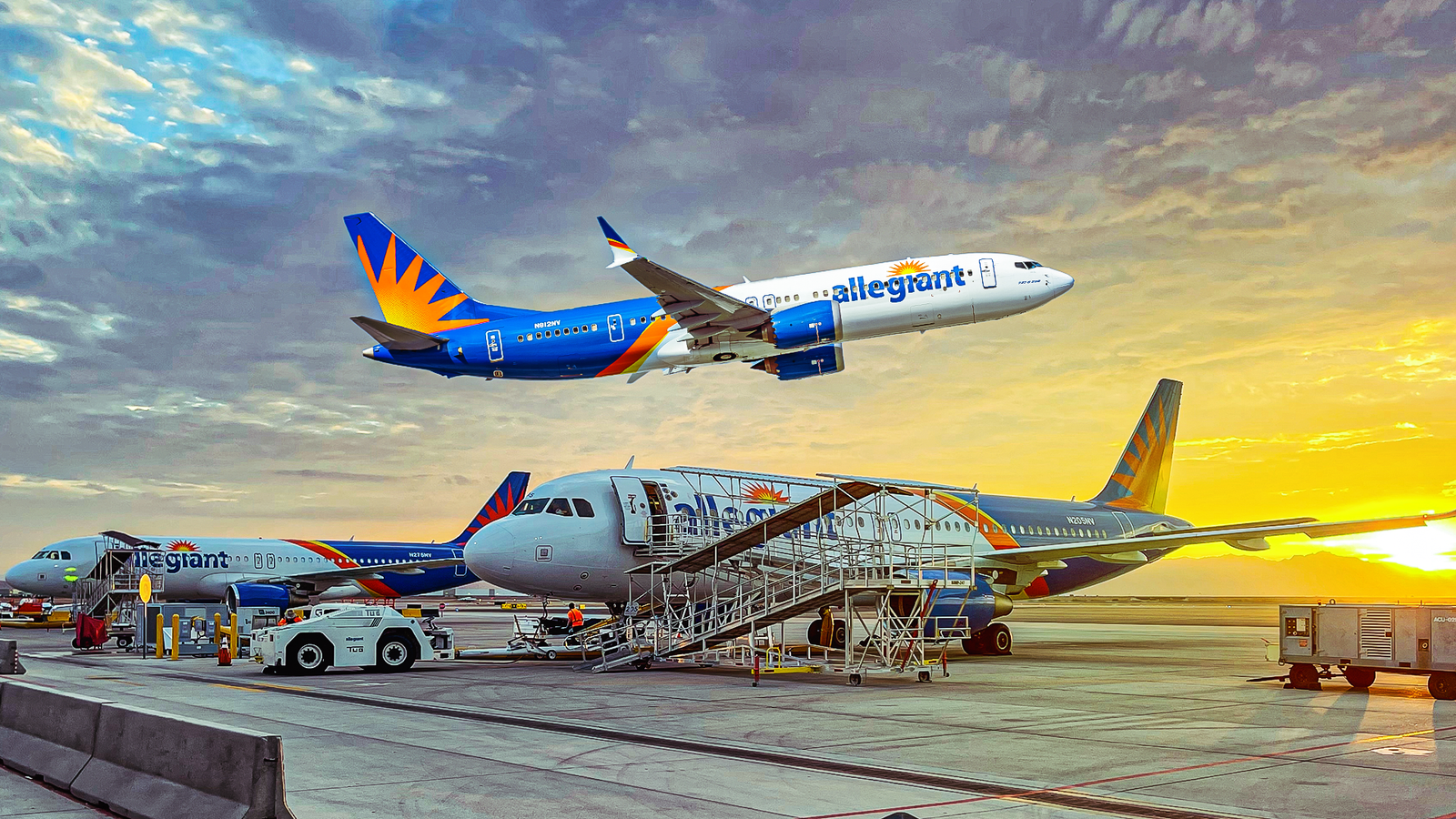
Published Nov 17, 2026, 8:33 AM EST Paul has had a career of 25+ years focused on the international technology sector, which has taken him to over 100 countries. Along the way, he developed a deep love for aviation, with a travel bucket list measured by aircraft types flown rather than destinations reached. Now he brings that avgeek passion, along with the journalism experience he accumulated early in his career, to write insightful pieces for Simple Flying. Allegiant Air surprised the aviation industry in January 2022 when it announced an order for 50 brand-new Boeing 737 MAX aircraft, with options for another 50. The Las Vegas-based leisure carrier had spent much of the previous decade moving away from Boeing-lineage aircraft, completing its transition to an exclusively Airbus fleet in 2018. So its decision to return to Boeing represented a fundamental change in its aircraft purchasing strategy. For years, Allegiant had built its business around acquiring inexpensive secondhand jets rather than purchasing new aircraft directly from manufacturers. However, changing aircraft availability, fuel efficiency, and long-term ownership costs eventually made new Boeing jets increasingly attractive. With its acquisition of Sun Country Airlines, completed in May this year, Allegiant now operates within a group combining both Airbus and Boeing fleets, illustrating how dramatically its aircraft strategy has evolved. How Allegiant Built Its Business Around Used Boeing-Lineage Jets Credit: Eliyahu Yosef Parypa | Shutterstock Allegiant began operations in 1998 with McDonnell Douglas DC-9 aircraft, subsequently building its fleet around the larger MD-80 family. Although developed by McDonnell Douglas, the aircraft became part of Boeing's product portfolio following the manufacturers' 1997 merger. The MD-80 was particularly attractive because Allegiant could acquire older aircraft at relatively low prices, allowing it to expand without the substantial financial commitments associated with purchasing new jets. Its historical MD-80 fleet numbered 61 aircraft, with 48 of them being the MD-83 variant. Almost all of them were aircraft built in the mid-to-late 1980s, having spent the first part of their lives with airlines such as SAS, Korean Air and Aeromexico. This strategy complemented Allegiant's distinctive business model, which focused on connecting smaller American cities with popular vacation destinations, including Las Vegas, Orlando and Florida's Gulf Coast. Unlike conventional airlines operating high-frequency schedules, Allegiant could adjust flying according to seasonal demand. Aircraft frequently spent more time on the ground, making low ownership costs especially important. Allegiant also acquired six Boeing 757-200s, using the larger narrowbodies to expand into longer-distance leisure flying, with a focus on services to Hawaii. However, these aircraft were less suited to the carrier's core network of shorter domestic routes, and were subsequently withdrawn as Allegiant concentrated on a simpler fleet. Why Allegiant Abandoned Boeing For Airbus Credit: Markus Mainka | Shutterstock The MD-80s had served Allegiant well, but their high fuel consumption, advancing age, rising maintenance costs, and a series of reputation-damaging mechanical incidents increasingly highlighted the need for a fleet overhaul. As a result, the airline started acquiring secondhand Airbus A319s and A320s from 2012. The aircraft, which had previously been operated by European airlines such as easyJet and Iberia, were considerably more efficient, without requiring Allegiant to abandon its preference for inexpensive used equipment. The financial advantages were immediate and substantial. According to Allegiant's January 2019 investor presentation, the Airbus A319 and A320 consumed approximately 25–30% less fuel than the MD-80 while offering improved reliability, reducing the number of spare aircraft required to support operations. Higher-density A320 configurations also provided additional opportunities to lower costs per passenger, while maintaining the operational flexibility essential to Allegiant's leisure-focused network. Aircraft Allegiant Seating Primary Role Economic Characteristics McDonnell Douglas MD-80 166 Original fleet backbone Cheap to acquire, high fuel consumption Boeing 757-200 215 Longer leisure routes Large capacity, higher operating complexity Airbus A319 156 Smaller leisure markets Lower fuel burn, inexpensive used aircraft Airbus A320 186 Higher-demand routes Greater capacity, improved seat economics The transformation culminated in November 2018, when Allegiant operated its final MD-80 passenger flight after 16 years of service. With the 757s already retired, Allegiant became an all-Airbus operator. The transition was more than cosmetic: management estimated that the fleet transformation would generate approximately $75 million in additional annualized earnings, demonstrating that inexpensive ownership and improved efficiency could coexist. How The All-Airbus Strategy Transformed Allegiant Credit: Allegiant Air Standardizing around the Airbus A320 family fundamentally changed Allegiant's operations. The A319 and A320 shared cockpit systems, pilot qualifications and most maintenance procedures, allowing the airline to simplify training, spare parts inventories and fleet management. This was especially valuable for an airline operating relatively low-frequency routes across numerous smaller markets. The transition was also remarkably rapid. In 2016, Airbus aircraft represented fewer than half of Allegiant's 84 active aircraft. Two years later, the airline had eliminated its Boeing-lineage passenger fleet entirely. The following timeline illustrates how Allegiant moved from its original secondhand-aircraft strategy to Airbus exclusivity, before eventually returning to Boeing with new aircraft. Year Fleet Development Strategic Significance 1998 One ex-SAS DC-9 Operations launched 2001 First MD-80 joins the fleet First of eventual 61 of the type 2012 First Airbus aircraft introduced Transition begins 2016 47 MD-80s, 4 757s, 33 Airbus jets Mixed-fleet operation 2018 Final MD-80 retired All-Airbus fleet achieved 2022 50 Boeing 737 MAXs ordered New-aircraft strategy introduced 2024 First 737 MAX delivered Boeing returns to the fleet 2026 Sun Country acquisition completed Major expansion of Boeing operations However, as the decade ended, the economics of Allegiant's secondhand aircraft strategy was also changing. The Boeing 737 MAX grounding, followed by pandemic-related manufacturing disruptions, delayed aircraft deliveries and encouraged airlines to retain older narrowbodies. Meanwhile, the secondhand A320ceos were aging, and maintenance requirements were increasing. As then-CEO Maurice Gallagher explained, the airline was facing new cost challenges: "With 120 used airplanes, we're just becoming a big MRO operation after a while, just overhauling airplanes. A new airplane would be a better way to go." Why Allegiant Returned To Boeing With The 737 MAX Credit: Markus Mainka | Shutterstock On January 5, 2022, Allegiant announced a landmark agreement to purchase 50 Boeing 737 MAX aircraft, split between 30 737-7s and 20 higher-capacity 737-8-200s, with options for another 50. The transaction represented Boeing's first direct order from a US ultra-low-cost carrier and marked Allegiant's first commitment to purchasing factory-new aircraft on such a scale. Gallagher described the decision as consistent with Allegiant's established approach to aircraft acquisitions: "Boeing was hungry, and our approach to fleet development has always been opportunistic. This exciting transaction is no exception." Boeing's offer combined attractive acquisition economics with substantial improvements in fuel efficiency. The manufacturer projected approximately 20% lower fuel consumption compared with Allegiant's existing aircraft, while the 737-8-200 provided higher seating density and potentially lower unit costs. Crucially, buying new aircraft also offered a longer operating life, reducing the disadvantages associated with their higher purchase prices. Date Firm orders Options Development January 2022 50 50 Original MAX 7 and MAX 8-200 agreement September 2023 50 80 More MAX 8-200s, fewer MAX 7s October 2026 56 74 Six additional MAX 8s ordered for 2028 The order subsequently evolved as Allegiant increasingly favored the larger MAX 8-200. A September 2023 amendment shifted the mix toward the larger variant by six aircraft and increased available options to 80. Allegiant also exercised another six purchase options in October this year, two years after entry into service, increasing its firm commitments to 56 aircraft and demonstrating continued confidence in the Boeing program. How The 737 MAX Changes Allegiant's Fleet Economics Credit: Markus Mainka | Shutterstock Perhaps the most surprising aspect of Allegiant's Boeing decision was its willingness to abandon a long-standing preference for used aircraft. Although a new 737 MAX requires a higher initial investment than a secondhand A320, its operating economics can offset that difference over time. Lower fuel consumption, fewer maintenance requirements during the early years of service, and greater reliability, all contribute to reduced lifetime costs. Allegiant also benefits from a longer period over which to depreciate the aircraft's purchase price. The potential financial advantages extend beyond fuel savings. While Boeing projected a 20% reduction in fuel consumption, Allegiant's subsequent management presentations outlined improvements in productivity and aircraft-level profitability. These projections helped explain why management considered the brand-new aircraft compatible with its ultra-low-cost model. Metric Projected advantage Comparison Fuel consumption Up to 20% lower Older Airbus aircraft Seat-mile fuel productivity 30% higher Existing fleet EBITDA per aircraft 40% higher Existing fleet Ownership expense Potentially comparable New MAX versus used Airbus Depreciable life Longer New versus mid-life aircraft But it's not all upside. Purchasing new aircraft introduces new risks that have been absent from Allegiant's traditional strategy. Higher capital commitments make profitability more dependent on achieving sufficient utilization, while Boeing's production and delivery difficulties have complicated fleet planning. Nevertheless, by the third quarter of this year, MAX aircraft accounted for 22% of Allegiant's available seat miles, compared with 12% a year earlier. That growing contribution demonstrates the aircraft's importance, although Allegiant must balance their efficiency against its established practice of adjusting capacity to seasonal leisure demand. Why Allegiant's Boeing Strategy Is Still Evolving Credit: Joe A. Kunzler | Shutterstock Allegiant's acquisition of Sun Country Airlines in May further transformed its fleet. As of September 30, the combined group's passenger operation comprised 76 A320s, 27 A319s, 21 737 MAX 8-200s, 43 Sun Country 737-800s and three 737-900ERs. Sun Country also contributed 22 737-800 freighters, significantly expanding the group's Boeing operations. Although the airlines remain operationally separate during integration, Allegiant expects to obtain a single operating certificate in 2028. Meanwhile, Allegiant's preference for the larger 737-8-200 has raised questions about whether it will ever operate the smaller MAX 7. During its November 5 earnings call, Chief Financial Officer Robert Neal explained that the introduction of Allegiant Extra and the forthcoming Allegiant First premium seating product had changed the economics of smaller aircraft. He stated: "We strongly prefer the cost economics of the MAX 8 at this point." Marketbeat's coverage showed that an analyst also indicated that Allegiant's original MAX 7 commitments had effectively become options, a characterization that management did not dispute. Allegiant may therefore never take delivery of a MAX 7, although the airline has not definitively ruled out the variant. Its latest decisions reinforce the principle that has guided its fleet strategy for decades: aircraft economics matter more than manufacturer loyalty. From inexpensive MD-80s to secondhand Airbus jets and now factory-new Boeing 737 MAXs, Allegiant has repeatedly adapted to changing market conditions. Its return to Boeing was not a reversal of its philosophy, but another expression of it.
Why Allegiant Air Broke Boeing Loyalty For Nearly 10 Years For Exclusive Airbus Operations But Decided To Go Back
Full Article
Original Source
Read the full article at Simpleflying →KhanList aggregates and links to publicly available news content. We do not host full articles from third-party sources. Always verify important information with original sources.