
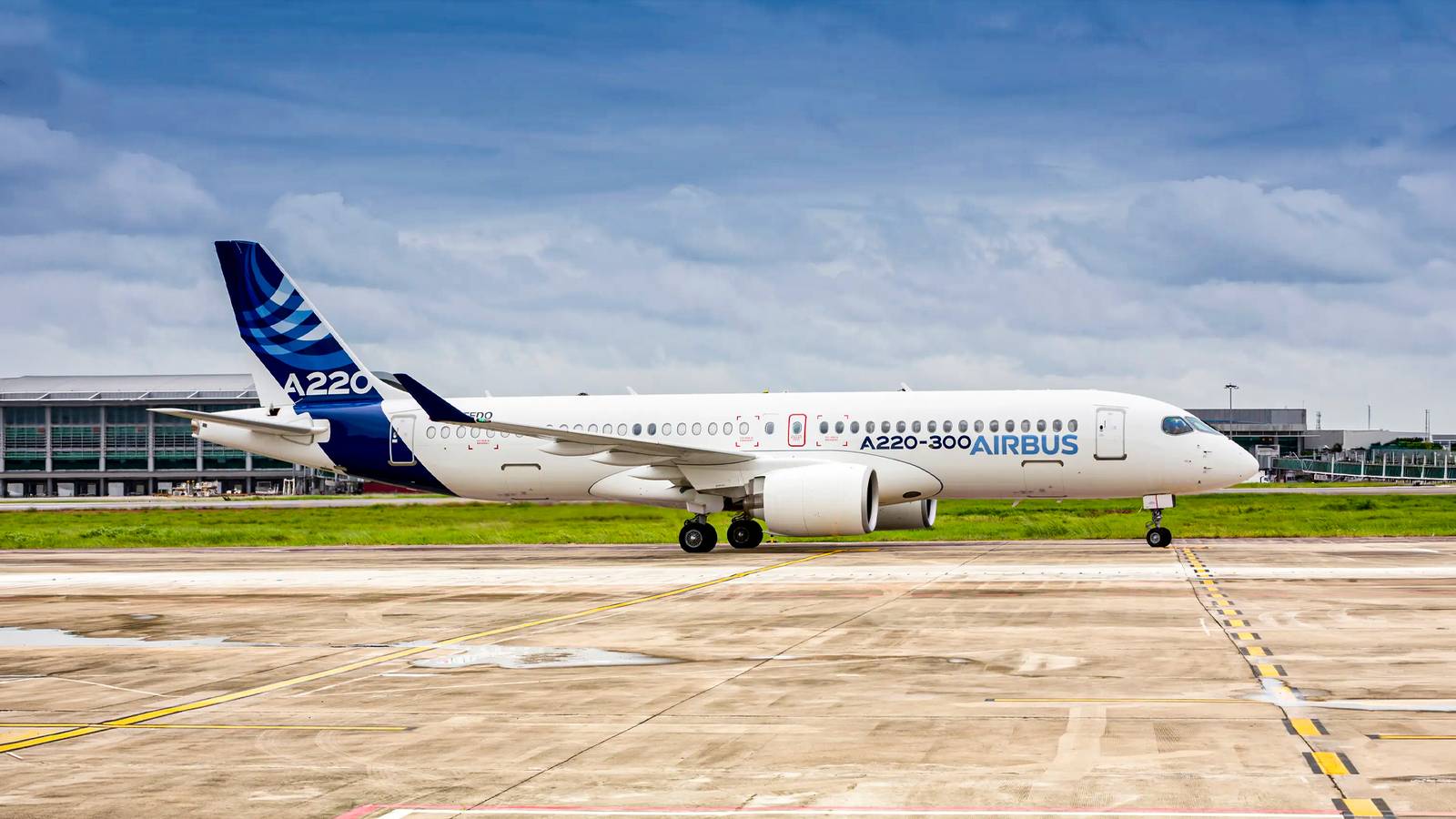
Published Sep 7, 2026, 1:00 AM EDT Aaron is an aviation enthusiast and world traveler with a deep interest in aerospace history and technology. He has traveled around the world numerous times, often incorporating visits to aviation museums and historic aircraft collections into his journeys. A native of New Zealand, he is an expert in aviation and maintains a broad interest in a variety of other subjects. Why do airlines keep paying 30% more for the Airbus A220 than the rival Embraer E195-E2, or do they? This appears to be a common mistake in online comparisons reporting list prices and not market prices. List prices are primarily marketing figures and starting points for negotiations. They are somewhat like a company advertising a holiday as being 'valued at $10,000' based on the full retail cost of flights, hotels, and meals. The company may have preferential agreements and bulk discounts that mean its actual cost is far lower. An individual traveler might also be able to negotiate or find the same holiday for substantially less. In reality, the larger A220-300 does appear to carry a slight premium over the E195-E2, but this appears to be closer to 5% than 30% based on market rates for new aircraft. Here is what to know about how the A220-300 and E195-E2 compete, their order books, and what they are valued at on the market. The article highlights why list prices are so misleading and are often more distracting than useful. The Airbus A220-300 Airliner Credit: Shutterstock The Airbus A220 is the world's most popular regional airliner on the market, with over 1,000 units sold/ordered. It was developed by Bombardier as the CSeries before being acquired by Airbus in 2018. As a cleansheet aircraft, it offers the largest windows in Airbus' lineup and is advertised to offer a 25% efficiency improvement compared with the aircraft it replaces. The aircraft seats five abreast (one fewer than the six-abreast A320 and Boeing 737) and is now operated by 25 companies around the world. The Airbus A220-200 comes with two variants, the A220-100 and the stretched A220-300, which is a better comparison with the Embraer E195-E2. The A220-300 is typically configured with 125–160 seats, while the aircraft has a range of around 3,400 nautical miles. Airbus advertizes, "With 25% lower operating cost per seat compared to previous generation aircraft, the A220 delivers an efficient, versatile and profitable aircraft for operators." All A220s are exclusively powered by the Pratt & Whitney PW1500G geared turbofan. As discussed below, the fuel-efficient PW1500G geared turbofan is one of the great selling points of the aircraft, but the engine woes have also been a major source of headaches for the program. Fortunately for the program, it seems the issues will soon be resolved. Last year, groundings were very high, but now efforts have brought engine-related groundings for the A220 down to just 2% to 3%. The Embraer E195-E2 Credit: Shutterstock Embraer’s newest aircraft, the E195-E2, entered service in 2019. It is notable for being the largest aircraft to be certified to operate at London City Airport (having operated there since 2023). It is the latest variant in Embraer's E-Jet E2 family, which is in turn an incremental development on the original E-Jet family. E-Jet E2 jets are powered by the Pratt & Whitney PW1900G geared turbofan, closely related to the engine powering the A220. Embraer claims its E-Jets E2 offers 29% better fuel efficiency per seat and 19% lower fuel consumption compared with previous-generation aircraft. It also claims the aircraft is the quietest in its class (up to 68% reduction in noise footprint) and has a 90% increase in capacity for baggage compared with the first E-Jet generation. Airbus vs Embraer (per Airbus, Embraer, IBA, etc.) Airbus A220-300 Embraer E195-E2 Entered service 2016 2019 Max seating 160 146 Seating abreast 5 4 Range 3,400 nautical miles 3,000 nautical miles (updated from 2,400 nautical miles in 2024) Number ordered 998 464 Commonly cited list prices Approx. 91.5 million $69 million Market value (April 2025) Approx. $40 million Approx. $38 million Lease rate (monthly) Approx. $300,000 Approx. $300,000 The E-Jet family is a four-abreast regional airliner, making it a different product compared with the A220-300. The E195-E2 is typically configured with 120–146 seats, or around 15 to 25 fewer than the A220-300, while also being considerably shorter-ranged. It has a maximum range of around 3,000 nautical miles (updated from 2,600 nautical miles in 2024), or around 400 nautical miles less than the A220-300. A220 Has Double The E-Jet E2 Orders Credit: Shutterstock The A220 family has attracted a total order book of 1,106 units, of which the vast majority (998) are the stretched A220-300 and the remainder (108) are the shorter A220-100. Of these, 532 units have been delivered, and 574 remain in the backlog. Notably, in May 2026, AirAsia placed a record order for 150 Airbus A220-300s, and it became the first customer for the 160-seat configuration of the A220-300. Since the COVID-19 year 2020, Airbus has been ramping deliveries up from 38 in 2020 to 93 in 2025. Ironically, given that Canada is the home of the A220 (CSeries) and that it is a source of national pride for the country, its Porter Airlines is the world's largest customer of the rival E195-E2, with 75 units ordered. Overall, Embraer has delivered 175 E195-E2s and 38 E190-E2s and has 289 E195-E2s in backlog as well as another 30 E190-E2s. Cumulative orders amount to 464 E195-E2s and 68 E190-E2s for a total of 532, or around half of the A220's total order book. The E-Jet E2 first entered service in 2018, two years after the A220, which entered service in 2016. Market Rates For A220-300 & E195 E2 Are Similar Credit: Shutterstock In May 2026, AirAsia announced a firm agreement with Airbus valued at approximately $19 billion at list prices for 150 A220-300 aircraft. That equates to an implied program value of about $127 million per aircraft, although the figure should not be interpreted as the list price of the aircraft itself, as such announcements may also encompass associated services and support. The list prices for these aircraft are typically around $91 million each. A widely cited list price for the E195-E2 is around $69 million, although it is unclear where these figures come from. But advertised list prices are not the same as market prices. List prices are the prices airplane makers advertise and are better understood as starting points for negotiation. Airlines typically do not actually pay these prices in the real world. Furthermore, according to market data gathered by IBA, the actual market values of the A220-300 and E195-E2 may be near the same. In April 2025, IBA wrote, "As of January 2025, the A220-300 holds a Market Value just above US$40 million for new models, rising 12.6% since January 2021. The E195-E2 is currently valued at around US$38 million, approximately US$4 million higher than the E190 variant... Lease Rates for the E195-E2 and A220-300 are on par, averaging around US$300K per month for new deliveries, giving the E195-E2 a higher LRF." The Confusing Price Similarity & Engines Credit: Shutterstock IBA's report that the A220 holds a market value of "just above $40 million" and the E195-E2 at around $38 million is surprising. On paper, the aircraft are not directly comparable: the A220-300 seats more passengers, offers significantly longer range, benefits from integration into Airbus' wider narrowbody ecosystem, and has the backing of a much larger production program. One possible explanation is that both aircraft have been affected by reliability problems with their Pratt & Whitney geared turbofan engines. The disruption was particularly severe among some A220 operators. IBA reports that "issues with the latest technology engines are impacting many airline operations and fleet availability, with 23% of PW1500G and PW1900G-powered Airbus A220 and Embraer E2 series aircraft currently inactive." IBA then adds, "Among PW1500G operators, airBaltic and Air France are the hardest hit, with 21% and 27% of their Airbus A220 fleets currently grounded, respectively." The E-Jet E2 PW1900G-powered fleet had smaller, but still notable groundings, affecting Embraer E190-E2 and E195-E2 operators. Porter Airlines had 12% groundings, while Linhas Aéreas had 16% groundings. Where The E195-E2 Has Tended To Win Credit: Shutterstock While the A220 order book may be double that of the Embraer E-Jet's, that still leaves a range of cases where the Embraer is preferred and outcompetes the A220. The E195-E2 has won multiple recent campaigns against the A220, including with LATAM, Finnair, SAS, Porter, Avelo, and some others. Airlines that already operate E2s or A220s are incentivized to order more of them to preserve commonality. But there are some patterns. Embraer routes tend to be shorter and thinner, and the lower trip cost and precise capacity are more important. Other factors include acquisition price, local support (e.g., LATAM), and delivery timeline (Embraer may be able to fulfill the orders sooner). Conversely, the higher capacity and longer-range A220-300 is favored on thicker and longer routes. Depending on the mission, the A220 can offer a lower cost per seat mile and lower fuel burn per passenger, but this can flip in the E2's favor, depending on the load factor and mission. Ultimately, the E195-E2 and A220-300 are less direct rivals than neighboring products. They overlap in the 120–150 seat market, but each is optimized for a different part of that segment. With real-world market values and lease rates now remarkably close, airline selection is often driven more by network strategy and fleet economics than headline aircraft prices.
Why Airlines Keep Paying 30% More For The Airbus A220 Over Embraer's E195-E2
Full Article
Original Source
Read the full article at Simpleflying →KhanList aggregates and links to publicly available news content. We do not host full articles from third-party sources. Always verify important information with original sources.