
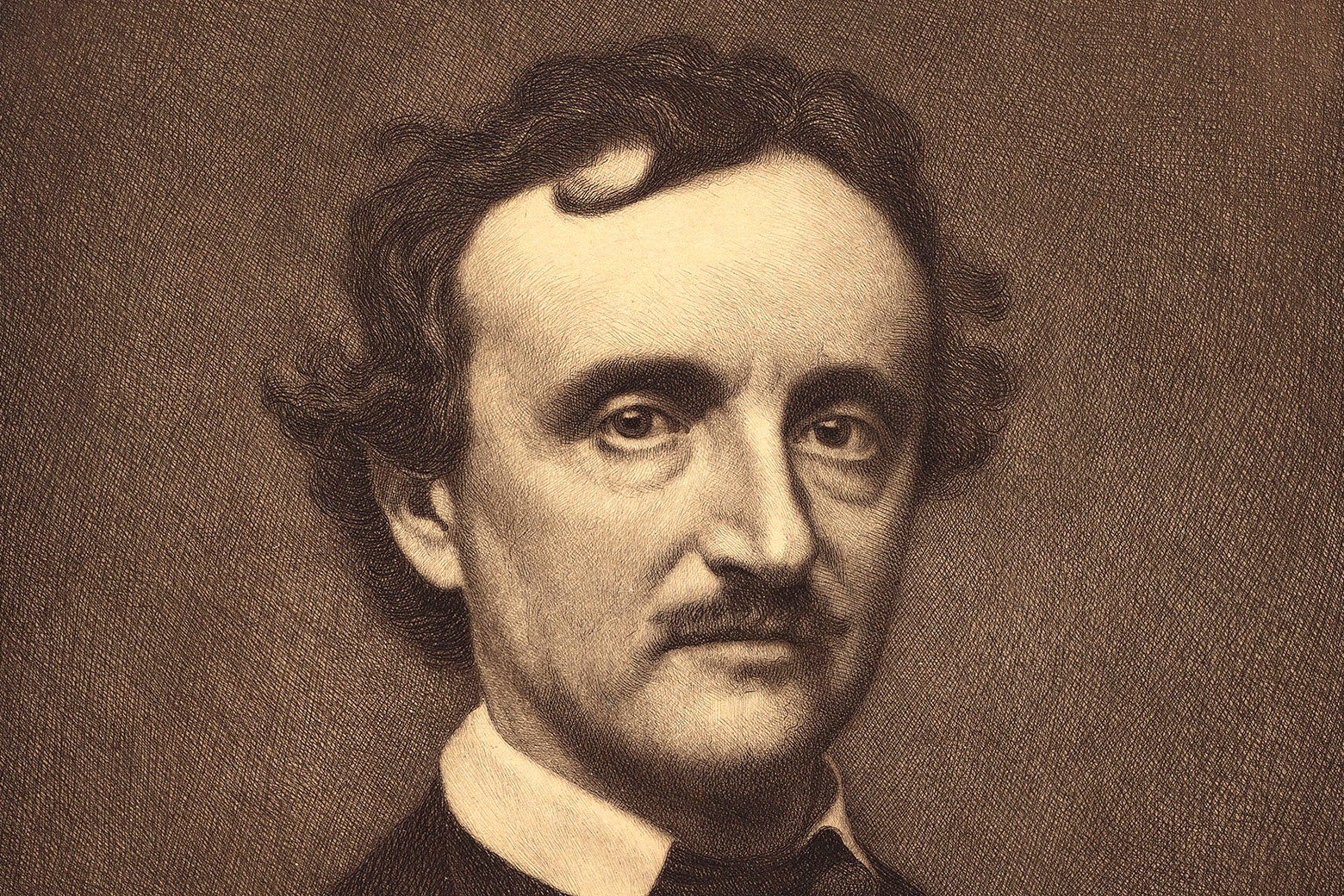
Books Edgar Allan Poe, Quintessential American Writer It’s time to acknowledge just how influential he was. By Enter your email to receive alerts for this author. Sign in or create an account to better manage your email preferences. Unsubscribe from email alerts Are you sure you want to unsubscribe from email alerts for Laura Miller? Oct 25, 20265:40 AM Sepia Times/Universal Images Group via Getty Images Sign up for the Slatest to get the most insightful analysis, criticism, and advice out there, delivered to your inbox daily. Who is the quintessential American writer? Whenever anyone starts kicking around that question, some predictable names turn up: Mark Twain, Herman Melville, F. Scott Fitzgerald, Ernest Hemingway, Toni Morrison. Rarely, though, does anyone mention Edgar Allan Poe, even though Poe is arguably the most influential American writer of all. In fact, after poking around online, I found just one site that listed Poe as No. 1 in the “Top 10 American Writers,” an MIT-affiliated outfit called Pantheon.world that claims to use “biographical data to expose patterns of human collective memory” via a “slow and painful process.” Whatever that means, Pantheon draws from international sources, and without a doubt, Poe is more highly revered abroad than in his own homeland. Emily Ogden’s Darkness Becomes Bright: On the Brief Life and Immortal Art of Edgar Allan Poe is a step toward correcting that. This slim, sinuous collection of essays on Poe’s influence, published earlier this fall, braids together strands of memoir, biography, and literary criticism to make a case for Poe as a writer whose “fundamental theme is the human cry issuing from desperate extremity,” and whose global impact has been formidable. A professor of English at the University of Virginia (a school Poe himself attended for one term back in 1826), Ogden writes that, “in the space of Poe’s works, some of us have been able to tolerate ourselves as we actually are: limited, cruel, perverse, and mortal, but, for all that, still glittering with a heavenly light.” To illustrate this, she explores what three non-American writers—the Argentinian novelist Julio Cortázar, the psychoanalyst Marie Bonaparte, and the French poet Charles Baudelaire—found revelatory and essential in Poe’s writing. It’s easy to see, though, why Poe doesn’t fit within many Americans’ notion of our literature. With the exception of a short, early, and minor work, The Narrative of Arthur Gordon Pym of Nantucket, he wrote no novels, the most exalted literary form during the 20th century, when the nation’s literary culture reached its maturity. Poe’s most famous tales and poetry make no effort to depict American life or social issues, and tend to take place in fantastical and vaguely European settings: moldering manor houses or the dungeons of the Spanish Inquisition. In fact, the settings of most of Poe’s stories feel detached from any real-world locations. They are the stuff of dreams, or rather, nightmares. Poe’s work, furthermore, seems in deliberate, even flagrant, contrast with what were once regarded as the great themes of American literature: the freedom of self-reinvention promised by a new society and its frontier, exploration, rugged individualism, and the struggle to conquer nature. Where other writers saw the American landscape as offering room to prove oneself and forge a destiny unfettered by the past, Poe’s tales and poems are claustrophobic and fatalistic. Tombs, prisons, catacombs, and walled-up alcoves abound in his fiction. Even when his characters aren’t physically confined, they are trapped by some inescapable doom: madness, guilt, grief, or the plague that stalks the aristocratic revelers in “The Masque of the Red Death.” Instead of optimistic and outgoing—the European stereotype of Americans—they are morbid and withdrawn. Instead of persevering against all odds, they despair. Slate receives a commission when you purchase items using the links on this page. Thank you for your support. A Jungian might identify Poe as the shadow cast by the American Dream, a double that personifies all of the fears and reservations exiled by ambition, like the doppelganger who haunts the narrator of Poe’s story “William Wilson.” What if you can’t actually escape your past, or be anything you want to be? Heresy! What if the creatures we have abused in our quest for mastery return to torment us, as in “The Black Cat”? What if the self that you regard as the triumphant creation of your will is in truth your own worst enemy? That last situation was certainly the case for Poe, as Ogden and so many others have documented. He was prone to self-sabotage, especially when he’d been drinking. “When Poe was drunk,” Ogden writes, “and sometimes even when he was sober, he would find himself acting against his own interests for reasons that were mysterious to him.” In a story that begins as a sort of essay, “The Imp of the Perverse,” Poe attributes to this tendency the urge that many people experience when standing at the brink of a great height. “There is no passion in nature so demoniacally impatient,” he writes, “as that of him who, shuddering upon the edge of a precipice, thus meditates a Plunge.” A more everyday version of this impulse is procrastination. “The most important crisis of our life calls,” Poe writes. “It must, it shall be undertaken today, and yet we put it off until tomorrow, and why? There is no answer, except that we feel perverse.” As Poe saw it, Ogden writes, perversity is “as fundamental a drive as hunger or libido.” Darkness Becomes Bright is more Freudian than Jungian, and so Ogden identifies Poe’s imp with Freud’s concept of thanatos, or the death drive. Poe believed that we sometimes want to do something merely because we “should not,” a definition that also encompasses simple rebellion against the superego commanding us to, say, hit the gym, order the salad, or get cracking on that big work project. Sometimes perversity represents the triumph of short-term desires over long-term goals, but sometimes, as per Freud’s thanatos, it is a longing to escape the burdens of consciousness entirely. The latter seemed to be one of the factors that drove Poe to drink and perhaps ultimately killed him at 40. Ogden identifies with this. “It is in me,” she writes, “to want to ruin everything.” For Baudelaire, Poe was his hero because he acknowledged all the dark urges denied by the oppressive moral codes of the French bourgeoisie, whom he delighted in shocking. Marie Bonaparte, an analysand of Freud’s—responsible for saving him and his daughter, Anna, from the Nazis—felt that the fear Poe’s tales inspired in her enabled her to access her own buried anxieties in order to free her from their subterranean effects. For Cortázar, Poe was a kind of exorcist, a “night watchman,” who by admitting to perverse and sadistic impulses let out some of the libidinal steam that powered them. Baudelaire and Cortázar wrote translations of Poe’s work that became hugely influential among writers and artists who spoke their own languages, and Bonaparte wrote a Poe biography. “The mysterious alchemy of Poe’s writing,” Ogden writes, “and of Baudelaire’s, too, and Cortázar’s, and of the work of many writers and artists in this cosmic cloud—is that here, horror yields beauty.” In what may be his most un-American mode, Poe asserted that art can only be diminished if it is obliged to deliver constructive messages, morals, or lessons. Art’s only duty is to our “sense of beauty.” This was an ethos that appealed to generations of European and Latin American artists and writers inspired by Poe, from Jorge Luis Borges and the French symbolists to René Magritte and his fellow surrealists. In the U.S., where we habitually resort to praising art for its ability to stimulate empathy or act as a catalyst for change, the sentiment seems almost alien. Poe, as Cortázar saw it, served as a sort of literary unconscious. Yet perhaps his most extensive influence came from his invention of the detective story, a genre that surpasses even horror fiction in popularity on both page and screen. Strangely, this innovation is often mentioned as an aside or afterthought in many considerations of Poe’s legacy, Ogden’s included. Poe’s detective, C. Auguste Dupin, a French gentleman fallen into genteel bohemian poverty in Paris and the obvious inspiration for Sherlock Holmes, first appeared in “The Murders in the Rue Morgue,” in 1841, and in only two sequels, “The Mystery of Marie Rogêt” and “The Purloined Letter.” Poe called these “my tales of ratiocination,” or reasoning, which made them diametrically opposed to his tales of madness and the supernatural. It is the purview of every detective story to seize upon the unknown and make it knowable. “The fantasy of mastery,” Ogden writes, “that the Dupin stories offer is so appealing that we have never tired of the genre. Every crime novel and long-running police procedural finds its origin here.” She argues that Poe was drawn to such “visions” when his own life felt most chaotic and precarious, when his child bride, Virginia, lay dying of tuberculosis and his career in journalism proved unable to adequately support his household. He had periods of almost superhuman productivity followed by interludes of drunken oblivion, where he might turn up at a friend’s door raving and wearing only one shoe. Poe’s detective stories are the flipside of his tales of horror, just as his tales of horror are the roiling repressed of can-do Americanism. If it took outsiders to fully appreciate Poe as an artist, it also required America to produce this writer, this repository of the unspeakable who insisted on speaking. In his iconic painting “Not to Be Reproduced,” Magritte depicted the image of a man looking into a mirror only to see the back of his own head. At his side is a book, reflected accurately: Poe’s The Narrative of Arthur Gordon Pym of Nantucket, in Baudelaire’s French translation. If we are always, relentlessly facing forward, the painting seems to suggest, we can never truly see ourselves. It takes an artist like Poe to show us the face we insist on hiding. Books History Slate Book Review Horror Mystery
Who Is the Most Influential American Writer? There’s an Obvious Answer—Even if Few Seem to Admit It.
Full Article
Original Source
Read the full article at Slate →KhanList aggregates and links to publicly available news content. We do not host full articles from third-party sources. Always verify important information with original sources.