
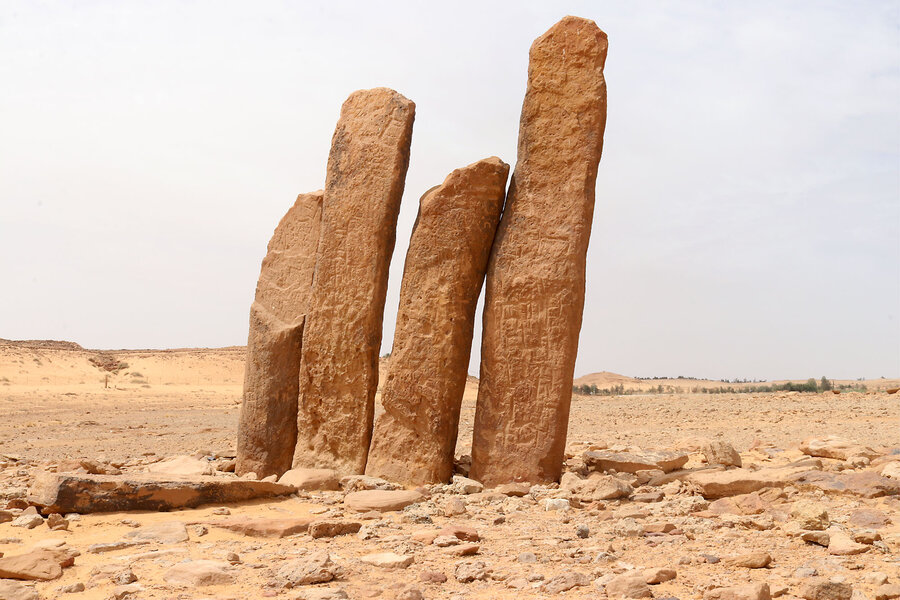
Sakaka, Saudi Arabia | Oct. 07, 2026, 7:46 p.m. ET | 4 min read At the edge of Saudi Arabia’s vast northern desert, they suddenly leap out from the ground, like the fingers of a stone giant reaching up through the sands.The clusters of leaning stone pillars are estimated to predate the rise of ancient Egypt by a thousand years.More than a roadside oddity 29 miles off the main highway heading into Jordan, with their original purpose lost in time, these carefully arranged stones are what’s widely referred to as Saudi Arabia’s Stonehenge. While many of the Middle East’s archaeological sites invoke pharaohs, Nabataeans, Romans, Islamic civilization, and Crusaders, the columns of Al-Rajajil are an echo of a prehistoric period wrapped in mystery.Saudi Arabia’s largely arid landscape is dotted by about a million prehistoric stone structures, but Al-Rajajil remains the most famous.The columns stand at a strategic crossroads connecting the Red Sea, the Arabian Peninsula, and the Levant. At the end of a road cutting between date farms south of the town of Sakaka, a gated 15-acre field emerges. There, 54 clusters of stone columns more than 6,000 years old point and fan out in every direction, like prehistoric missiles aimed at the sky.The stone pillars were cut and shaped using a technique still unknown to researchers. Experts believe they were brought to the site from a faraway location, also unknown.Judging by modern sensibilities and available research methods, there appears to be little rhyme or reason as to how these pillars are arranged.Some columns are short and stout, while others are tall – the tallest is 13 feet. Some stand in a line; others are splayed out.A few pillars are inscribed with the faint drawings of humans, four-legged animals of an unidentifiable species, and a series of mysterious symbols: circles, lines, and misshapen triangles. But what, exactly, were they for? Taylor LuckThe entrance of Al-Rajajil museum in Sakaka, Saudi Arabia, April 2, 2026. Saudi authorities have recently embraced and promoted the ancient carved stone columns known as Saudi Arabia’s Stonehenge. The markings lead some experts to believe that the site had ceremonial purposes for the seminomadic herders known to have frequented the area thousands of years ago.Alas, the columns were situated before the existence of written language, before their own stories could be etched in stone.In recent centuries, local Arab tribes here in the Al Jouf region called the site Al-Rajajil – in Arabic, “the men” – because, from a distance, the weathered pillars resemble groups of people standing on the horizon.It is not just a local legend. From afar in the haze of the desert sun, the columns almost look like narrow, distorted people, aliens standing in a distant vista.The megalithic site is one of the more unusual sites in the Arab world, and dates to between the fifth and fourth millennium B.C., the late Neolithic or start of the Chalcolithic period, at the very beginning of the Copper Age. The place that is now part of northern Saudi Arabia was a very different region back then.These arid plains dotted with date palms were once full of natural lakes and lush pastures on which local inhabitants roamed and grazed their livestock.Semisedentary groups, whether tribes or large family clans, would have traveled to chase pastures for grazing but are believed to have stayed within the same geographic region and would return to sites such as Al-Rajajil to live, trade, and bury their dead. Taylor LuckA close-up view of carvings on an ancient stone column, one of the Columns of Rajajil, at a prehistoric site in Sakaka, northern Saudi Arabia. Archaeologists over the years have posed different theories as to the carefully grouped stone slabs’ purpose: Headstones for a collective burial ground An astronomical chart Markers demarcating tribal land An arena for social gatherings Or simply stone beacons guiding wary travelers along trade routes or signaling the existence of a settlement Excavations over the past few decades have revealed tombs, pottery, serrated blades, arrowheads, human and animal bones, cairns, and a residential building with stairs – indicating that Al-Rajajil might have been a village.But even the site’s plush and modern visitors center, where a staff of four offers dates and coffee, and presents a documentary on the region’s history, leaves visitors with more questions than answers.Long ignored by Saudi Arabia, the columns of Al-Rajajil are now embraced by authorities as part of the area’s rich pre-Islamic history – a bid to encourage tourism to the kingdom’s remote regions and recognize the role of the prehistoric northern Arabian Peninsula in human development.In 2023, the columns of Al-Rajajil were nominated, along with other stone megaliths in Saudi Arabia, to be added to the UNESCO World Heritage List, as the Prehistoric Stone Structures in Saudi Arabia. In its petition adding Al-Rajajil to UNESCO’s tentative list of heritage sites, the Saudi government noted that it remains a “still largely unresearched heritage” and that “research in this field is still in its infancy.”Yet the columns of Al-Rajajil remain a site well off the beaten path.On a late morning in April, a Monitor correspondent was the first visitor in more than a week. For months, the Monitor repeatedly contacted the Saudi Heritage Commission for expert comment but did not receive a response. Deepen your worldviewwith Monitor Highlights.Politics with respectGet political stories with respectful analysis.There‘s a world of new ideas in everyBooks newsletter.There‘s more to life, enrich yours withCulture & Learning weekly.Follow humanity‘s discoveries withScience & Nature stories in your inbox.Gain a spiritual perspectivefrom the stories in your inbox.Want to understand the deeper impact of critical events? Learn the Monitor‘s insight.Already a subscriber? Log in to hide ads. One leaves the site with Al-Rajajil remaining a stranger.“The men” still stand silently on the horizon, refusing to tell their story. ALREADY A SUBSCRIBER? LoginReal news can be honest, hopeful, credible, constructive.The Christian Science Monitor was founded in 1908 to lift the standard of journalism and uplift humanity. We aim to “speak the truth in love.” Our goal is not to tell you what to think, but to give you the essential knowledge and understanding to come to your own intelligent conclusions. Join us in this mission by subscribing.
Who built Saudi Arabia’s ‘Stonehenge’ and why? ‘The men’ aren’t saying.
Full Article
Original Source
Read the full article at Csmonitor →KhanList aggregates and links to publicly available news content. We do not host full articles from third-party sources. Always verify important information with original sources.