
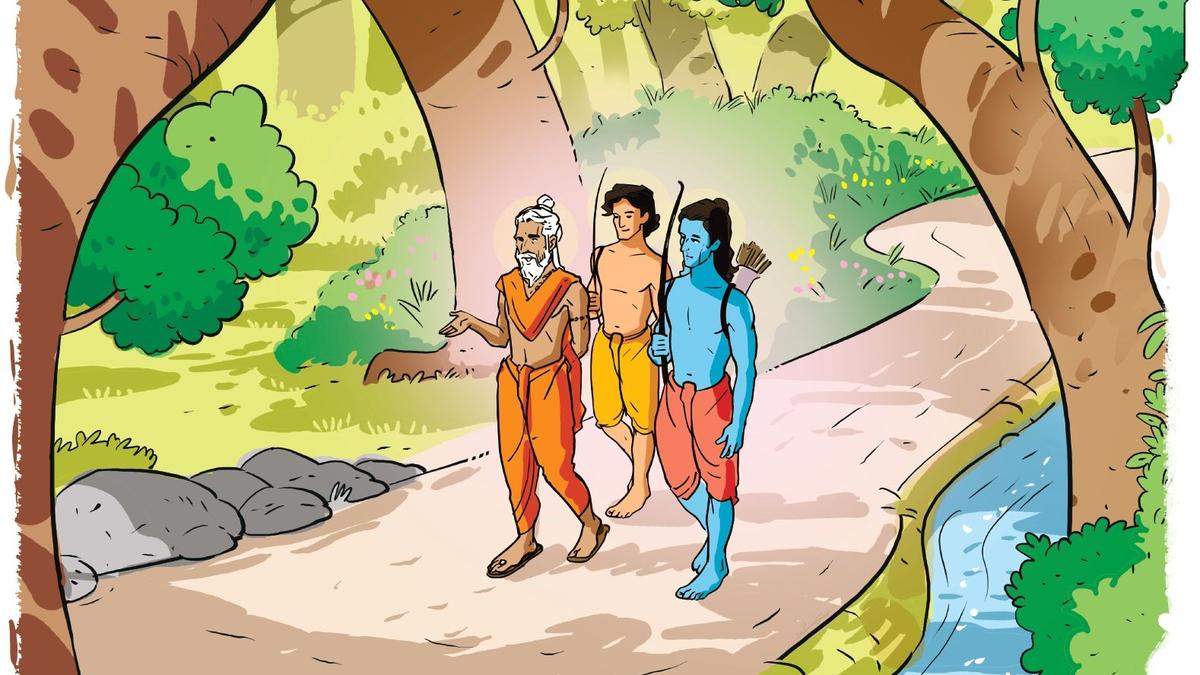
Having defended the yajna from Maricha and Subahu, Rama and Lakshmana walk with Sage Vishwamitra to Siddhasrama, a peaceful and thriving grove.Rama: Gurudev, this sanctuary feels entirely different from the terrifying Tataka Van. Why do dark forces continuously target it?Vishwamitra: You have a keen sense, Rama. This is Siddhasrama, the Hermitage of Fulfilled Wishes. When the Asura king Bali conquered the three worlds, Sage Kashyapa performed penance here. His prayers were answered when Lord Vishnu incarnated as Vamana to conquer Bali. Now, our time here is complete. We must journey onward to Mithila.The trio travels along a scenic path. A gentle, cooling breeze sweeps through the trees.Rama: The winds here move in such distinct, harmonious currents that they feel almost alive.Vishwamitra: You feel the presence of the Maruts, the celestial wind gods. Long ago, Diti, the mother of Asuras, undertook severe penance in this forest. Her unborn child held immense power. Recognising a potential threat to the cosmic balance, Indra, the king of gods, used his power to divide Diti’s unborn child into seven distinct entities.Lakshmana: He destroyed the child?Vishwamitra: No, he transformed them in the womb. The seven entities were blessed to become the Maruts. Instead of causing destruction, they were assigned to govern the seven distinct layers and currents of the sky. The seven Maruts who represent the different spheres of the wind and atmosphere are Avaha, Pravaha, Samvaha, Udvaha, Vivaha, Parivaha, and Paravaha.Rama: Is it similar to the seven types of storms: Thunderstorm, Tropical Cyclone, Tornado, Blizzard, Hailstorm, Dust Storm, and Ice Storm?Lakshmana: Or the seven layers of the atmosphere: Troposphere, Stratosphere, Ozonosphere, Mesosphere, Thermosphere, Ionosphere, Exosphere?Vishwamitra (laughs): I am impressed by your academic knowledge. Since the seven belong to the daityas, think of them as something like storms that can destroy things wherever they go.In the evening, the trio the city of Visala. The gates are lined with welcoming citizens.Vishwamitra: Welcome to Visala. This city is governed by the righteous King Sumati, a descendant of the great Ikshvaku dynasty. We shall rest here tonight.King Sumati rushes forward with his priests and bows to the sage and the two princes.King Sumati: Venerable Sage! My kingdom has been blessed by your visit. Who are these two mighty youths who walk beside you?Vishwamitra: They are the sons of King Dasharatha of Ayodhya. They have just cleansed Siddhasrama of darkness. Tonight, we seek the shelter of your righteous city. Tomorrow we will continue our journey to Mithila.Did You Know?Thunderstorm: A localised storm accompanied by lightning, thunder, heavy rain, and sometimes gusty winds or hail, powered by rising warm, moist air.Tropical Cyclone: A massive, rotating low-pressure weather system over warm ocean waters, known as hurricanes in the Atlantic and Northeast Pacific, typhoons in the Northwest Pacific, or cyclones in the Indian Ocean.Tornado: A violently rotating column of air extending from a thunderstorm base to the ground, capable of producing extreme, localised destruction.Blizzard: A severe winter storm featuring heavy snowfall and sustained winds of at least 35 mph, reducing visibility to near zero for three hours or more.Hailstorm: A storm that drops balls or irregular lumps of ice (hail) formed when strong updrafts carry raindrops high into freezing atmospheric layers.Dust Storm: Also called haboob, this strong windstorm sweeps loose sand, dirt, and dust across dry or desert regions, severely reducing visibility.Ice Storm: A winter storm where freezing rain coats surfaces in a heavy layer of clear ice, leading to dangerous travel conditions and power outages.Build your own atmospheric layersJust like the seven Maruts govern their own specific layers without mixing, you can use liquid density to build distinct, separated layers in a single glass!What You Need: A tall clear glass jar, honey, blue or green liquid soap, water mixed with a few drops of food colouring, rubbing alcohol mixed with another food colouring; vegetable oil, medicine dropperStep 1: The Troposphere: Carefully pour a thick layer of honey or syrup into the bottom of the jar without touching the sides. This is your heaviest and densest layer. Step 2: The Stratosphere: Slowly pour an equal amount of liquid soap directly on top of the honey. Step 3: The Mesosphere: Tilt your jar slightly and pour the coloured water very slowly and carefully along the inside wall of the jar so that it rests on top of the soap. Step 4: The Thermosphere: Keep the jar tilted and slowly pour the vegetable oil along the inside wall. See how it floats perfectly on the water! Step 5: The Exosphere: Using a dropper, trickle your coloured rubbing alcohol gently down the side of the jar to form the final and lightest layer on top. The Science Behind It: Why didn’t the liquids mix together into a messy soup? The answer is density! Density measures how tightly packed the molecules in a substance are. The honey has tightly packed molecules, making it heavy, while the rubbing alcohol has loosely packed molecules, making it light. Just like the gases in Earth’s atmosphere, the heaviest materials sink to the bottom, and the lightest float to the top!The author is the founder and CEO of Vaayusastra Aerospace, an IIT-Madras IC graduated ed-tech company, and a Ph.D. research scholar in Education at NITTTR.
Who are the Maruts?
Full Article
Original Source
Read the full article at Thehindu →KhanList aggregates and links to publicly available news content. We do not host full articles from third-party sources. Always verify important information with original sources.