
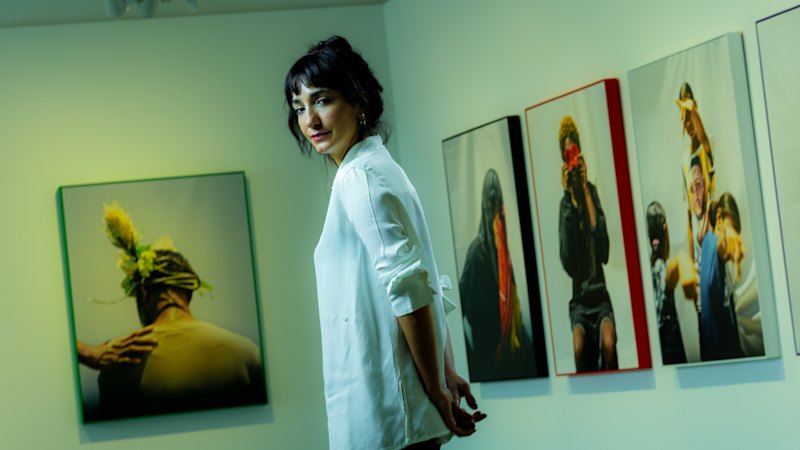
Bursts of colour typify Hoda Afshar’s compassionate and humanistic photography, often strikingly at odds with its subject.The first room of a/part, Afshar’s new show at Buxton Contemporary, curated by Charlotte Day and Shanysa McConville, presents a series of self-anonymised portraits of Indigenous children with experience of incarceration. The portraits are bursting with personality and colour. Faces are obscured by flowers, hands and clothing, and in one case, full Joker make-up. More than one flips the bird. They’re kids after all.Hoda Afshar (centre) with curators Shanysa McConville (left) and Charlotte Day (right).Justin McManus“Often these stories are framed in a way that it denies the subject the right to beauty,” says Afshar. “For me, beauty is a method to rehumanise, to give agency and humanity back to the people who have been historically dehumanised through the lens of the camera.”The portraits are one half of the work Code Black/Riot (2025), a mix of photography and video created in collaboration with Behrouz Boochani, an Iranian journalist and refugee who was incarcerated on Manus Island for six years, and Vernon Ah Kee, artist and member of the Kuku Yalandji, Waanji, Yidinji and Gugu Yimithirr peoples.Boochani recognises the system the kids have experienced. In an accompanying essay, he describes the “complex corridors [and] cold processes and paperwork that entangle them in a twisted, mechanised labyrinth that leads nowhere”.Afshar spent nine days at the facilities of YETI (Youth Empowered Towards Independence) in Cairns, getting to know the kids and taking their portraits with an analogue large-format camera. Her subjects range from nine to 18 years old.“They are absolutely extraordinary in what they do,” Afshar says of YETI. “I think they should be a model for the entire country. To be honest, working with them restored my hope in humanity.”The second half of Code Black/Riot is a four-channel video work, doubled to eight screens for its Melbourne premiere. Prison staff and inmate interviews are staggered across the screens, describing detention centre conditions. A child describes the five times they’ve been incarcerated, in periods of a month to a year. When short-staffed, the warders instigate “night mode” – inmates are locked in pitch-black rooms for days on end.Portrait of Kurdish-Iranian journalist Behrouz Boochani by Hoda Afshar, on display at Buxton Contemporary. Justin McManusAgainst this, we see shots of the natural beauty beyond the walls: the vibrant life of the rainforest, the cool water, and the birdsong of Cairns.The pops of colour and nature in Code Black/Riot also reflect prison life. The colourful frames on Afshar’s portraits – yellow, purple, pink – match the wardens’ emergency colour coding. Vernon Ah Kee’s colour-field paintings act as a key: yellow means officer assistance required; purple, external threat; pink is self-harm. Code black is riot.Birds are a recurring motif as well, from the birdsong in the background of Code Black/Riot to the names used for prison accommodation units – Heron, Kingfisher, Cassowary, Magpie, Hawk, Sandpiper.It’s a naming convention Behrouz Boochani recognised from his six-year incarceration on Manus Island, where he was twice sent to a solitary confinement unit named after the island’s distinctive native bird, the chauka. Beauty and connection to land is weaponised.“It can’t be an accident,” says Afshar. “It’s like a textbook used all over, which continues to become more and more complex over time.”Older portrait work is featured upstairs, including Remain (2018), a portrait series of stateless men on Manus Island, also featuring Boochani, and Agonistes (2020), depicting nine whistleblowers, all of whom have been persecuted professionally and personally since speaking out, captured as digital facial scans that resemble brass busts.Artist Hoda AfsharJustin McManusAfshar moved from Iran to Australia in 2007. Her family remains in Iran. Since last year, she has watched from a distance as war endangers her family yet again. In 2026, Afshar was travelling in the Northern Territory when the US began bombing the Persian Gulf. She found herself in an eerily similar landscape of red sand and white cliffs, with controlled burning filling the air with smoke, and a military exercise sending fighter jets overhead. Her inner world and the world around her merged.In the new video work, Shafaq شفق, still images taken on this trip are matched with narration from Afshar.“The imagery was identical, but the reality was different,” she says. “People were cheering the jets. It was very jarring. I was in tears. One person’s suffering is another’s entertainment.”This juxtaposition sits with those downstairs: the colour coding and its meaning, the natural world surrounding Cairns, just beyond the prison walls.“It’s another Australian city next to the ocean,” says Afshar, “but the prison is at the heart of it. The fact that we live with these realities and choose not to see it is very much of the reality of this country.”The subjects of Code Black/Riot are Indigenous, but Afshar is adamant that it’s not an Indigenous story – it’s an Australian story.“All of these are Australian stories that demand an Australian solution,” she says. “It’s our responsibility as citizens to think about others.”a/part by Hoda Afshar is at Buxton Contemporary until April 24.The Booklist is a weekly newsletter for book lovers from Jason Steger. Get it delivered every Friday.
Whistleblowers, children and stateless men: The artist telling stories one image at a time
Full Article
Original Source
Read the full article at Smh →KhanList aggregates and links to publicly available news content. We do not host full articles from third-party sources. Always verify important information with original sources.