
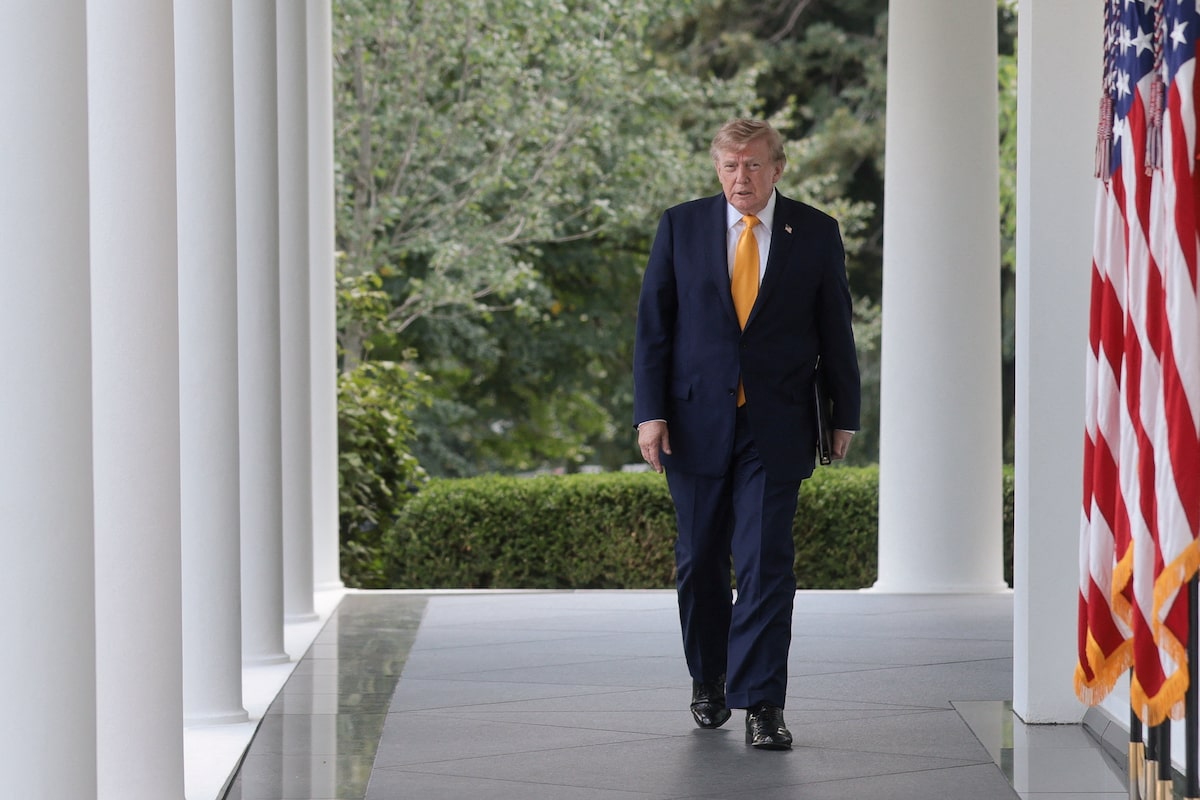
Open this photo in gallery:U.S. President Donald Trump in the Rose Garden at the White House on Monday. Trump is escalating his economic attacks on Canada and Iran.Jonathan Ernst/ReutersDonald Trump was determined to have his way with Iran only to find that Iran wasn’t willing to bend to his commands. Then he tried the same technique – demands, tough talk, threats of punishment – with Canada only to find the same result. The stunning break in trade negotiations, which Mr. Trump had signalled were on the verge of settlement – much like the negotiations with Iran, which he repeatedly also said were nearing a happy resolution – grafted the U.S. President’s Middle Eastern frustration onto a North American landscape. Prime Minister Mark Carney was no more willing to conform to the American President’s demands than was Iranian Supreme Leader Mojtaba Khamenei. Both refused to fall in line – clearly the expectation in the White House – the way members of the Republican Party have. When Mr. Carney employed the word “war” in announcing Canada’s withdrawal from the trade talks and girding Canada for the suite of 50-per-cent tariffs the President has threatened, he instantly transformed Mr. Trump into a wartime president – a wartime president twice over, in two vastly different dimensions. The frustrating, even infuriating, view from the White House: Two wars, no victories in sight. Editorial: A free Canada is worth the sacrificeIn the Trump era, to reverse the famous aphorism of the 19th-century military theorist Carl von Clausewitz, international trade is warfare by other means.For a President accustomed to having his way – he has bullied rivals in the New York real estate market, Ivy League universities, powerful law firms, heads of regulatory agencies and the Supreme Court – the Carney rejection was a remarkable signal of the limits of intimidation. And the imposition of Mr. Trump’s tariffs on more than 500 Canadian items such as car coats, track suits, awnings and gloves used for shovelling snow is the North American version of a blockade of the Strait of Hormuz.Indeed, there is a “Groundhog Day” element to the two conflicts, one military, the other economic. In both cases, negotiations are suspended. In both cases, at issue is a second country’s dignity.Mohammad Bagher Zolghadr, then Iran’s Secretary of the Supreme National Security Council, told Mr. Trump on July 6, “Speak to the Iranian people with respect, otherwise we will respond to you in a different language.” This week Mr. Carney, speaking at the Davie shipyard in Lévis, Que., said much the same thing: “When the Americans go to the negotiation table first, with the right attitude toward our industries and a true partnership, of course we’ll come to the negotiating table.”Opinion: Mark Carney is digging in for the trade warIn Iran, a barrage of bombs and missiles failed to bring the theocratic leaders of a rogue nation to heel. In Canada, a fusillade of 51st-state takeover threats, insults and tariffs failed to bring America’s closest ally to a trade agreement that the Prime Minister characterized as “not something we’re going to accept.”Nearly nine months ago, Amir Saeid Iravani, Iran’s ambassador to the United Nations, said, “Iran will not surrender its sovereignty.” Shortly after the end of the trade negotiations, Mr. Carney, who pledged Canada would match dollar-for-dollar the new Trump import duties, said, “We were not prepared to compromise Canada’s sovereignty or to undermine key industries.”In the cases of both Canada and Iran, Mr. Trump assaulted the independence of another country and, in his first remarks after the failure of the talks, he once again taunted Ottawa: “Canada wants the benefits of being a State, without being one!!!”The Iran situation, to be sure, has far different elements than the North American imbroglio.Iran possesses the desire if not the implements at present to create a nuclear weapon that would threaten global stability. Its proxies have sown terrorism throughout the Middle East and present a danger to U.S. installations in the region and, potentially, at home. Editorial: Canada’s sovereignty is not negotiableCanada – whose defence, Mr. Trump has repeatedly reminded the country’s leaders, is largely dependent upon the American military umbrella – possesses no physical threat to the United States. It hasn’t targeted American installations in Alaska or North Dakota and has no sleeper cells in Greater Boston determined to detonate a bomb under Fenway Park. Mr. Carney, who spoke the other day of “the storm that blows in from Washington,” has won plaudits at home and respect abroad for defying Mr. Trump in a way no other Western leader has done. The Iranian leadership has strengthened its once-precarious domestic position by continuing to defy Mr. Trump.In both cases, Mr. Trump, thwarted in his effort to prevail and frustrated that his demands have been spurned, is escalating his economic attack. As the conflict with Iran nears its six-month mark, the President is warning that an “economic D-Day” is imminent; Treasury Secretary Scott Bessent on Monday promised a fresh package of economic measures to pressure Iran. Having been defied at the trade talks by Canada, Mr. Trump threatened new tariff measures on automobiles, trucks and steel.Then, on Tuesday, Mr. Trump, acknowledging there would be little trade with Ontario in the coming weeks and perhaps substantially longer, threatened to change the name of Lake Ontario to Lake America. The name “Ontario” comes from the Huron word “Ontarí’io,” which translates into “great lake” or “beautiful water.” The province was named for the lake, rather than the other way around, and in any case preceded the arrival of Europeans to North America. Mr. Trump tried the same gambit with the Gulf of Mexico. The U.S. Department of Interior and the Coast Guard have been calling the body of water the Gulf of America. But Congress has not formally adopted the term and other countries, international agencies and news outlets generally have been employing the traditional name.
Whether it’s Iran or Canada, for Trump, the result is the same
Full Article
Original Source
Read the full article at Theglobeandmail →KhanList aggregates and links to publicly available news content. We do not host full articles from third-party sources. Always verify important information with original sources.