
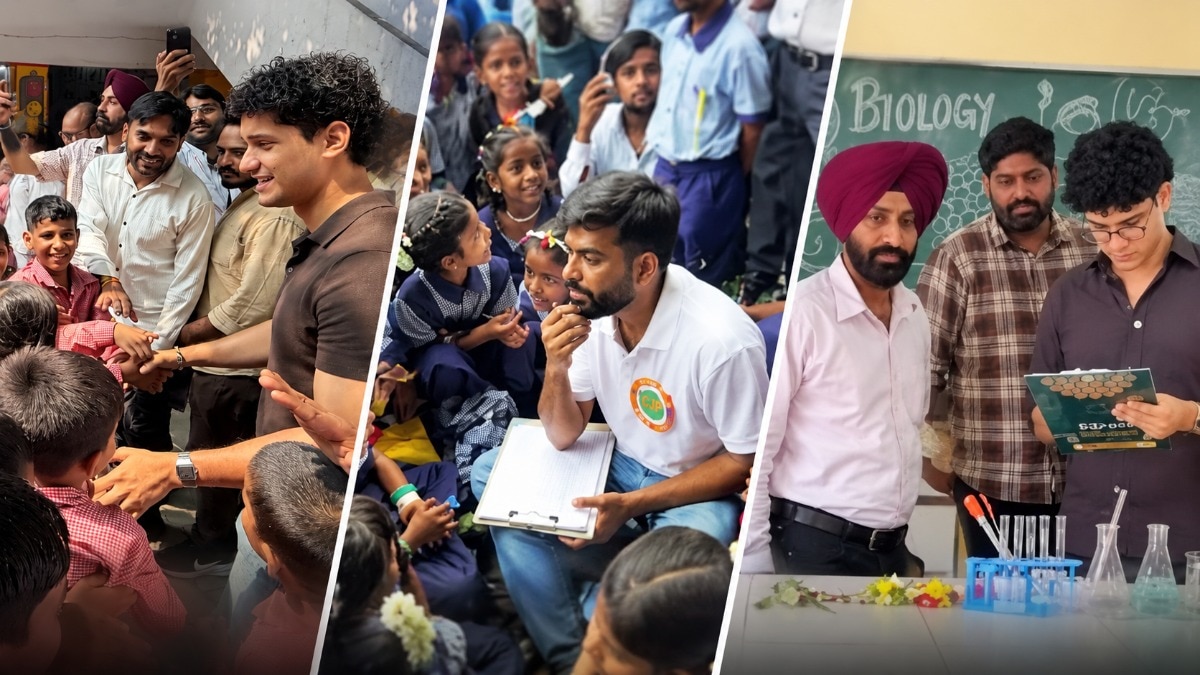
Since tasting success by forcing the Union Education Minister to resign, the Cockroach Janta Party (CJP) has taken its activism to at least half-a-dozen states. From the Jantar Mantar protest site, cockroaches have crawled into government schools in several states, led by the BJP and opposition parties. But the allegations of "selective"activism have haunted CJP founder Abhijeet Dipke and other leaders. A big reason is their past association with the AAP. In fact, on several occasions, the AAP has behaved like the CJP's B-team.When it comes to schools, the big cockroaches, the CJP's national leadership, have intervened in both BJP- and Opposition-ruled states. But, is there a difference in the nature of those interventions? The CJP campaigns in BJP-ruled Maharashtra, Rajasthan and Uttar Pradesh have included protests, ultimatums and demands for resignations, while prominent interventions in AAP-ruled Punjab and Congress-ruled Karnataka have taken the form of "school audits" and "meetings with authorities".The CJP inspected three schools in Punjab. One of them was a School of Eminence in Ludhiana, having a swimming pool and equipped with an AI lab. Another was a 90-year-old government senior secondary school. AAP chief Kejriwal thanked "Sourav [Das, the CJP co-convenor] for "pointing out the deficiencies". That does not establish the alleged "selective activism" at the word go. But it makes the nature and intensity of its top leadership's activism worth examining.Lat week, a reporter accused Dipke of double standards in Punjab schools. The CJP founder reacted in a way that many said, "He lost his temper." "It's not our responsibility to point out problems," he said. An achievement amid the CJP stir is that there have been some tangible positive outcomes. Governments and local authorities in Maharashtra, Rajasthan, Uttar Pradesh and Haryana have jumped to act. They have moved on to school repairs after deficiencies were highlighted by the CJP.So, where exactly have the CJP's big cockroaches crawled since the protest at Jantar Mantar? What did they do once they got there? Here's a state-by-state look. CJP: FROM JANTAR MANTAR TO SCHOOLS IN THE GRASSROOTSThe CJP burst into national prominence through the 37-day Jantar Mantar agitation, demanding the resignation of then Union Education Minister Dharmendra Pradhan over examination paper leaks and irregularities in the education system. After that agitation, its attention widened its attention. From examination irregularities, the CJP's immediate focus shifted to the condition of government schools.Even before Pradhan's resignation on July 25, the CJP and the style of agitation had travelled out of New Delhi. Demonstrations took place in cities including Mumbai, Bengaluru and Nagpur, while similar student protests sprang up elsewhere over examination irregularities and jobs. By July 23, CJP spokesperson Ashutosh Ranka claimed protests were under way in 34 cities, saying, "These are all the cities currently protesting against paper leaks. India has woken up."Following the Jantar Mantar triumph, Dipke on August 15 launched 'School Thik Karo' from Santuk Pimpri, his native village in Maharashtra's Hingoli district, auditing a Zilla Parishad school. There, the first audit flagged no safe drinking water, too few benches, dirty toilets and broken windows. From Maharashtra, the CJP, claiming to have around 1,500 volunteers, were auditing schools across states, including UP, MP, Assam, Jharkhand and Bihar.Rajasthan was an early flashpoint. The CJP's Ashutosh Ranka joined inspections and said, at one Jaipur district school they found 18 children studying in a cattle enclosure after their building had become unsafe. Ranka and the other CJP members were allegedly attacked, and the oufit alleged that they were "BJP's goons."Days ago, on September 16, Dipke launched the Adivasi School Thik Karo campaign from Nagpur and launched its first phase from Maharashtra's Gadchiroli on September 17. The CJP would then proceed to Nashik and then to Gujarat. "We don't want to target anyone. Our agenda is that schools for these tribal students should be improved," Dipke said. Dipke arrived in Delhi on June 6, when CJP began its Jantar Mantar protest, which continued in phases until Dharmendra Pradhan resigned on July 25. BJP-RULED STATES SAW CJP TURN UP THE HEATIn the BJP-ruled states where CJP's top leadership has physically intervened. The audits show they have gone beyond just school auditing. From June 12 to September 19, Dipke and his national core team visited at least four BJP/NDA-led states or UTs. Uttar Pradesh, Rajasthan, Maharashtra and Delhi have seen street protests, resignation demands, deadlines, threats of agitations and confrontations with security personnel.UTTAR PRADESH: More than a week before Pradhan resigned, Dipke on June 12 travelled to Lucknow and joined thousands of competitive-exam aspirants and teachers at Eco Garden protesting paper leaks, recruitment delays and alleged examination irregularities. Three months later, on September 15, CJP's Saurav Das took School Thik Karo to Noida, where his team inspected a government school and flagged poor toilets and infrastructure while alleging that several schools had been shut to prevent further "audits". The District Education Office denied the claim.RAJASTHAN: Similarly, before Pradhan's resignation, Dipke on June 15 reached Jaipur for the CJP's maiden protest at Shaheed Smarak. There he was assaulted as he entered the venue and the video went viral. The police in Rajasthan, ruled by the BJP, arrested five people. Rajasthan later became a centre of School Thik Karo campaign. Ranka led the school inspections. In August, Abhijeet Dipke alleged that authorities in Maharashtra's Latur district brought students from another school and presented them as pupils of a Zilla Parishad primary school during his visit. MAHARASHTRA: The BJP-ruled state has seen the CJP's most sustained state campaign. It's Dipke's home state. He launched School Thik Karo in Hingoli, toured Zilla Parishad schools across Hingoli and Latur and, after an FIR over one school visit, challenged the government to file "not one but 100 cases" against him if exposing deficiencies was a crime.In September, the CJP also backed MPSC aspirants, demanded the resignation of top commission officials and set a September 24 deadline. He has threatened a statewide agitation. Dipke has now moved to Nagpur and Gadchiroli with the Adivasi School Thik Karo campaign.DELHI/CENTRE: This is where it all began. Dipke arrived in New Delhi on June 6, where not many cockroaches listened to him, until educationist and activist Sonam Wangchuk addressed them, an hour after flying in from Leh. He had already issued an ultimatum demanding Education Minister Dharmendra Pradhan's resignation. The protest later became a prolonged sit-in after Wangchuk's fast added a weight to it.The broad pattern in these four BJP/NDA-led states is that the CJP's national leadership has repeatedly used audits, ultimatums, resignation demands, sit-ins or threats of wider agitation. This is a benchmark against which its interventions in Opposition-ruled states can be compared. The CJP plans to take its Adivasi School Thik Karo campaign to Gujarat after completing its Maharashtra leg. Map for representation only, not to scale. (Author/ India Today) YES, CJP WENT TO OPPOSITION STATES TOODipke has rejected the charge that the CJP looks only at BJP-ruled states. "Sourav went to Punjab and spoke on shortcomings, Ashutosh went to Karnataka, Ankit [Bharadwaj] went to Jharkhand," he said, referring to AAP-ruled Punjab, Congress-ruled Karnataka and JMM-led Jharkhand.PUNJAB: Here, Saurav Das led a "social audit" of government schools in Ludhiana. His assessment was not uniformly critical. He praised aspects of the Schools of Eminence, the AAP government's flagship school. He pointed at a dampened wall in the washroom, asking for a repair. Punjab's education minister subsequently engaged with Das.That visit became a political flashpoint. The Punjab Congress challenged the CJP to examine AAP's schools "with the same eyes" it used elsewhere. Several non-partisan people posted videos and images of poorly maintained Punjab government schools, asking why CJP was not auditing those instead of the flagship Schools of Eminence. AAP chief Arvind Kejriwal thanked Saurav Das for "pointing out the deficiencies" and said, "We will immediately address them." Punjab has around 19,000 government schools, while the state government has announced 118 Schools of Eminence. However, only some of the proposed schools have been inaugurated. KARNATAKA: Here, Ashutosh Ranka and his team inspected four Bengaluru government schools. They highlighted teacher shortages, unsafe roofs, sanitation and infrastructure shortcomings. Ranka said CJP volunteers had audited more than 200 schools in the state, while the CJP on September 10 announced plans to take the drive across all 31 districts. Ranka met Education Minister Madhu Bangarappa over the findings. Repair work reportedly began at a school in Varthur within a day of the visit.The CJP has also cited Jharkhand as evidence of scrutiny across party lines.So, the CJP's record reveals that its national team has crossed the BJP-Opposition-ruled state divide. What differs is the form of pressure. Street mobilisation, resignation demands and deadlines have featured prominently in several BJP-ruled states. "School audits" and engagement with authorities and ministers have dominated the best-documented CJP's interventions in Opposition-ruled Punjab and Karnataka. These differences, whether they reflect intentional selectivity or difference in circumstances, are open to debate and scrutiny. How closely the CJP's actions match its propagated ideals is for onlookers to judge. What everyone can agree on is that schools are getting attention.- EndsPublished By: Sushim MukulPublished On: Sep 21, 2026 08:00 IST
Where has CJP taken its activism since Jantar Mantar, BJP or Opposition states?
Full Article
Original Source
Read the full article at Indiatoday →KhanList aggregates and links to publicly available news content. We do not host full articles from third-party sources. Always verify important information with original sources.