
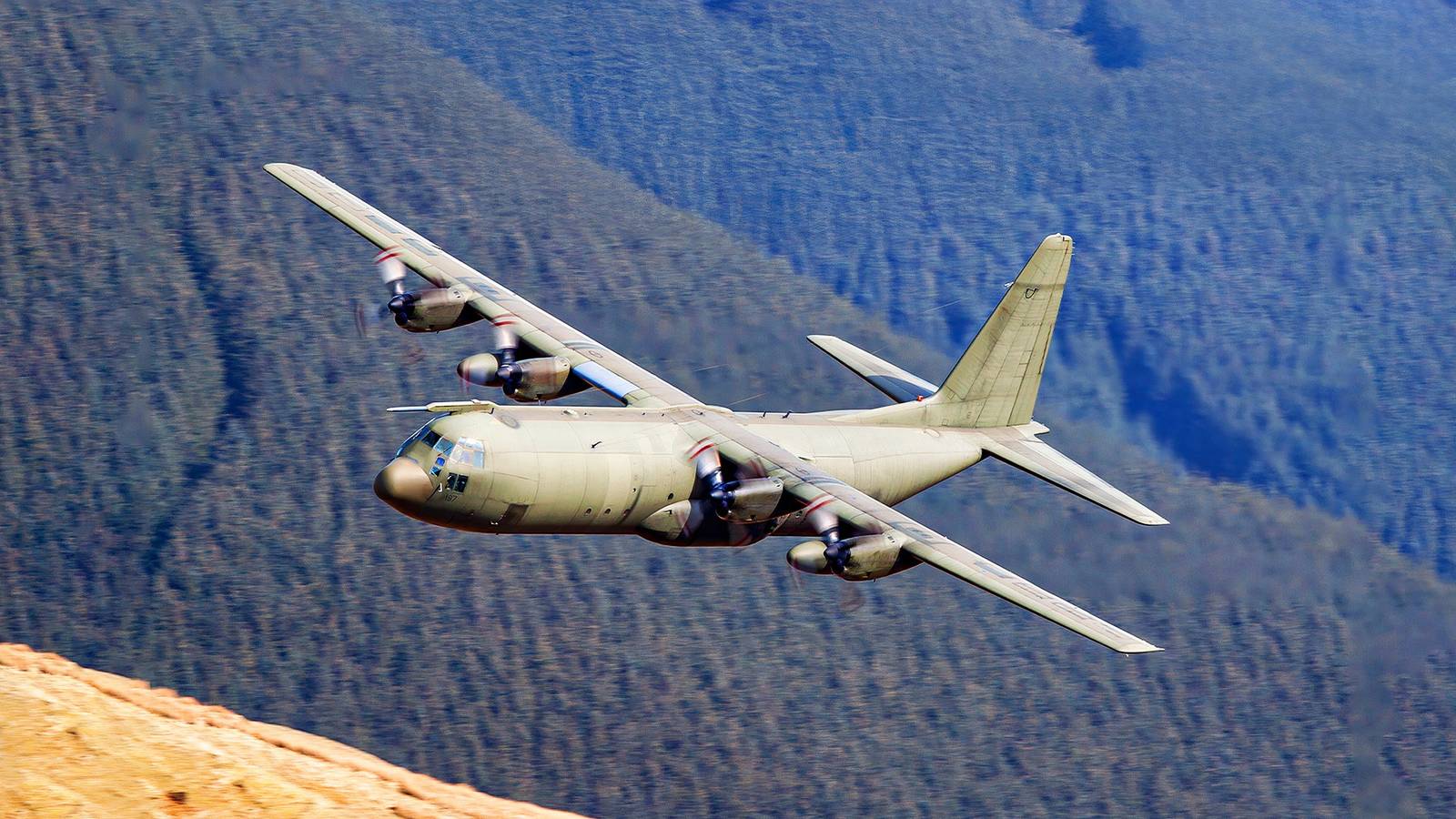
Published Oct 16, 2026, 8:00 PM EDT Chris earned a Master’s degree in Defense and Strategic Studies (Highest Honors) from the University of Texas at El Paso. His graduate work concentrated on Global and National Security, Low-Intensity Conflict, Modern Warfare, and US grand strategy. He also undertook extensive regional studies, analyzing how key regions integrate into the broader US security architecture. This rigorous program provided him with a comprehensive understanding of U.S. military operations, global strategy, and weapons systems. Additionally, he gained a strong appreciation for great power competition.—an increasingly central force shaping international relations and conflict for the foreseeable future. The Montana Air National Guard's 120th Airlift Wing has been receiving the latest variant of the long-serving Lockheed Martin C-130 Hercules, the C-130J-30 Super Hercules. The unit began inducting the aircraft just over 10 years ago as it gradually phased out its older inventory. Following retirement from active service, older aircraft have several possible destinations. Some may be sold to partner nations seeking reliable airlift capabilities. This option can connect the receiving nation to an established ecosystem of contracted training, maintenance and readily available spare parts. Other retired planes may be sent to Davis-Monthan Air Force Base for long-term storage or retained as training aircraft. The Montana Air National Guard Transitions To The C-130J Credit: Montana Air National Guard The Montana Air National Guard's primary unit is the 120th Airlift Wing, which operates the C-130H. According to the unit's official website, it specializes in airdrop and airlift missions and commands about 1,000 airmen, about 400 of whom are full-time. The 120th began receiving the new cargo haulers in 2014 and operated eight C-130Hs in total. According to the State of Montana, the unit will receive eight C-130J Super Hercules aircraft through a one-for-one replacement program. The Montana website further states: "The Defense Appropriations Act of FY22 and FY23 appropriated 32 C-130Js for the Air National Guard. On March 24, 2023, the Director of the Air National Guard approved eight bases as potential locations for these aircraft and on September 14, 2023, the governor announced Great Falls as a preferred location." After 12 years of flying the C-130H, the 120th flew its final tactical training mission with the model on October 3, according to Defence Blog. For the final flight, two of the unit's Hercules aircraft flew in a two-ship formation over Montana before returning to Great Falls Air National Guard Base, on the east side of Great Falls International Airport (GTF) in Great Falls, Montana. Upon their return, firefighters greeted the two cargo planes with a traditional water salute, marking their retirement from active service. Regarding the cargo haulers, Colonel Jason Green, commander of the 120th Airlift Wing, stated: "The C-130H has been central to our mission for more than a decade, and its legacy is defined by the Airmen and the missions that made these aircraft such an important part of the 120th . . ." Some Of The 120th's Retired C-130's Are Destined For Service With Partner Nations Credit: US Air Force As the USAF begins inducting the new C-130J models, it has started retiring older C-130H aircraft at around 11,000 flight hours, or slightly less than half their expected service life. This raises the question: given that these cargo haulers may still have considerable service life remaining, what will happen to them? One possibility is that they will be transferred to partner nations, which is a common practice for surplus or older military equipment. Foreign military sales are intended not only to transfer equipment the US no longer needs, but also to strengthen military relationships with nations that work alongside the United States. According to the US Department of State, "...the United States government manages approximately $55 billion (£41.6 billion) per year in new sales of defense equipment to foreign allies and partners." Recent C-130H transfers include three airframes delivered to Colombia. The aircraft were acquired under a 2018 bilateral agreement through the Defense Surplus Goods Sales Program, with the sale valued at $30 million (£22.5 million), according to Military Leak. In 2024, the Philippines received the second of two C-130Hs, which landed at Clark Air Base in central Luzon. The transfer deal was valued at 2.5 billion Philippine pesos ($25.5 million / £19.3 million), the Philippine Daily Inquirer reported. One of the more recent C-130H deliveries went to Tunisia, a North African nation that received the planes earlier this year. According to the Africa Defense Forum, its air force "...now flies five C-130Hs, one C-130B and two newer-generation C-130J Super Hercules that were delivered between 2013 and 2015." Tunisia uses these capable aircraft to train pilots, enhance security along its southern border, and help deter human smuggling and terrorist activity. The United States and Tunisia have cooperated on C-130 operations for more than 40 years. Some Of The Retired Hercules' Will Go To The Boneyard While Others Will Train A New Generation Of Airmen Credit: US Air Force Another destination for retired C-130s is Davis-Monthan Air Force Base, also known as the "Boneyard." The storage facility is operated by the 309th Aerospace Maintenance and Regeneration Group (AMARG). Its 2024 inventory lists nearly 250 airframes from the C-130 family. These aircraft are placed in long-term storage and, when required, may be returned to service, sold, or used as spare-parts donors for planes that remain operational. Aside from being sold or used for spare parts, some C-130s are repurposed as training aircraft. For example, two Hercules' arrived at Kelly Field in San Antonio, Texas, on August 25 last summer. At the airfield, the two airframes will be used at the 737th Training Group’s Air Base Training Range. The 737th Training Group trains 93% of the Air Force’s enlisted personnel, with basic military training conducted on the premises and lasting seven and a half weeks. Trainees working on these Hercules planes gain exposure to airfield operations long before they are assigned to their first duty stations. They will develop proficiency in cargo loading, refueling operations, and coordinating aircraft movements on the flight line. These skills are fundamental to operating, generating, and sustaining airpower in a combat zone. Back To The 120th Airlift Wing & Its Most Recent Mission Credit: US Air Force Over the last 13 years, the 120th Airlift Wing's airmen have deployed to more than 50 countries and participated in four major combat deployments. Their most recent overseas deployment was in 2025, when the unit deployed to Djibouti, a strategically important East African nation. Djibouti's strategic importance stems in part from its location near the southern entrance to the Red Sea. According to the Africa Center For Strategic Studies, "The Red Sea maritime corridor has typically accounted for roughly 30 percent of global container traffic, 15 percent of global oil and shipping transits, and 12 percent of global annual trade—valued at $1 trillion. The Red Sea maritime corridor has historically managed 95 percent of maritime traffic between Europe and Asia." In Djibouti, approximately 150 airmen from the 120th operated under US Africa Command (AFRICOM), one of the US military's 11 unified combatant commands, which oversees US military activities across the African continent, according to The Electric. According to Lieutenant Colonel Ben Tougas, a C-130 navigator with the unit, the deployed personnel supported US allies through crisis response and intertheater logistics. AFRICOM is responsible for US military operations, exercises, and security cooperation across the African continent, its island nations, and surrounding waters. At any given time, between 2,500 and 3,000 United States Army personnel are in Africa, participating in a variety of operations and engagements with their African counterparts, according to the Center for Strategic and International Studies. As the air component supporting this geographic command, US Air Forces Africa conducts air operations across a theater spanning three continents, covering more than 19 million square miles and encompassing 104 independent states. Thus far in 2026, AFRICOM has publicly acknowledged 86 strikes, largely targeting ISIS affiliates and al-Shabaab. The latter is an al-Qaeda-affiliated violent extremist organization operating primarily in Somalia. A Look At The C-130J, The Air National Guard's & USAF's Newest Variant Credit: US Air Force The C-130J is the newest model in this venerable aircraft family. The prototype YC-130 made its maiden flight in 1954 at Lockheed's Burbank, California, plant, and the C-130H entered production in 1965. The Air Force took delivery of the C-130J in February 1999, and it has since received 121 of the planes. According to Lockheed Martin, as of October 2026, the company has delivered more than 570 C-130Js to 27 countries. Across the global fleet, these aircraft have accumulated more than 3 million flight hours. The family includes six production variants and 20 mission configurations. C-130J Production Variants Mission Type C-130J Manufactured with a longer fuselage C-130J-30 for combat delivery KC-130J Aerial and ground refueling MC-130J Special Operations; aerial and ground refueling (US Air Force-only variant) HC-130J Search and rescue support missions; aerial and ground refueling (US Air Force-only variant) HC-130J Search and rescue/maritime support missions (US Coast Guard–only variant) LM-100J Civil-certified multipurpose air freighter The C-130J-30 has been designed with an additional 15 feet (4.6 meters) of unobstructed, fully pressurized cargo-hold space. Lockheed states that the cargo area can be rapidly reconfigured to accommodate 128 fully equipped soldiers, 97 stretchers, passengers, or 92 paratroopers and their equipment, prepared for deployment into a combat zone. For cargo stowage, the aircraft can accommodate eight pallets or 24 Container System Delivery Bundles, which are standardized, airdropped cargo packages. For ground cargo delivery, the C-130J is also equipped with the Enhanced Cargo Handling System (ECHS). The system features electrically actuated locks and vertical restraints, flip-to-stow roller conveyors, an underfloor variable-speed winch, an enhanced loadmaster console with a Multifunction Control Display Unit, and cargo-door dual uplocks and actuators. The C-130J-30 Will Continue Montana’s Airlift Mission Credit: US Air Force The transition from the C-130H to the C-130J-30 marks a new chapter for the Montana Air National Guard’s 120th Airlift Wing. However, its mission remains unchanged: providing tactical airlift, transporting personnel and cargo, and supporting operations alongside US allies and partners worldwide. As the newer Hercules enters service, Montana’s retired C-130Hs could find new roles through transfers to partner nations, long-term storage at Davis-Monthan Air Force Base, or use as training aircraft. Regardless of their destination, these airframes may continue serving military and training needs long after leaving Montana’s flight line.
Where Do Retired C-130 Hercules Go? Montana's Final H-Models Show The Answer
Full Article
Original Source
Read the full article at Simpleflying →KhanList aggregates and links to publicly available news content. We do not host full articles from third-party sources. Always verify important information with original sources.