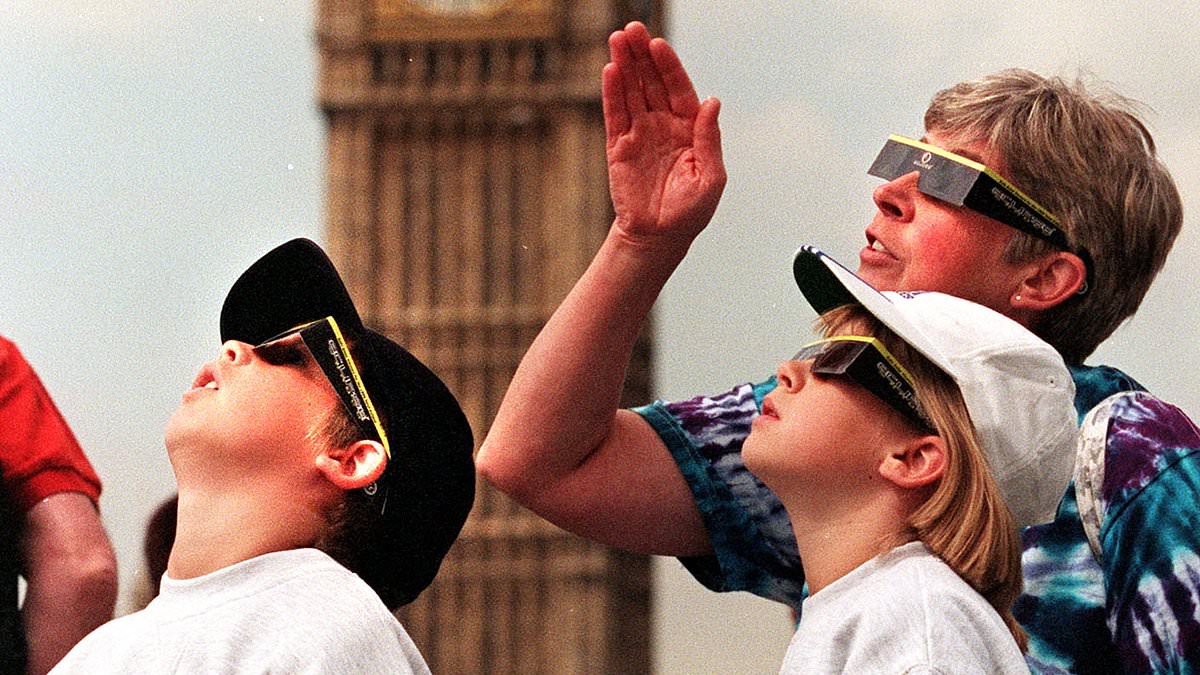
The last time the UK experienced an almost total solar eclipse – which will happen just after 6pm this evening – Britons looking up to the skies were on the cusp of a new millennium.Back in the summer of 1999, the Venga Boys, Madonna and Westlife were flying high in the charts and the finishing touches were being added to London's disastrous Millennium Dome – nicknamed 'the upside-down wok' – that would eventually become the O2 arena. On August 11 that year – 27 years and one day ago – the sun, surrounded by the halo of its corona, was completely blacked out for two minutes and six seconds. The weather that day was what we might then have described as a classic English summer, cloudy and with the mercury hovering at around 20C (68F) in London. Today, however, temperatures are forecast to hit 32C (90F) as the UK experiences yet another heatwave. In 1999 millions across the UK took the time to watch the eclipse, but many were left underwhelmed – particularly in the South West. More than 600,000 people descended on Cornwall to stand in the path of totality but the cloudy English weather scuppered the view for many.There was drama for the National Grid though, the electric power network reported its biggest surge in history shortly afterwards. A woman and her two children watch the start of the eclipse on Westminster Bridge on August 11, 1999Recalling the moment when the day turned into night and back again, spectators looking back have said donning eclipse glasses and watching live was a 'weird sensation' and an 'eerie experience' – but one that made some 'quite emotional'.Speaking to the BBC, Barbara Logan, who saw the phenomenon in Cornwall, said: 'We were all gathered down in the square with our glasses ready. It was a weird feeling, you didn't know if it was night-time or daytime.'Nigel Brown, from Horsham, said: 'Once the eclipse started it was a wonderful but really eerie experience. I couldn't believe how day turned into dusk and the birds stopped making a noise.' Welders in Newcastle prepare for the total eclipse in 1999 Britons of all ages catch the start of the eclipse at the Angel Of The North in 1999Anne Le Cheminant, who watched the eclipse in Guernsey, told the corporation: 'I'm still quite emotional about it, it was just such a gigantic, awesome event. It was eerie, it was very strange... you could feel the collective awe of everyone watching it.'In London, thousands of office workers poured into the streets, parks and squares as the temperature noticeably dropped when the sun was obscured from view.At St Thomas's hospital, nurses and doctors climbed onto the roof to experience the spectacle.Some 200 wealthy Britons took to the skies, paying £1,500 each to travel on two eclipse-chasing Concordes.But some of the best views in the country were to be found on Alderney, in the Channel Islands, where 250 scientists watched the eclipse from a ruined Victorian fort.At 10.10am, the clouds parted, allowing for a first view of the sun – now missing a small bite. A crowd gathered at the Louvre in Paris to watch the total solar eclipse on August 11, 1999 A sign warned motorists on the M3 motorway near London of upcoming delays some 125 miles away in Devon and Cornwall, during the first eclipse in Britain for more than 70 yearsAt 11.15am, the last traces of the sun vanished behind the moon. There were gasps as the corona – the outermost layer – came into view.But, as quickly as night had fallen, daylight returned, moving many of the professional observers to tears.The Daily Mail's Ray Connolly, reporting from Fistral Beach in Newquay, Cornwall, described how the clouds parted 'like a moment from the Bible'.He added: 'It's easy to see why the ancients feared an eclipse, why so many saw it as a portent of doom, or the end of the world.'Because for just a moment on Fistral Beach, Cornwall, yesterday morning, we saw the world without the sun.'And thrilling though it was, it was also just a little bit frightening. Being in the "totality," as we experienced eclipse-watchers no say, is pretty awesome.'As the countdown begins to tonight's almost total solar eclipse and you've still got a pair of eclipse glasses hanging around in the back of a drawer from last time around, you might be tempted to use them. The sun as seen from London, during the solar eclipse in 1999However, experts have cautioned against this. These decades-old pieces of safety equipment may have degraded since the last eclipse, meaning they don't offer any real protection.Scientists warn that using these worn-out eclipse viewers will put your eyes at risk of permanent damage and vision loss.If you are planning on viewing the eclipse, experts recommend using specially made eclipse glasses bearing the ISO 12312-2 safety standard.Dr Greg Brown, Astronomer at Royal Observatory Greenwich, told the Daily Mail: 'It is possible for the film on older solar eclipse glasses to degrade over time.'So it is recommended to only use eclipse glasses manufactured with the last decade.'Although it might be tempting, experts stress that you must not look at the sun with your naked eyes at any point during the eclipse. Three friends, (L-R), Gianluca Zani, Daniela Miglietta and Francesco Guarino, all from Italy, who travelled especially to England to view the eclipse, wake up to cloud cover at Mounts Bay, Penzance, Cornwall, on Wednesday 11 August 1999 Welders in Newcastle preparing for the total solar eclipse, a day in advance of the actual event in 1999Mohamed Elalfy, a consultant ophthalmologist and president of the Royal College of Ophthalmologists, says: 'Crucially, the retina has no pain receptors, so people will not feel the damage as it happens.'Symptoms may only become apparent several hours later and can include blurred vision, a central blind or dark spot, distorted vision, reduced colour perception and increased sensitivity to light. While some people recover over weeks or months, others can be left with permanent visual impairment.'That makes it extremely important that you have the right protective equipment to view the eclipse, so that the bright light of the sun doesn't cause serious damage.Kyla Black, Boots Opticians Director of Optical Practice, says: 'If you're purchasing specially made eclipse glasses, make sure to double–check that they are undamaged before use as even a glimpse of damage could have an impact on your eyesight.'That is especially important for older pairs which might have been scratched or scuffed while being stored over the last few decades.You can check a pair for scratches by holding them up and looking at the brightest light in your house.If the protection is still working, you shouldn't be able to see even the slightest bit of light poking through.However, if the glasses are old or you aren't quite sure, it is better to play it safe and get a new pair, which are cheaply available online or from institutions like the Royal Observatory Greenwich. French police officers observe on 11 August, 1999 near Notre-Dame in Paris, the solar eclipse Office workers watch the solar eclipse in Cardiff, August 1999 A cub scout catches a glimpse of the solar eclipse from the Greenwich Observatory Spectators at Edinburgh's Royal Observatory view the solar eclipse in 1999Likewise, using a pair of dark sunglasses isn't enough to keep your eyes safe during the eclipse.'It's a common myth that wearing multiple pairs of sunglasses can protect you from any harmful UV light,' says Ms Black.'This is untrue and should be avoided at all costs as only purpose–built eclipse glasses can allow you to watch an eclipse.'But if you don't have a pair of eclipse glasses and can't find one in time, there is still a way to enjoy the spectacle.Dr Megan Argo, an astrophysicist from the University of Lancaster, told the Daily Mail: 'The safest way for the public to enjoy the eclipse is to view it indirectly.'Standing beneath a leafy tree creates hundreds of tiny images of the Sun on the ground, which gradually change into crescents as the eclipse progresses.'You can also replicate this process using a kitchen colander or a simple pinhole camera made from a cardboard box.'Projecting the Sun safely with a colander, a pinhole viewer or by using a tree canopy, will help people see the shape of the Sun's disk change as the Moon covers part of it for a couple of hours,' says Dr Argo. School children gather to view the partial solar eclipse at the Glasgow Science Centre in Glasgow, Scotland on March 20, 2015 School children use protective glasses to look into the sky at a partial solar eclipse on March 20, 2015 in GlasgowThe eclipse will begin shortly after 6pm BST on Wednesday, with the exact start time depending on your location.Viewers will be able to see as the moon appears to take a 'bite' of the sun's right-hand corner, before sliding over to cover almost the entire surface.The deepest moment of the eclipse will come about an hour later, when parts of the UK will see up to 96 per cent of the sun vanish.After shrinking to a slim inverted crescent, the sun will then begin to re-emerge, with the eclipse coming to an end shortly after 8pm BST.Unfortunately, the UK won't quite get to see totality, but this will still be the biggest solar eclipse in over 26 years.The very best place in the UK to see the eclipse will be Bishop Rock in the Isles of Scilly, where 96.5 per cent of the sun will be obscured.That drops to just over 90 per cent for viewers up in Inverness, while London, Birmingham, Manchester and Edinburgh will all see roughly 91 per cent of the sun obscured.
Where did YOU watch the UK's last solar eclipse? Office workers poured into the streets, hospital staff climbed onto roofs and spectators - armed with glasses, welding masks or colanders - raced up hills to witness Britain go dark in 1999
Full Article
Original Source
Read the full article at Dailymail →KhanList aggregates and links to publicly available news content. We do not host full articles from third-party sources. Always verify important information with original sources.