
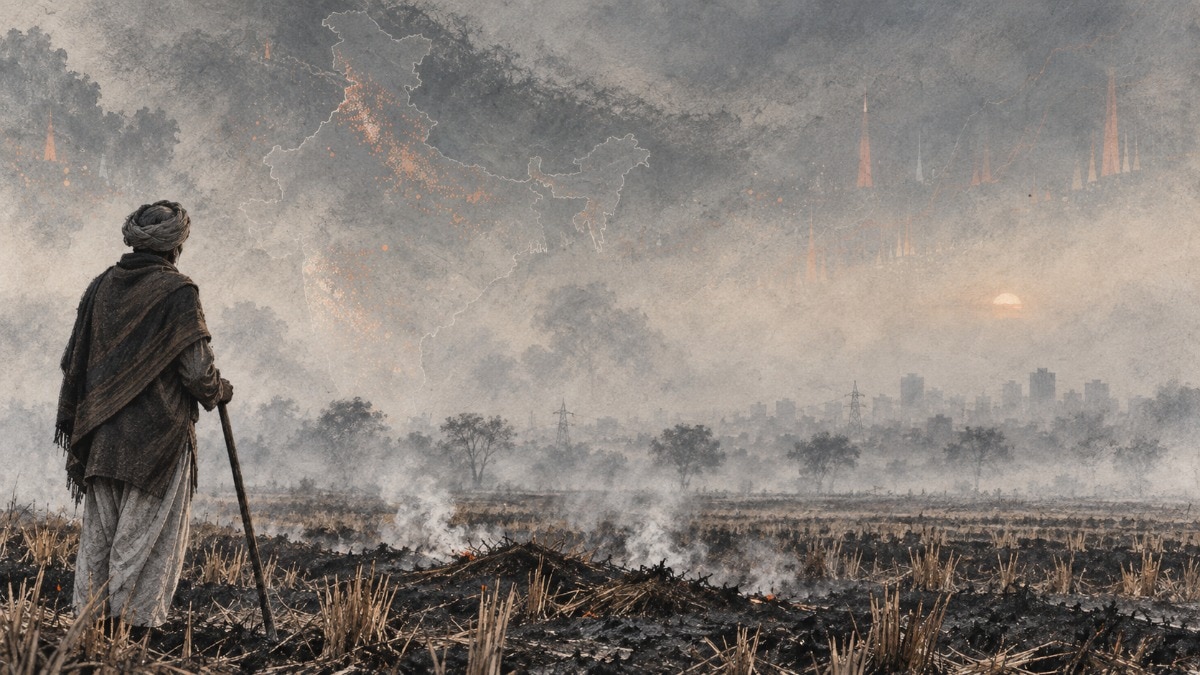
This is the first of a three-part story. Everyone talks about the autumn stubble burning that's allegedly responsible for Delhi's bad air. But the spring burning that nobody mentions is usually twice as big.Harvesters will move into Punjab's paddy fields this week. Within a month, the air over Delhi will thicken with particulate matter. AQI readings will cross 400. And the capital will spend eight weeks blaming Punjab.Punjab votes by early 2027. And in its run-up, this alleged cause and effect will be discussed — loudly, and mostly without numbers.But here’s what northern India looked like on November 11 last year. A grey smudge the length of the Indo-Gangetic plain, from Lahore through Amritsar and Delhi to Lucknow and Patna, pinned against the Himalayas by the shallow, still air that follows monsoons. From that height, smoke and fog are the same colour.What is unmistakable is that it stops at no border and no state line. So, before the argument starts, this is what India's burning actually looks like. Satellites mapped 53 lakh hectares of India as burnt in 2025. That’s about 53,000 square kilometres, a third more than the area of Kerala. That is not one phenomenon; it is three. In different states, in different months, for different reasons.Between March and May, India burned 32.7 lakh hectares, nearly two-thirds of the year's total. The October–November season that dominates the news covered 15.1 lakh hectares. The spring fires were larger. They are also almost invisible in the national conversation, because their smoke does not sit over the capital.Three states account for most of it, and each burns for its own reason.Punjab burns rice stubble in the fortnight after the paddy harvest in the autumn, and wheat residue again in spring. Its fires are small, dense and almost entirely agricultural: a field cleared in a day, so the next crop can go in.Madhya Pradesh now burns a comparable area, across a longer window and a far larger state. Its fire count has climbed every season since 2021 while Punjab's has collapsed. It attracts almost no political attention, and it sits hundreds of kilometres too far south for its smoke to reach Delhi in autumn.Mizoram is not a stubble story. Its burning is jhum, the shifting cultivation of the northeastern hills, where a forest patch is cleared and burnt before planting. It is over almost as soon as it begins: 99 per cent of Mizoram's burning for 2025 was by mid-March.Three lines, three shapes. Mizoram goes vertical in March and stops. Madhya Pradesh climbs twice. Punjab is flat until April, then near-vertical through late October and November, the weeks the capital notices.None of this is an argument about Delhi's air, and that is the point. Crop residue is one contributor among several. The Central Pollution Control Board's own estimates reportedly put it at 3.5 per cent of Delhi's PM2.5 from October to December 2025, down from 13 per cent in 2021.But a seasonal average buries the days that matter. Over October and November, the Centre for Science and Environment put the worst day near 22 per cent. Stubble is a small part of Delhi's winter air most days and a large part of it on a few, and almost the whole argument lives in that gap.What is not in dispute is that the burning is real, it is measurable, and it is changing, in ways that fit neither side's story.- EndsPublished By: Pathikrit SanyalPublished On: Sep 10, 2026 19:28 IST
When India burns: Spring versus autumn
Full Article
Original Source
Read the full article at Indiatoday →KhanList aggregates and links to publicly available news content. We do not host full articles from third-party sources. Always verify important information with original sources.