
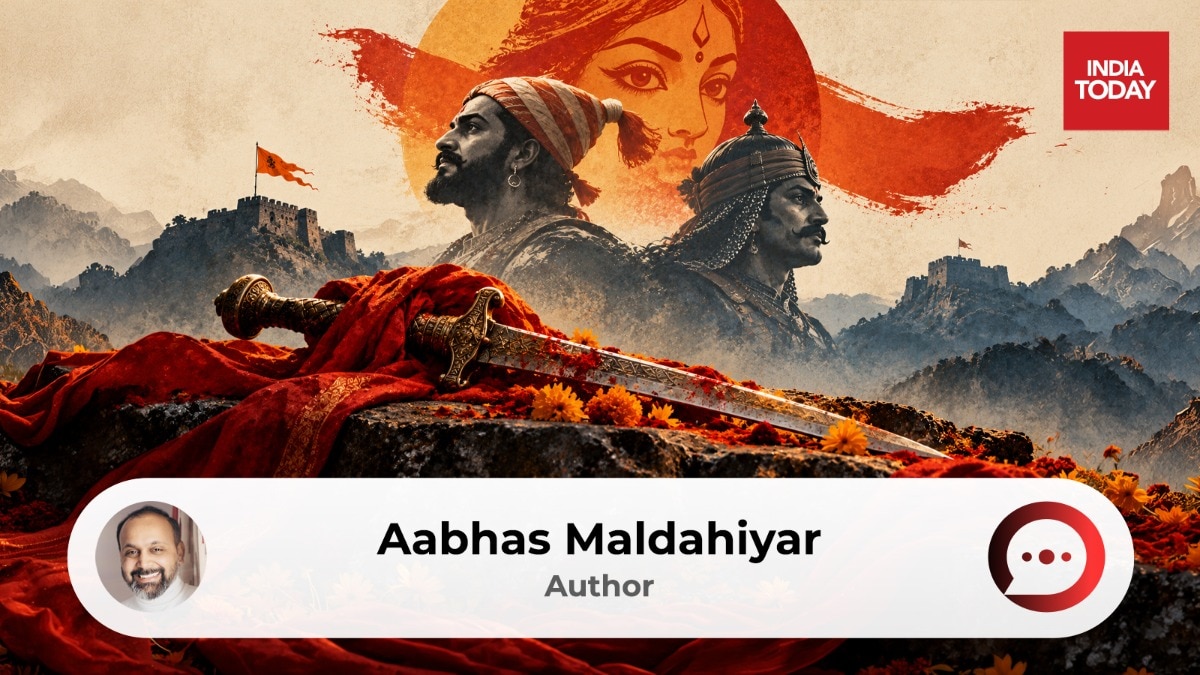
When the drums of Dussehra sounded, the warrior knew that the season of waiting was over.The monsoon had withdrawn. The roads were opening, the horses were being readied, and the armouries were stirring. Across the Maratha Swarajya, forts that had watched the rains roll past were preparing for another season of war. But before the army marched, before the sword left its sheath, there was the Goddess.Bhawani.The Mother, whose Shakti gave courage to the fearful, fury to the warrior and purpose to the sword. During Navaratri, she was worshipped; on Vijayadashami, weapons were honoured and the campaigning season began. For the Marathas, this was more than a ritual marking the end of the rains. It was a meeting of faith and duty, of the sacred and the martial, of the Goddess and the cause of Swarajya. The warrior bowed before Bhawani. Then he rose to fight.BHAWANI AND THE SWORD OF SWARAJYANo figure stands more powerfully at the intersection of Maratha martial tradition and the worship of Shakti than Chhatrapati Shivaji Maharaj. The tradition of Shivaji receiving a sword from the Goddess Bhawani has endured for centuries. The weapon, popularly known as the Bhawani Talwar, became an emblem of divine protection, courage and the struggle for Swarajya. In this tradition, the sword was not simply an instrument of war. It represented a sacred responsibility: power must be wielded in defence of a cause greater than the man who carried it.One of the earliest Marathi accounts of Shivaji's life, the Sabhasad Bakhar, written by Krishnaji Anant Sabhasad in the late 17th century, describes the Goddess Bhawani as a source of divine strength for the Maratha ruler. According to the account, Bhawani entered Shivaji's body as he prepared to confront Mughal general Shaista Khan, giving him the courage and strength to face his adversary.Another account appears in Paramananda's Sivabharata, composed during Shivaji's lifetime. The Goddess is described as promising to reside in Shivaji's sword before entering the weapon herself. However, the earliest explicit reference to the Bhawani sword is found in Hari Kavi's Sambhuraja 1685. In verses 126-128, the poet describes the Goddess's sword in the hands of Shivaji's son, Sambhaji.The distinction does not diminish the tradition's cultural force. It allows us to understand it more clearly. Bhawani became inseparable from the memory of Shivaji and Marathas because the Goddess expressed the spiritual conviction behind his struggle. The sword became her emblem, and the warrior her servant.DUSSEHRA: WHEN THE MARATHA ARMIES MARCHEDThe connection between Dussehra and military campaigning is directly described in Sabhasad's account of Shivaji’s military organisation.According to the Sabhasad Bakhar, translated by historian Surendranath Sen in his 1920 work Siva Chhatrapati, Shivaji's army generally remained in its home territories during the monsoon, when heavy rains made movement and supplies difficult. Once Dasara was over, the Maratha forces set out on military campaigns, often spending around eight months away from their home territories before returning.This is among the clearest historical testimonies to the place of Dasara in the Maratha military calendar.The practical reasons were obvious. Horses needed fodder; soldiers needed grain; supplies had to reach distant forts and camps. The monsoon made movement arduous, while its retreat opened the roads and made sustained campaigning easier. Shivaji’s forces were organised around the realities of terrain, weather and logistics.Yet Dussehra was not experienced just as a convenient date for military mobilisation. It was the festival at which the warrior sought the Mother Goddess’ blessing before entering danger. The seasonal rhythm of war was joined to the religious calendar.Imagine the departure: the rains behind, the road ahead, the fort receding into the distance. A soldier might not know whether he would return before the next monsoon. The worship of Bhawani gave that uncertainty a language of courage. The sword was honoured because it might be needed; the Goddess was invoked because the hand that wielded it could falter.The army marched after Dasara as the faith that accompanied it had been renewed during Navaratri.SHASTRA PUJA: THE RAJPUT KHANDAThe Rajput tradition offers a striking parallel, though its weapon must be distinguished from the Maratha Bhawani Talwar.The khanda, a broad, straight, double-edged sword, held an important place in Rajput martial traditions. British historian James Tod, in his Annals and Antiquities of Rajasthan, describes how the rulers of Mewar worshipped the royal sword during Dussehra. According to Tod, the sword was brought out of the ayudhashala, or armoury, for ceremonial worship. The rituals also involved buffalo sacrifices, in which the Rana of Mewar himself participated. The observances included buffalo sacrifices, in which the Rana himself participated.The Khanda was not simply an ornament of royal ceremony. It represented the power and obligation of kingship: to defend the land, protect the ruling house and resist those who threatened the kingdom. Before the weapon could be carried into battle, it was honoured before the sacred.In the Rajput imagination, the sword and the warrior were bound by duty. Its worship on Dussehra gave that duty a religious expression.The Maratha tradition of Bhawani and the Rajput tradition of the Khanda were identical. One became closely associated with Shivaji and the Goddess, who symbolised his struggle; the other was embedded in the royal martial observances of Mewar. Both reveal the importance of Shastra Puja and Mother Goddess in a culture where the weapon was understood way more than a tool.DEWAIR: THE FIRE OF MEWARIn 1582, Maharana Pratap's resistance to the Timurid Grkniyn Empire reached a decisive phase at Dewair. After years of struggle, Rajput forces struck at the imperial military presence in Mewar. The campaign, in which Amar Singh also played an important role, became a symbol of the kingdom’s refusal to accept subordination.Dewair is often linked in historical accounts to the autumn campaigning season and Vijayadashami. The episode belongs to the larger history of Mewar's resistance: a kingdom battered by conflict, yet unwilling to surrender its sovereignty.The memory of Pratap’s struggle sits naturally beside the martial meaning of Dussehra. The Goddess’s blessing was not a promise that victory would come easily. It was an invocation of the courage required to continue when defeat seemed possible.THE SWORD MUST TASTE BLOODA martial maxim associated with warrior traditions declares that a sword drawn from its scabbard must taste blood, preferably that of the enemy. In its most severe form, the saying warns that a warrior who fails in his duty may have to turn the blade upon himself.The precise wording is not established as a universal rule followed by all Rajput or Maratha warriors. Its force lies in the ideal it expresses. To draw the sword was to accept the consequences of its use. It was not a gesture for display or a threat made without commitment.For the Maratha, the sword was bound to Swarajya. For the Rajput, it was bound to the defence of the kingdom and the honour of the house. Both traditions demanded resolve from the man who took up arms.Shastra Puja, then, was not a celebration of violence for its own sake. It was a reminder of the gravity of the weapon. The sword was worshipped before it was used because battle demanded a commitment that could not be withdrawn without consequence.THE WOMEN WHO CARRIED THE BURDENThe martial traditions of Rajasthan also preserve brief, harrowing stories of women whose sacrifices became emblems of resolve.Hadi Rani, in a celebrated Rajasthan tradition, is said to have sent her severed head to her husband, Rawat Ratan Singh Chundawat, before he departed for battle. The story, preserved in Rajasthan’s heritage tradition, is not securely established as contemporary history. Its terrible power lies in the ideal it depicts: honour demanding a sacrifice beyond imagination.Panna Dhai is remembered for saving the young Udai Singh by concealing him and sacrificing her own son in his place. In the traditional account, her deed preserved the future ruler of Mewar.The Rajput tradition of jauhar, associated with desperate sieges and the fear of captivity, speaks to the same brutal world. The siege of Chittor in 1303, 1535 and 1567-68 are historically attested, where Saka through Jauhar and Kesari became the benchmark of sacrifice for Dharma.Although these tales are not the centre of Navaratri or Dussehra. They are reminders of what martial duty could demand from the people left behind. The warrior rode into danger, but the families who waited at home bore their own share of fear and loss.WHEN BHAWANI CALLED THE WARRIOREmpires arrived with armies, cannons and proclamations of conquest. India answered, time and again, with something they could neither capture nor command: the fierce, unyielding power of the Mother.From the Rajput strongholds of Mewar to the battlefields of the Marathas, from swords raised in the name of Bhawani to weapons consecrated on Vijayadashami, Shakti was more than a deity to be worshipped. She was the courage to resist, the resolve to endure, and the fire that refused to die even when kingdoms fell.For generations, Navaratri was more than a festival. It was a reckoning. The warrior worshipped his weapons, invoked the Mother, and prepared to ride into battle. The sword was steel, but the resolve behind it was Shakti. Dussehra marked not an escape from the world of conflict, but the moment when devotion stepped onto the battlefield.Centuries later, that spiritual inheritance found a new battlefield under British rule. The Shakta tradition, with its fierce vision of the Mother as power, courage and the destruction of oppression, became a source of inspiration for Indian revolutionaries. Bankim Chandra Chattopadhyay’s Vande Mataram gave the motherland a sacred voice; in nandamah, the image of the Mother became inseparable from the struggle for national regeneration. Revolutionary movements drew strength from this imagery, invoking the Mother not as a symbol of passive suffering, but as a force demanding courage, discipline and sacrifice. For many, the fight for freedom became an act of service to the Motherland.The enemies changed. The centuries have turned. The battlefields shifted from forts and forests to secret societies, prison cells, gallows and the streets of a colonised nation. Yet the image endured: the Mother who gives life, the Mother whose honour must be defended, the Mother whose power awakens the courage to fight.One may debate the precise place of every ritual, invocation and legend in the historical record. But the larger truth is difficult to miss: Devi Maa, as Shakti, became one of the most enduring and powerful emblems of India’s resistance to foreign domination across the ages. She was worshipped before the sword was drawn, invoked when the odds seemed impossible, and remembered when freedom demanded the ultimate sacrifice.A civilisation does not survive centuries of upheaval by steel alone. It survives because something within it refuses to kneel. For countless Indians, that something bore the face of the Mother.And so Navaratri's deepest message reaches beyond the temple and the battlefield alike. Shakti is not just the power to destroy an adversary. She is the courage to confront domination, the strength to endure defeat, and the resolve to rise again. The sword may rust, kingdoms may fall, and empires may vanish. But the Mother’s call, once awakened in a people, can outlive them all.- Ends(Views expressed in the piece are those of the author)
When Devi fought along with Shivaji, Maharana Pratap against mighty enemies
Full Article
Original Source
Read the full article at Indiatoday →KhanList aggregates and links to publicly available news content. We do not host full articles from third-party sources. Always verify important information with original sources.