
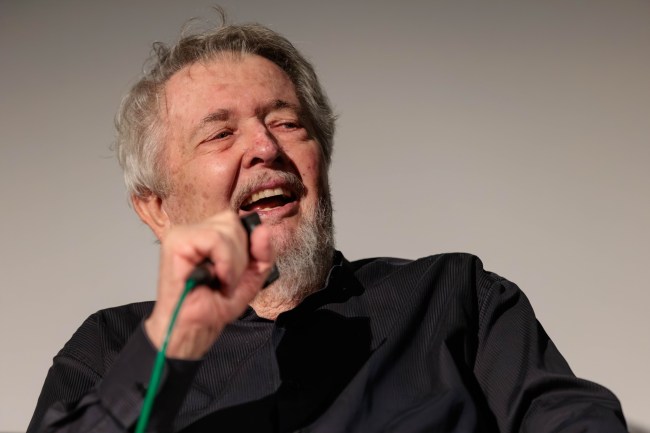
One wouldn’t necessarily think of Clint Eastwood and Eddie Murphy as vying for the same roles, but according to writer-director Walter Hill, the action-comedy classic that made Murphy a movie star began as a vehicle for the man who became famous playing Dirty Harry Callahan. “They wanted me to write it for Clint Eastwood,” Hill said of the screenplay that would ultimately become “48Hrs.” “We met with Mr. Eastwood, and he said he liked the idea, but he had to be the convict, because if he was the cop it was just Dirty Harry, and he was quite right about that.” Hill screened “48Hrs.,” his raucous 1982 buddy movie about a racist cop (Nick Nolte) and a Black convict (Eddie Murphy) who team up to catch a killer (James Remar), at the American Cinematheque for a live edition of IndieWire’s Filmmaker Toolkit podcast. After presenting a gorgeous 35mm print to a packed crowd at the Cinematheque’s “Friend of the Fest” podcast festival, Hill took the stage for a lively discussion of the film‘s convoluted but serendipitous creation. Although losing Clint Eastwood — then one of the biggest movie stars in the world — might not have seemed like good luck at the time, it led Hill to reconfigure “48Hrs.” and turn it into the potent blend of violent action and racially tense comedy it would become. “While I was [writing], [Eastwood] decided to take the Don Siegel movie, ‘Escape From Alcatraz,'” Hill said. “We knew he wasn’t going to play two prisoners in a row, so I wrote it for a Black man to be the prisoner.” Hill wanted Richard Pryor, but the studio wasn’t interested in that idea, and the project lay dormant while Hill went off to make “The Long Riders” and “Southern Comfort.” Ironically, by the time Paramount was ready to resurrect “48Hrs.” Richard Pryor had become a huge star and was no longer available to play a part that was essentially the second lead. With Nick Nolte cast as the white cop, Hill went on a talent hunt for the Black convict after approaching Gregory Hines and finding that the actor couldn’t get out of a Broadway contract in time to make Hill’s start date. At the time, Eddie Murphy was a rising star on “Saturday Night Live” but had never made a movie before. Hill didn’t watch “Saturday Night Live” — “I was usually drunk and asleep by the time it was on,” the director said — but his girlfriend Hildy Gottlieb was Murphy’s agent, and she made sure Hill saw some of the actor’s work. “She gave me a bunch of tapes, and I wasn’t such an idiot that I couldn’t see that the guy had enormous talent. I should say that I was so indebted to the agent that brought Eddie to my attention that we got married, and we’re still married.” ’48Hrs.’©Paramount/Courtesy Everett Collection Because Murphy was an untrained actor, Hill knew he’d rely on his raw talent, and that capturing his best moments on camera would be like catching lightning in a bottle. “I said to Nick, ‘You better be good every take, because the one take where he’s good, we’re going to print it,'” Hill said. Letting Nolte and Murphy improvise a little fit Hill’s ambition for the movie, which was to be a little looser than his more tightly scripted prior films. “I wanted this one to be rough around the edges. I wanted it to move fast.” Hill’s ambition was to combine a kind of gritty reality in the behavior — which he felt was necessary given the tricky depiction of race relations — with a slightly dreamier quality in the visuals, which he achieved with long lenses, split diopters, and, in one case, a spectacularly elaborate long take in which all of the movie’s exposition is laid out in one complicated unbroken shot. “All movies operate in their own special world, and you choose how you want to deliver that special world,” Hill said. “Even the movies that seem to be brutally realistic, they aren’t.” One scene Hill allowed to be slightly heightened — to great comic effect — was the one in which Murphy enters a redneck bar posing as a policeman. Critic Roger Ebert said Murphy became a movie star in that one scene, and Hill recognized he had something special when he was shooting the material. “I looked over to [co-screenwriter] Larry [Gross] and said, ‘We’re rich,'” Hill said of the day he watched Murphy take command in the bar scene. “What I should have said was, ‘The studio’s rich,’ or ‘Eddie’s rich.'” Ironically, the studio Murphy would indeed eventually make very rich — not just on “48Hrs.” but subsequent films like “Trading Places,” “Beverly Hills Cop,” and “Coming to America” — didn’t know what they had when Hill’s rushes started coming in. “One of the executives came out of dailies and said, ‘Walter Hill will never work at Paramount again,'” Hill said. “They didn’t think Eddie was very funny, and they thought that was my fault. We had a couple of knockdown, drag-out fights before they backed off.” Hill says the studio feared racial tension, but he believes that’s one reason the movie has stayed alive 44 years after its release. “Both characters are in their way racist, certainly by the modern definition,” Hill said. “They grow to a mutual respect, but I didn’t want a silly, happy ending. [Murphy] goes back to jail, and Nick is in less-than-perfect condition at the end of the film. I think the reason the movie has consistent interest has to do with the racial tension creating an energy that was unusual in an action movie, and our country is not free of this racial tension to this day. That’s why I think this movie kind of hangs in there.” To hear the entire conversation with Walter Hill and make sure you don’t miss a single episode of Filmmaker Toolkit, subscribe to the podcast on Apple, Spotify, or your favorite podcast platform.
When Clint Eastwood Stepped Away, Eddie Murphy Stepped in and Made ’48HRS’ an Action Comedy Classic
Full Article
Original Source
Read the full article at Indiewire →KhanList aggregates and links to publicly available news content. We do not host full articles from third-party sources. Always verify important information with original sources.