
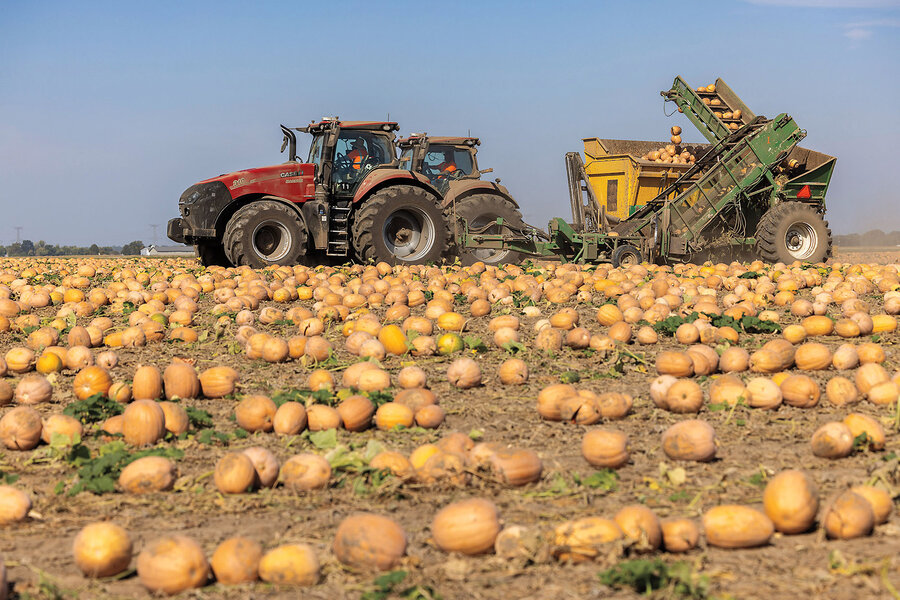
Familiar recipes offer not only a sense of connection but also a form of time travel. Consider pumpkin. It first started appearing as a New World ingredient in English pie recipes in the 1600s. But the basic custard combination of pureed pumpkin, sugar, spices, eggs, and milk appears to have changed little since pumpkin pie appeared in the first American cookbook in 1796. A similar recipe can be found today printed on cans of Libby’s pumpkin in grocery stores.Looking at how ingredients evolve in recipes over time tells us a lot about the people and places where the food was grown and consumed. It can also tell us a lot about the present.So, for Thanksgiving this year, Monitor reporters and editors thought it would be interesting to explore the pumpkin pie, the holiday’s top dessert. (If you take umbrage with that characterization, check out the results of our pie poll on page 24.) We took a closer look at some of the pie’s ingredients – eggs, flour, pumpkin – to discover what stories they might hold. Pie ingredients, it turns out, have a lot to tell us.Economics reporter Laurent Belsie raised his hand to investigate eggs, and found that some people who started keeping chickens when egg prices skyrocketed have become attached to raising their own food. (Even as they become more familiar with the occasional hassles of backyard birds.)Elsewhere, California bureau chief Cindy Carcamo visited a family who was inspired by a pie-shaped piece of land to grow heritage wheat and build a mill to process it into flour – part of a nationwide shift toward local grains. And I took a trip far beyond New England, where European settlers first encountered “pompions,” to the place that produces most of the world’s canned pumpkin today: Illinois. Pies, savory and sweet, have long been at the heart of Anglo-American cooking – an original comfort food, explain culinary historians Kathleen Fitzgerald and Keith Stavely, authors of a new book, “Northern Comfort: The New England Baking Tradition.” The two devote three chapters to pie. Anyone who has made one from scratch – rolling out the dough and adding a delicious filling – knows the pleasure of lingering in a kitchen as the pie’s aroma drifts from the oven.“There’s something beautiful about a well-made, delicious, buttery crust and a beautiful filling. It really is something very comforting,” says Ms. Fitzgerald.Mr. Stavely takes it a step further. Deepen your worldviewwith Monitor Highlights.Politics with respectGet political stories with respectful analysis.There‘s a world of new ideas in everyBooks newsletter.There‘s more to life, enrich yours withCulture & Learning weekly.Follow humanity‘s discoveries withScience & Nature stories in your inbox.Gain a spiritual perspectivefrom the stories in your inbox.Want to understand the deeper impact of critical events? Learn the Monitor‘s insight.Already a subscriber? Log in to hide ads. “When you make a pie, especially one with top crust, you’re making yourself a present. The crust is the decorated box ... and then you open it up, and there’s this gift, this treasure inside,” he says.We hope that as you find time this holiday week to pause and reflect, you’ll learn something new – and find something pleasurable – as you open up this magazine. Perhaps you’ll even be inspired to bake a pie to share. ALREADY A SUBSCRIBER? LoginReal news can be honest, hopeful, credible, constructive.The Christian Science Monitor was founded in 1908 to lift the standard of journalism and uplift humanity. We aim to “speak the truth in love.” Our goal is not to tell you what to think, but to give you the essential knowledge and understanding to come to your own intelligent conclusions. Join us in this mission by subscribing.
What’s in the Thanksgiving pie? A lot of stories.
Full Article
Original Source
Read the full article at Csmonitor →KhanList aggregates and links to publicly available news content. We do not host full articles from third-party sources. Always verify important information with original sources.