
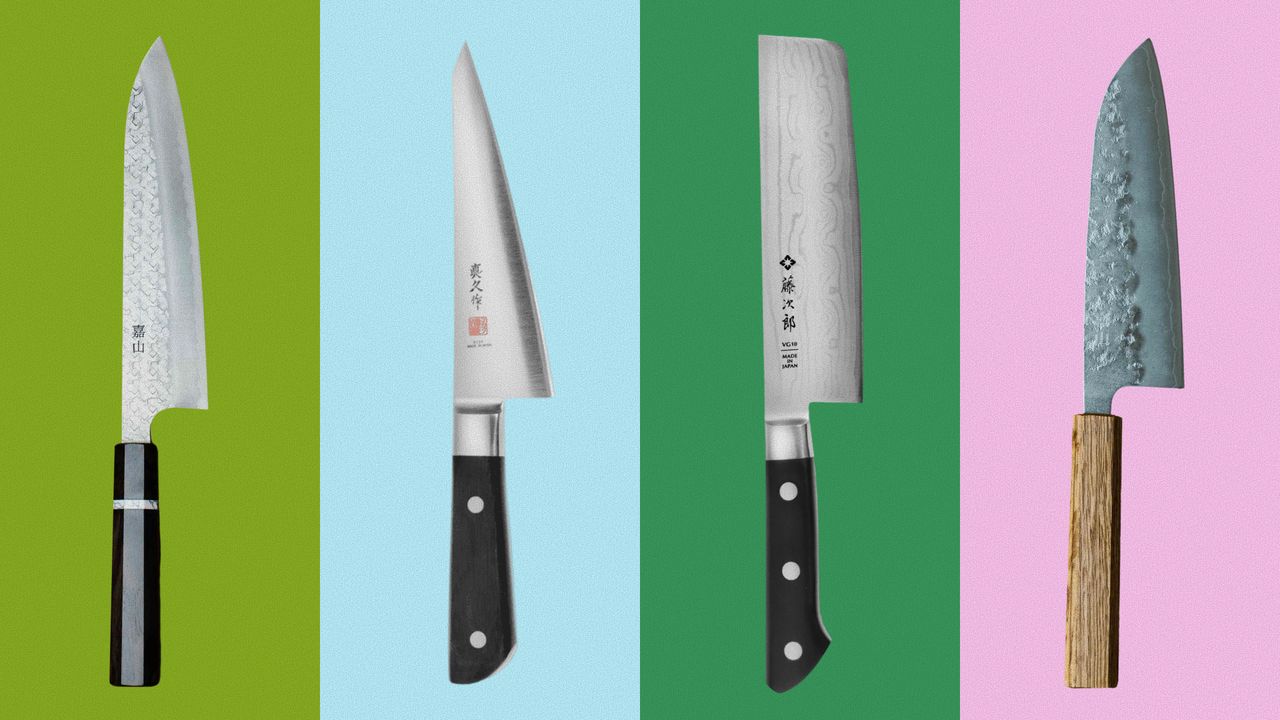
The popularity of Japanese knives in home and commercial kitchens has exploded in the last few years, and for good reason: A lot of them outperform their Western counterparts in kitchen tests. Western-style knives are bulkier, all-purpose kitchen tools—years ago, it would be common for many chefs to use the heavy bolster near the heel of the blade to crack open a can of tomatoes during service. Japanese knives (and Japanese-style knives produced by manufacturers elsewhere) are designed with precision cuts in mind and usually have a specific purpose. However, because they’re designed with that specificity in mind, it can be tricky to know what you need and what you’ll use.Japanese knives we'll cover hereGyutoSantokuNakiriDebaPettyFunayukiKiritsukeHonesukiThankfully, we’ve reviewed a wide variety of Japanese-style knives for Bon Appétit and have assembled a round-up to help you identify exactly what your kitchen needs. While there are more styles of Japanese knives than those listed here, these options have all been thoroughly tested, giving us the confidence to speak to each knife’s utility. Before we jump into specific styles, however, it’s useful to give a quick rundown on some of the broad strokes of what makes a Japanese-style knife unique.Many Japanese knives are designed for push cuts or pull-through slicing rather than the rocking chop of a heavy, Western chef’s knife. They tend to have a straighter edge than their Western counterparts, making them slightly less adept at speeding through a mince of herbs, but more precise in their cuts. Most Japanese-style knives also feature a sheep’s foot tip that curves down to the point, giving the user more control over fine-point work.Japanese knives are often made with a harder steel than their Western counterparts. Harder steel helps a knife’s edge retain sharpness, which lets manufacturers use steeper sharpening angles for a finer edge. This helps most Japanese knives slice more delicately than Western knives, though harder steel can chip on material like ice or bone.Traditional Japanese-style knives are only sharpened on one side, giving them a much finer edge than the 50/50 bevel of Western-style knives that are sharpened on both sides. Some modern Japanese knife makers have pivoted to a 50/50 style bevel for ease of sharpening; however, when you’re shopping, you’ll encounter plenty of knives with 70/30 bevel with the inside edge (the left edge for a right-handed knife) sharpened at a steeper angle. A 70/30 bevel is easier to maintain than a single-bevel but offers a sharper edge than a 50/50 bevel.Many traditional Japanese kitchen knives feature a wa-style handle—an octagonal wood handle that envelops a hidden knife tang (the metal part of the knife that connects to the handle). Wa-style handles help keep knives lighter and nimbler, while many Western-style knives use full-tang construction, adding weight and heft to the blade. Many modern Japanese knifemakers, though, combine full-tang knife handles with Japanese blade shapes to create a hybrid style knife that’s both durable and adept at slicing.The types of Japanese KnivesGyutoMacProfessional Series Chef's KnifeAkira SakuKazan Arare SG2The gyuto, or Japanese chef’s knife, originated in Japan in the early 1900s, when French cooking began to gain popularity in a rapidly modernizing country. This knife style took cues from the traditional French chef’s knife and combined them with elements of traditional Japanese knife-making. The resulting Japanese take on a chef’s knife was primarily designed for slicing meat, though it also features a curved edge that makes it easy to chop herbs. Compared to a Western chef’s knife, the gyuto has a straighter blade and a drop point tip with a lower overall profile. This is primarily designed so that the user can place the knife's tip on the cutting board and draw it through food, taking advantage of the gyuto’s sharp edge and thin blade for precision slicing. But while the gyuto excels at slicing meat, its general shape makes it an overall great pick to anchor your knife collection, and many home cooks opt for a gyuto as their daily driver over a traditional chef’s knife.We’ve long been fans of the gyuto fan here at Bon Appétit, with MAC’s Professional Hollow Ground Chef’s Knife topping our chef’s knife review for years. For a wicked sharp, more traditional option, we really like the Kazan Arare by Shibata gyuto, which impressed us so much we had to give it its own review.SantokuMacMAC Professional Series SantokuKazanKazan Ginsan Nashiji SantokuIncreasingly common as a part of brands’ knife sets, the santoku knife is a relatively modern knife shape, first appearing in the 1940s or so. Nicknamed the “three virtues” knife, the santoku draws on the gyuto, nakiri, and deba to create a well-rounded utility knife that’s great for cutting meat, fish, and vegetables. Typically, these knives feature a pretty steep sheep’s foot tip for precision point work, a tall heel for push cuts, and just enough curve for pull-through slicing and rock-chopping. A santoku knife is great for well-rounded utility work—think cutting cheese and an apple for a snack, slicing leftover roasted chicken to make a sandwich, or dicing an onion for a curry.Typically, we like a santoku knife that’s between six and seven inches, so it contrasts with the longer gyuto. Our favorite overall model is the MAC Professional Santoku Knife, but if you’d like a razor-sharp version with a traditional wa-style handle, we love the Kazan Ginsan Nashiji Santoku.NakiriTojiro DP Damascus NakiriTojiro Classic Nakiri KnifeNakiri knives have a straight edge and a sturdy spine, specifically designed for chopping vegetables. Sometimes referred to as a “vegetable cleaver,” the nakiri excels at push cuts, making it great for both matchsticking carrots and breaking down tough-skinned squash. Since most gyutos feature thin blades and fine edges, the nakiri also holds a spot in the Japanese knife lineup as a tougher, heavier knife for more demanding tasks. Traditional nakiri knives may also feature a blunt, rounded tip, which can be rotated against the cutting board to create a smooth, chopping motion.The Tojiro DP Damascus Nakiri is by far our overall favorite tested nakiri knife for its extremely sharp edge and overall balance, but it’s also pricey. We also really like the Tojiro Classic nakiri, though it can have stock issues due to its popularity and price point.DebaKAISeki Magoroku Kinju ST Deba KnifeThe deba knife is a traditional Japanese knife designed for fish butchery. Unlike a Western fillet knife, which is designed to be flexible and nimble, the deba is a heavy, sturdy blade with a thick spine that gives the heel of the blade a cleaver-like feel. But a deba knife is also designed for precision slicing, and usually features a traditional single-bevel edge. That single-bevel edge allows the knife to come to a finer point than a double-bevel edge, and the sheep’s foot tip adds to the deba knife’s ability to portion out delicate fish fillets, as well.We haven’t tested deba knives because they require a bit of knowledge and skill to use them for breaking down whole fish, but if you’re intrigued by the shape and want a cleaver-like knife for your kitchen, the Seki Mago Roku Deba from Kai is an affordable, solid option. Otherwise, we think most people would be better served looking to a nakiri or santoku knife.PettyTojiroClassic Petty KnifeMacProfessional Petty KnifeNamed for the French word “petite,” which means small, the petty knife is often a replica of the gyuto, just in a much, much smaller form. Most petty knives are around five inches long and feature a thin, lightly curved blade with a drop point tip and heel just tall enough to keep your fingers from bashing into the cutting board. Petty knives are great utility knives for small tasks, like dicing a shallot, slicing garlic, or slicing herbs, but they’re also long and nimble enough to be great slicers. Unless you do a lot of handheld turning and peeling, a petty knife is a great replacement for a paring knife in your lineup.We found that both the MAC Professional Petty Knife and the Tojiro Classic Petty Knife were sharp enough to slice a steak while still being the perfect size to slice strawberries for your morning yogurt bowl.FunayukiTraditionally a fisherman’s knife used for all sorts of purposes on the boat, the funayuki is an old-school knife shape that predates the gyuto and santoku, and it likely helped inspire both shapes. The traditional funayuki is a shorter knife, around seven inches long, with a narrow, pointed tip and a tall heel. They are santoku-sized but gyuto-shaped. Unlike the deba knife, which was a heavy, single-bevel knife used for fish butchery, the funayuki was designed to be light and nimble so that fishermen could fillet their lunch while at sea. These days, most home cooks might pick up a funayuki as a secondary, shorter gyuto, or opt for this shape over a santoku as an all-purpose utility knife with a narrower tip.Though it’s not as common in modern kitchens, one of our favorite Japanese chefs' knives is the Akiru-Saku Funayuki Gyuto, which is more traditionally shaped like a funayuki but is advertised as a gyuto since the two shapes are so similar.KiritsukeShun Classic Blonde 8" Kiritsuke KnifeThe kiritsuke is a Japanese slicing knife with an angular “sword tip” that allows the user to make precision cuts. The initial design combined a long slicing shape and tall heel, making the kiritsuke a hybrid knife, similar to the santoku. For most people, the kiritsuke will be a version of an all-purpose chef’s knife that could take the place of a gyuto as a daily driver, with the big difference coming in the shape of the tip.When reviewing chef’s knives, we found that the Shun Classic Kiritsuke was a great all-purpose chef’s knife with a unique tip that some people might prefer over a gyuto, since it curves upwards more like a Western chef’s knife and allows for more of a rock chop motion.HonesukiBoning and fillet knives are often unitaskers that don’t see much use unless you’re a fan of home butchery, but the Japanese honesuki is an even more specialized boning knife shape. Designed specifically for poultry, the honesuki is a steep, wedge-shaped knife with a very fine point and a tall heel. The goal is to have a knife that’s delicate enough to slip between a chicken joint while being sturdy enough to cut through cartilage. While the honesuki was designed for a specific purpose, we find that this shape is more versatile and can be swapped in for a petty knife for other small chopping and dicing tasks in ways that a curved fillet knife can’t.We like the MAC Professional Honesuki as a great option that could tackle most boning-knife tasks while remaining sharp and versatile enough for utility work. If you find yourself breaking down a whole chicken while also wanting a strawberry-slicing knife, the honesuki could be a nonconventional multitasker.
What You Need to Know About Japanese Knives
Full Article
Original Source
Read the full article at Bonappetit →KhanList aggregates and links to publicly available news content. We do not host full articles from third-party sources. Always verify important information with original sources.