
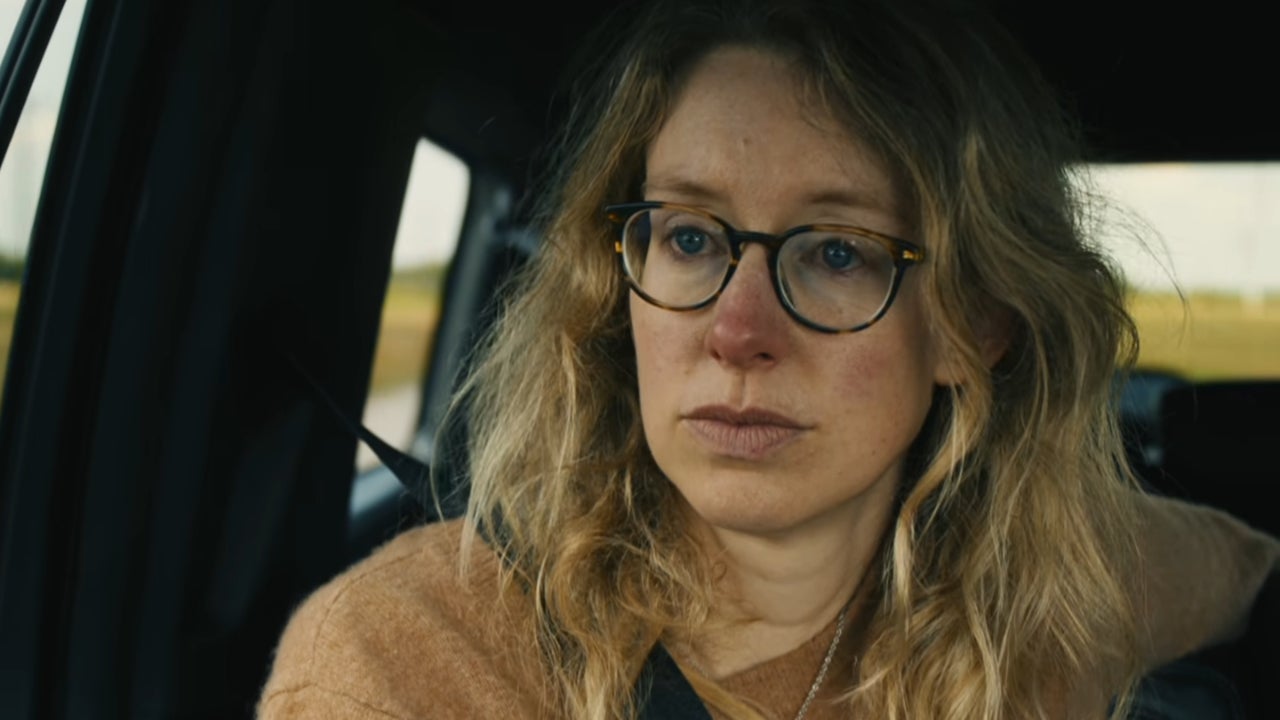
Nathan Fielder and Lance Oppenheim’s bonkers Elizabeth Holmes documentary “You Can See Everything” was the talk of the Telluride Film Festival when it premiered as a secret screening on Sept. 6. It grabbed headlines with two different trailers released since then, causing body-language experts to weigh in on the meaning of Holmes’ unnerving grin and big, unblinking eyes. Before it was even released, it had whipped up more buzz than any other fall movie, with the possible exception of that other wacky two-and-a-half-hour-plus flick with a ginormous twist, “Digger.” But will that mean a damn thing to awards voters this season? As with a lot of questions raised by “You Can See Everything,” the most accurate answer is probably another question: Who the hell knows? The film is deliberately, gloriously confounding, a sort-of documentary in which you can trust neither the subject of the film nor the person telling the story. Elizabeth Holmes is a cipher, Nathan Fielder is a cipher, and the whole thing bobs and weaves and delights in keeping the viewers and maybe even participants questioning everything. And now that the grosses are big, the reviews are raves and the buzz is still buzzy, “You Can See Everything” could conceivably be a contender in lots of different Oscar categories this season. So let’s take a look at them one-by-one. Best Documentary Feature In a way, this would seem to be the obvious place for the film to contend, since Fielder and Oppenheim have quite likely made what will be the top-grossing non-music documentary of this decade. But to do that, it will have to win over the Academy’s Documentary Branch, a notoriously insular group that often looks askance at nonfiction films that aim to entertain. The doc branch has grown enormously over the past decade, and it has gotten more adventurous in its choices. But even more than that, it has gotten more international, with American-made doc nominees being in the minority in five of the last seven years. In addition, the branch has learned through experience that if an entertaining mainstream film is nominated, it will most likely win over darker, more serious and artier fare. The last 15 years have seen “Undefeated” over “Paradise Lost 3,” “Searching for Sugar Man” over “The Gatekeepers,” “20 Feet From Stardom” over “The Act of Killing,” “My Octopus Teacher” over “Collective,” “Summer of Soul” over “Flee,” and the list goes on. Perhaps as a result, the branch seems determined to keep the most entertaining films out of the running, with presumed favorites like “Will & Harper,” “Still: A Michael J. Fox Movie,” “American Symphony,” “Apollo 11,” “Good Night Oppy” and “Won’t You Be My Neighbor?” missing out on nominations in recent years. That could hurt Fielder and Oppenheim’s film, which is leagues more playful than the usual choices of a branch that prefers dark films about international conflict and social issues of real import. (Think: “NAZA,” “Musk,” “14th,” “Black Sunflowers,” etc.) But the other problem, and maybe a bigger one, is that “You Can See Everything” gleefully bends the rules of nonfiction filmmaking in a way that tweaks and criticizes the form itself. We know we can’t really trust Elizabeth Holmes – who, after all, is in prison for lying to Theranos investors about the ability of her blood-testing machine to work. But Fielder and Oppenheim embrace her dishonesty and immerse us in her fanciful world (She’s never told a lie! She doesn’t understand Abbot and Costello!). And then they fool around with re-enactments and other controversial elements of a documentarian’s toolkit. The film is a tease that can’t be trusted, which is par for the course for Fielder. Not only do we not know what to believe about Holmes, we don’t really know what to believe about Fielder, either, whether he’s engaging with his subject, lurking in the shadows or talking about the film at screenings. Did a guy who has been a central presence in all of his work really go into this thinking he wasn’t going to be on camera, only changing his mind when Holmes and her husband Billy Evans kept asking him questions? That’s what he and Oppenheim have said, but it’s a stretch to accept it, particularly since it’s coming from a man who is known for going on late-night talk shows in character. Beyond that, can we really say with any assurance that he isn’t acting when we see him in the film lurking around corners or appearing to fall for Holmes’ unnervingly wide-eyed charm? Is he besotted, or is he acting besotted to up the film’s WTF quotient? It’s worth remembering that when Martin Scorsese made his 2019 film “Rolling Thunder Revue: A Bob Dylan Story by Martin Scorsese,” using real archival footage to tell a wildly fictionalized story, the film was accepted as a doc by many awards bodies – including the Critics Choice Documentary Awards, which nominated it for Most Innovative Documentary, Best Archival Documentary and Best Music Documentary. It was submitted to and accepted by the Academy’s doc branch, but voters resisted its playful charms and its rampant fictionalization, and it didn’t even make the shortlist. It seems likely that something similar could happen with “You Can See Everything,” which has earned five Critics Choice doc nominations but will probably be a tough sell for the branch. Which leads us to … Best Picture History is working against the film here, too. If you look at the three types of films that are eligible for Best Picture but also have their own categories – animated features, international features not in English and documentary features – you’ll find some sobering statistics. Three animated features have been nominated for Best Picture. (“Beauty and the Beast,” “Up” and “Toy Story 3.”) Twenty-two films in languages other than English have been nominated for Best Picture, 12 of those coming in the last eight years. And no documentary has ever been nominated in the top category. In recent years, it’s hard to think of a doc that has even gotten close – but then, it’s hard to think of a high-profile doc like “You Can See Everything.” It’s a case of history vs. singularity: Will the fact that it doesn’t feel like anything else out there mean that Best Picture voters will overcome what seems to be an immediate dismissal of nonfiction films? My guess is that yes, it will. Buzz notwithstanding, “You Can See Everything” isn’t a slam-dunk best-pic nominee. But it’s jaw-dropping enough to stir up real passion, which is a big advantage in Oscar nomination voting, where it’s better to be No. 1 on 5% of the ballots than No. 4 on 50%. Best Supporting Actress I’m not sure how you even talk about this one. From the start, A24 has been begging viewers not to drop any spoilers about the film, foremost among them the identity of an actress who appears in the second half of the film. She is playing a role at times, and maybe playing herself at other times, though it’s possible that’s a performance too. And she does it very well, which has led to her winding up on a number of Oscar prediction lists – where she’s listed as “[REDACTED], ‘You Can See Everything.’” Maybe we have to give this one some time, because the movie needs to be out long enough for [REDACTED] to turn into a real name before the campaign can get any kind of momentum. But when it does, it’s entirely possible that a buzz could build, because it really is one of the most fun performances you’ll see in a theater this side of Julianne Moore in “The Debut.” Let’s just say that yes, this person is a legitimate contender. But to maintain any kind of momentum until voting begins in January, she’s going to need to be talked about. By name.
What Will Oscar Voters Think of That Wacky Elizabeth Holmes Documentary?
Full Article
Original Source
Read the full article at Thewrap →KhanList aggregates and links to publicly available news content. We do not host full articles from third-party sources. Always verify important information with original sources.