
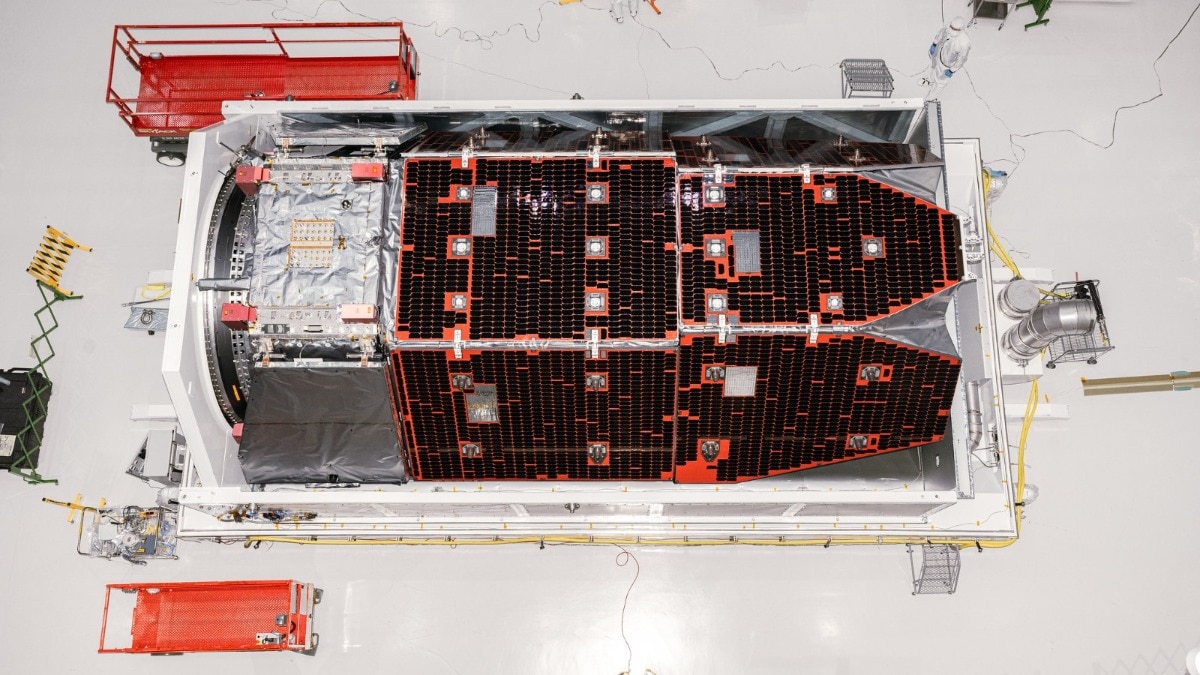
The launch of Nasa's Nancy Grace Roman Space Telescope is drawing closer, with preparations now entering a crucial phase.Nasa teams recently began integrating the observatory with SpaceX hardware at the Kennedy Space Center in Florida, ahead of its planned encapsulation later this month.The Nancy Grace Roman Space Telescope is in final preparations for an early September launch, eight months AHEAD of schedule and UNDER budget.This milestone is the result of more than a decade of dedication and millions of hours of work by NASA and our industry partners. Their pic.twitter.com/dmNglbc93h— NASA Administrator Jared Isaacman (@NASAAdmin) April 21, 202Roman is scheduled to launch on August 30 aboard a SpaceX Falcon Heavy rocket at 4:56 pm IST from Launch Complex 39A.Once in space, the telescope will travel to a region about 1.6 million km from Earth, where it will begin a five-year mission to survey the universe on an enormous scale. A COSMIC SURVEYThe Nancy Grace telescope is designed less like a telescope that spends hours studying one object and more like a cosmic surveyor.Its Wide Field Instrument can capture an area of sky at least 100 times larger than Hubble's, while maintaining comparable sharpness. That combination of a wide view and infrared vision would allow Roman to gather huge amounts of information quickly. A look at the Nancy Grace Roman Telescope at work in Nasa facility. (Photo: Nasa) Nasa expects its five-year primary mission to produce data covering more than a billion galaxies, hundreds of millions of stars and more than 1,00,000 worlds.More specifically, Roman will conduct three major surveys.One will map huge areas of the universe to study how galaxies have formed and how dark matter is distributed.Another will repeatedly photograph the same regions, effectively creating a time-lapse of the changing universe.A third will look towards the crowded centre of the Milky Way, where it will search for planets and other objects using the effect of gravity on starlight. Technicians work on the Nancy Grace Telescope inside Nasa's Space Center in Florida. (Photo: Nasa) FROM DARK ENERGY TO ALIEN WORLDSOne of Roman's most significant goals is to investigate dark energy, the name scientists give to whatever is causing the universe's expansion to speed up.By studying galaxies and cosmic changes across vast distances, Roman will help scientists test ideas about how the universe has evolved.Its observations will also be used to find more than 1,000 exoplanets through gravitational microlensing, including planets that are difficult for other missions to detect. The team of technicians and engineers working on the Nancy Grace Space Telescope. (Photo: Nasa) This technique can reveal worlds far from their stars and even planets that wander through the galaxy without a star.Roman also carries a Coronagraph Instrument, a technology demonstration that will block some of a star's glare to directly image nearby giant planets.The technology could help future missions search for potentially Earth-like worlds. Technicians are seen working on the Nancy Grace Space Telescope. (Photo: Nasa) Nasa's Goddard Space Flight Center is managing the mission, with major contributions from the Jet Propulsion Laboratory, Caltech and the Space Telescope Science Institute.Unlike Hubble and James Webb, Roman's greatest strength will be the breadth of its view, allowing it to repeatedly survey enormous stretches of the sky to build a much bigger picture of how planets, galaxies and the universe change over time.- EndsPublished On: Aug 14, 2026 16:04 IST
What will Nasa's Roman telescope do in space? Observe 100 crore galaxies
Full Article
Original Source
Read the full article at Indiatoday →KhanList aggregates and links to publicly available news content. We do not host full articles from third-party sources. Always verify important information with original sources.