
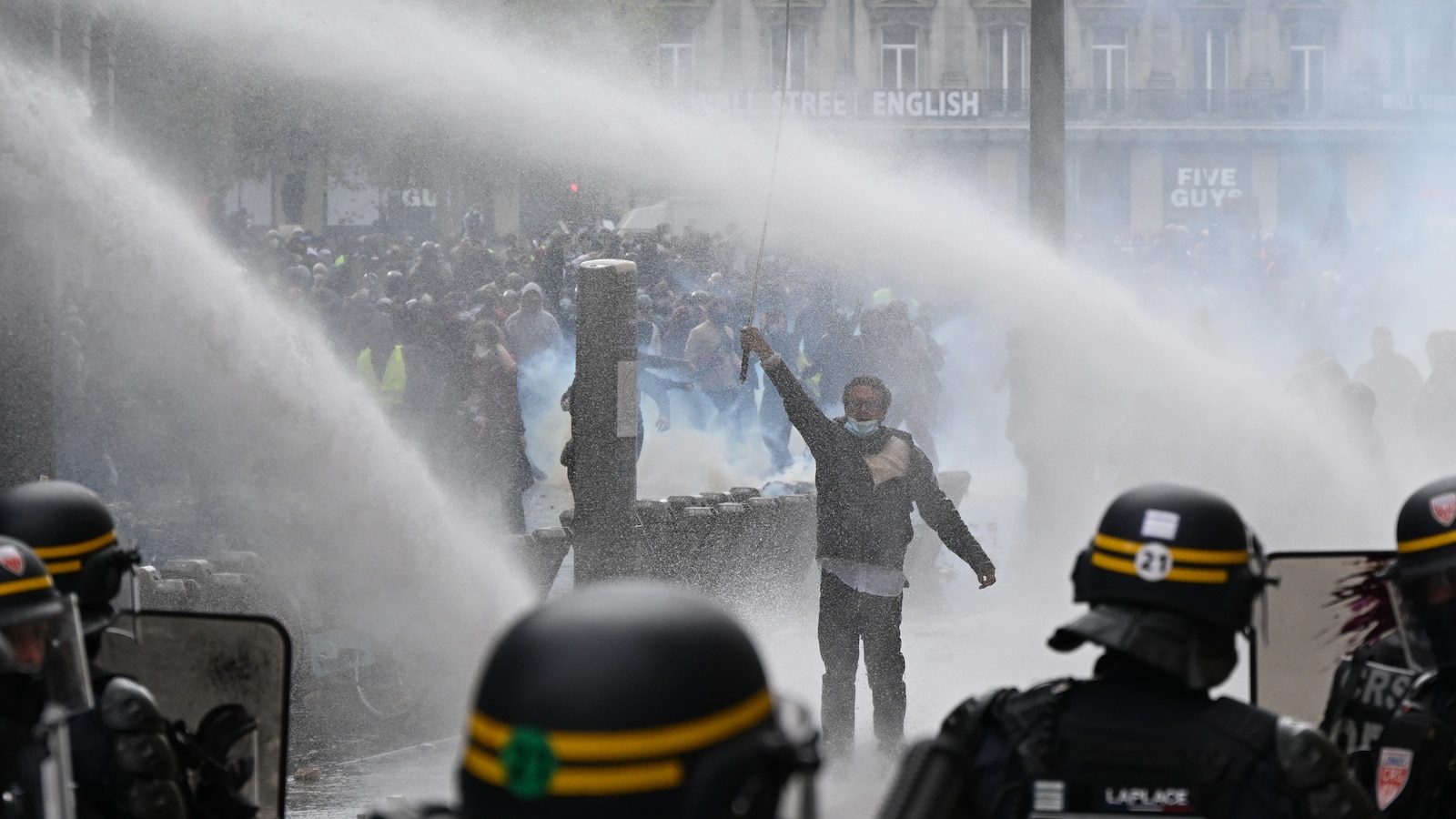
PARIS -- Police across France are under pressure to maintain security during further protests expected in some cities, while facing scrutiny over their riot-control tactics used during previous unrest that left some teenagers seriously injured.Officers have appeared outnumbered and overwhelmed during last weekend's protests against rising living costs and poor conditions in schools. Authorities have announced police reinforcements ahead of further protests expected on Saturday, amid fears of renewed violence.A 17-year-old girl lost an eye while participating in a protest in Mulhouse last Saturday, while a 17-year-old boy lost a hand in Saint-Etienne. Other teenagers have suffered disabling injuries during weeks of high school blockades and street demonstrations.Here’s a look at French police tactics and riot-control weapons.French police forces are equipped with batons, tear gas, sound grenades and foam-round launchers, as well as riot shields equipped with powerful strobe lights designed to disorient protesters. Electric stun guns are prohibited in crowd-control operations.“Intermediate-force weapons are defensive response tools that allow law enforcement officers to respond to a threat in a graduated and proportionate manner,” French National Police said in a statement to The Associated Press.But critics, including families of injured teenagers, say the police have been too heavy-handed.Some have called for bans on foam-round launchers, tear gas and stun grenades, echoing demands made by human rights groups since the violent 2018 “yellow vest” protests.Earlier this month, Amnesty International called for a permanent ban on all stun grenades, saying they are designed to shock, disorient and sow panic, and that some can cause permanent hearing loss and life-changing injuries from blasts and shrapnel.United Nations guidance on what it calls “less-lethal weapons” says kinetic impact projectiles should be used only against an imminent threat, targeting the abdomen and never the head, face or neck. Firing from elevated positions or at close range, or bouncing rounds off the ground, can increase the risk of serious injury.Foam-round launchers, though classified as less-lethal and considered safer than rubber-bullet shotguns, “in certain circumstances, can kill,” said Neil Corney, an arms researcher at the U.K.-based Omega Research Foundation who helped draft the U.N. guidance.Proper training and guidelines can reduce injuries, he said, pointing to Spain, where authorities replaced criticized rubber-bullet shotguns with foam-round launchers following a violent police crackdown on Catalonia’s 2017 independence referendum. Injuries have declined there, he said.Foam-round launchers were initially developed for military training and later adapted for “high-risk, hostage-type situations” and anti-terrorism operations, said Patrick Wilckin, an arms researcher at Amnesty International.“They were never really meant for policing of protests,” he said.Accountability is another concern. Unlike bullets, foam rounds generally leave no traceable evidence. Activists have proposed stamping identification numbers on the rounds to help identify officers involved in incidents that cause serious injuries. Corney said the measure would greatly improve accountability at little cost.The use of such weapons reflects a broader shift in French policing toward keeping officers at a distance from protesters, said Jean-Marie Godard, an author specializing in France’s internal security.Popular ReadsIn the early 2000s, France’s conservative government moved away from community policing, which emphasized foot patrols and engagement with residents, toward specialized riot-control units.People across France’s political spectrum regret abandoning the community policing model, Godard said.French policing today differs from that in many other European countries, according to Laura Keesmann, a sociologist at the University of Antwerp who led a wide-ranging comparative study of policing methods in France, the U.K., the Netherlands and Sweden. In the other countries studied, police often engage directly with demonstrators, sometimes mingling with crowds to defuse tensions, she said.“That is just really, really not the case in France,” she said. “There’s much more of an authoritarian way of policing.”Keesmann stressed, however, that French police face unusually militant and sometimes violent protesters.On the eve of last Saturday’s protests, Interior Minister Laurent Nuñez said his instructions were “very clear: the police and gendarmes should be able to use the entirety of the intermediate weapons at their disposal.”France has more than 250,000 national police officers and gendarmes. Police generally operate in cities, while gendarmes usually cover rural areas and smaller towns. Both forces fall under the Interior Ministry, which said 997 officers and gendarmes were injured during Saturday’s unrest, seven of them seriously.Police said more than 100 protesters and residents were injured in Paris on Saturday. Authorities have not released a nationwide injury tally. About 2,400 people were arrested across France that day.Godard said protest movements have become increasingly decentralized as labor unions have lost influence over demonstrations, drawing a wider range of participants, including radical groups.French authorities have blamed much of the recent violence on far-left radicals, accusing them of orchestrating clashes with police and targeting public buildings. Others took advantage of the unrest to loot businesses, authorities said.___McNeil reported from Brussels. AP journalist John Leicester contributed to the story.
What to know about the weapons and tactics blamed for injuring French protesters
Full Article
Original Source
Read the full article at Abcnews →KhanList aggregates and links to publicly available news content. We do not host full articles from third-party sources. Always verify important information with original sources.