
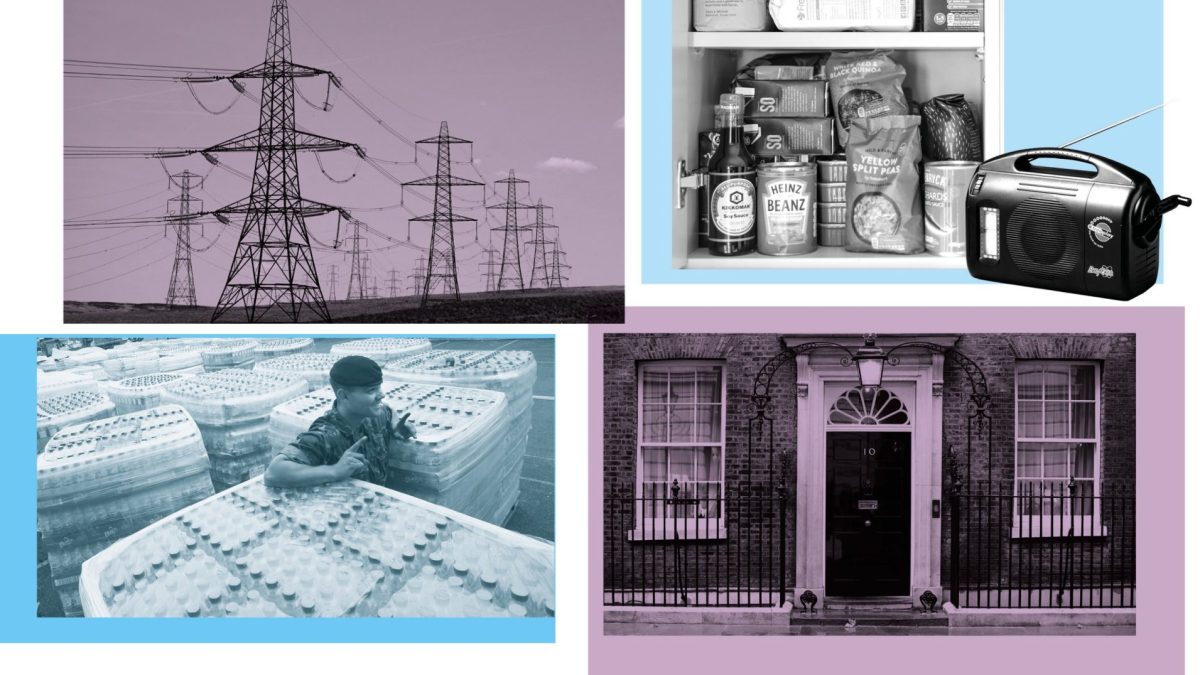
It is a bitterly icy morning in January 2027. Parents are taking their children to school and commuters are travelling to work, all wrapping up warm against the chill. And shortly after 8.30am, Britain’s lights go out. Minutes later, it becomes apparent it is not just the country’s electricity networks that have been cut. In large parts of the country, mobile phone signals also disappear. Water pumping stations grind to a halt, cutting off supplies to homes, hospitals and businesses across Britain, while major train lines are disrupted, leaving passengers stranded on board. At first, the cold weather is suspected as causing the national power cut. But in Whitehall, it soon becomes clear that a widespread and multi-layered cyber attack by a hostile state is wreaking havoc on Britain’s critical national infrastructure. Unfolding is what resilience planners call a “Black Sky” event. The Government’s “Be Ready” messaging – launched months earlier, asking people to stockpile enough bottled water and tinned food for three days – suddenly becomes reality. Here’s what might happen in those days – and what you should do. Day One The first priority in an electricity blackout is food and water. Those who listened to “Be Ready” advice already have enough stockpiled to keep them going through the start of the power cut. The difficulty comes for those who didn’t. Cash machines and card payment devices at supermarket checkouts stop working, forcing ordinary people to rely only on what they have at home. People first need to work out what they need for their households, then find cash to buy essentials from the supermarkets that remain open.Lord Harris of Haringey, the chair of the National Preparedness Commission, said the three-day stockpile advice announced by the Government in October was designed to ensure the authorities could better target vulnerable people in a real emergency. He said: “The more people who are able to do that, the fewer people the authorities and emergency services have to worry about in the event of some crisis, and the advice is essentially designed to be threat neutral.” The first priority in an electricity blackout is food and water (Photo: Getty Images/Moment RF/Pojcheewin Yaprasert) Another necessity is digging out a wind-up or battery-powered radio, which the BBC – as designated emergency broadcaster – will be reachable on. Public information alerts will be broadcast on Radio 2 and Radio 4 via its FM transmitters. In updates from the Government, people are advised to stay at home where they can keep their household together and organise bottled water and food supplies. The message is: “Go in, stay in, stay tuned.” At 4pm, the chief medical officers for each of the UK’s four nations broadcast advice on how to conserve water and food. It says: “Please listen carefully. I am about to provide you with important information. You may want to write this down so that you can refer to it later. This advice will be repeated regularly. “We have planned in case this extraordinary situation happened and this advice has been created by doctors and scientists to help keep you and your family healthy.” People are told to drink at least two litres of fluid a day – or around eight cups – of water, soft and fizzy drinks or even juice from tinned fruit, and that while supplies are limited, water should only be used for drinking, washing hands and preparing food. Inside the doors of No 10 Over in Whitehall, Andy Burnham calls a meeting of the Government’s emergency committee, Cobra. This establishes a hierarchy of command that stretches from central government to local resilience forums that include police, fire service, ambulances, utility companies, local authorities and voluntary groups. If mobile phone signals were not affected, the Government would use its Emergency Alerts system to send messages to all users across the country. But in this scenario, with mobile phone signals down, government officials have to use satellite phones and FM radio transmitters to contact designated civil contingency chiefs across the country. One of the top priorities is to ensure back-up generators are firing into action for essential services such as hospital critical care units, government offices and emergency services, as well as high-security nuclear and defence establishments. These generators typically have enough on-site fuel for 72 hours, so the pressure is on the authorities to restore mains power within three days. Major banking institutions use industrial-grade batteries that take over automatically if there is a mains power cut, under a protocol known as Uninterruptible Power Supply, to ensure the security of trading operations and financial transactions. Water, gas and electricity companies use the Priority Services Register, which lists the most vulnerable water and energy customers, to organise getting emergency supplies such as bottled water and blankets to them within hours. Phil Tonkin, field chief technology officer at cyber security firm Dragos, who was formerly global head of security for the National Grid, told The i Paper: “On the first day of a major disruption, the priority would be maintaining public order and making sure people are kept informed, while essential service providers focus on identifying those who are most vulnerable.” Day Two The second day of the power cut begins with some relief when daylight breaks. Public health advice from the chief medical officers is broadcast to FM radios: “At this point, food that may still be safe to eat even though the fridge is not working includes pre-prepared or packaged salads and sandwiches, and cooked chilled meats, as long as they look and smell normal.” Ensuring people are not without drinking water after 24 hours is now even more important. The Government deploys the army, coordinated by local resilience forums, to help deliver bottled water to remote communities where there are no local shops, and to vulnerable households. Dan Bird, field chief technology officer for cyber security firm Horizon3, who worked on critical infrastructure for the Ministry of Defence for 20 years, said: “It makes sense that all the resources that are available to the government get used in extraordinary and different ways to help serve the nation. The armed forces would be part of that, as well as fire services, local blue light services.” Ambulances and other blue light services will come to the fore in the event of a ‘Black Sky’ event (Photo: NurPhoto via Getty Images) In larger towns and cities, some of the major supermarket chains have backup diesel generators for their biggest stores, allowing them to stay open. The situation leads to long queues at stores, with customers restricted to buying two of each item. Evidence from the nationwide blackout in Spain and Portugal last year, however, suggests that there would not be widespread civil unrest. Tonkin said: “[In the 2025 Iberian blackout] fuel could not be delivered at petrol stations, affecting transport, while backup batteries on mobile phone masts came under greater strain as other communications links failed. “Despite these challenges, civil society remained exactly that, with no reports of looting or public order offences.” Day Three In Whitehall, the government is still working to get the nation’s power back online – as time is running out on the back-up generators supplying power to hospitals and other critical infrastructure. In an ideal scenario, if there was just one dimension to the crisis – such as just electricity supplies being cut – the authorities would be able to restore some power within 24 hours. The National Energy System Operator (NESO), effectively air traffic controllers for Britain’s energy system, has a “Black Start Strategy” which – in the event of a nationwide blackout – aims to restore 60 per cent of the country’s power within 24 hours and 100 per cent within five days. Tonkin said that NESO’s Black Start Strategy was designed to use as much manual operation, with a minimum level of communication and digital technology, as possible, in case all networks including internet and phone were down. Bird said the Government has built-in contingencies, such as having more than one undersea cable for communications and internet, as well as the use of satellites and radio signals. But he added: “Where the challenge comes is the scenario that we in the defence sector call multi-domain attacks. “For instance, if you have a flood, and you have cyber disruption, and you have a social media campaign, psychological operations to agitate people … those things can be very, very hard to understand because there’s so much complexity in that kind of event. The response becomes much more difficult.” In Whitehall, ministers and officials would also be thinking about “what happens next”, Bird said. He added: “What’s the next step in that threat? The government is meeting the terms of the threat in an appropriate way. But if it continues to escalate, what does that look like?” What you can do now This is, of course, a hypothetical scenario – but the level of grey zone and cyber activity has escalated in recent months, raising concerns that a “Black Sky” event could really happen. Bird suggested that, in addition to stockpiling, people should simulate what living under a nationwide blackout would be like for an afternoon. He added: “Switch off all the power in your house and don’t use the loo for an afternoon, just to see how you cope without the simple stuff: washing hands, boiling water, managing without devices, having no communications.” A Government spokesperson said: “The UK has one of the most resilient electricity systems in the world, and there has never been a complete outage in the grid’s 75-year history. They said it had a “robust and agile approach” to risk assessment and added that it regularly updates the UK’s National Risk Register, and that the latest version includes risks to electricity and gas infrastructure.
What to do in the first three days of a catastrophic ‘Black Sky event’
Full Article
Original Source
Read the full article at Inews →KhanList aggregates and links to publicly available news content. We do not host full articles from third-party sources. Always verify important information with original sources.