
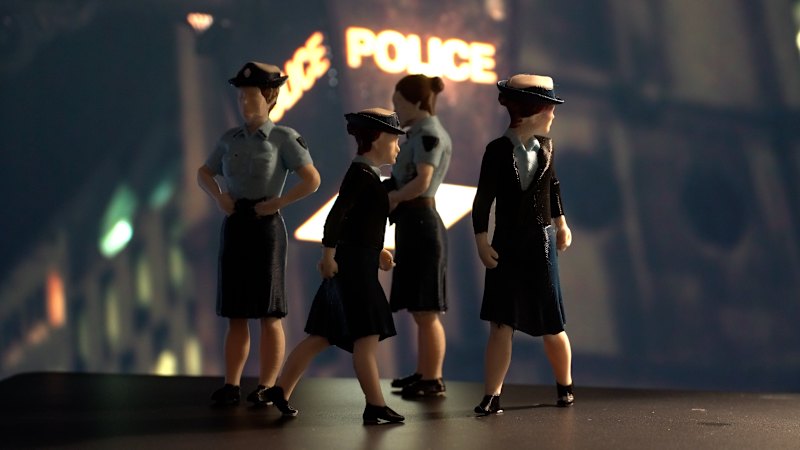
After 27 years as a police officer, the last 15 of them as a detective working some of the highest profile cases in the country, Narelle Fraser hit the wall. “I lost the best career in the world because I ignored the signs of mental illness,” she says.But since she decided to start speaking publicly about the PTSD she suffered – and that she’s convinced many, if not most, of her fellow police endure – she has found a new one. “Completely out of nowhere, I became this accidental mental health advocate.”Fraser’s avocation began around 2017, when she went on the Australian True Crime podcast to talk about her experiences publicly for the first time. It has now stepped up a whole level with the imminent release of the documentary feature, The Policewoman, in which she rakes over the coals of some of those cases and the deep psychological impact they had on her.Narelle Fraser was a police officer for 27 years.Bonsai FilmsDirector Claire Pasvolsky heard the podcast while she was doing the dishes at home in Newtown, and was instantly captivated. “She’s such a compelling storyteller,” she says of Fraser. “Narelle was putting herself into the position in her story as if it’s happening now, as herself, as the victim, even the perpetrator and the families. I don’t think I’d ever come across a better storyteller, and I started immediately seeing images in my mind.”When the episode reappeared on her feed a few months later, Pasvolsky took it as a sign. She reached out to Fraser, asking if she might be open to a chat. A month later, the pair was having coffee in Melbourne, bonding, and taking the first steps on what would ultimately be an eight-year journey to the screen.Along the way, Pasvolsky has made another documentary and a feature film, and written a PhD on the representation of stalkers in popular culture (“it was inspired by Narelle”, she says). It’s not that people weren’t interested, more that what they were interested in was not the story Pasvolsky and Fraser wanted to tell.A US broadcaster saw enormous potential for a true crime procedural series based on the cases Fraser had worked, among them the Maria Korp murder and the case of “Mornington Monster” John Myles Sharpe, who killed his pregnant wife and their 20-month-old daughter with a speargun. What they didn’t want was a focus on the toll of working those cases.“The feedback was, ‘oh, that’s a bit of a downer, we don’t really want that’,” Pasvolsky says.There was local interest too, but again along much the same lines. To make the film they wanted, Pasvolsky had to largely self-fund it. She also had to rope in her entire family, too. Husband Steve shot much of it, produced and edited, using a $350 3D printer; 15-year-old son Teddy made the small dolls used for most of the recreations, painting them by hand. A scene in which Fraser was talking while driving was shot by Felix, who is 14, from the back seat; 17-year-old Luca, who wrote his first screenplay aged 11, helped out with the re-enactments.The miniatures in the film were created by the director’s son Teddy, who was 14 at the time.Bonsai FilmsThe result is a film that is inventive, harrowing, and searingly honest. And in the handful of Q&A screenings around the country ahead of its national release on Thursday, it has struck a chord.Serving and former officers alike have reached out to Fraser, all around the country, in a volume that has taken her entirely by surprise.“To be honest, I actually can’t keep up,” says Fraser. “The responses are 99.999 per cent positive. It’s hitting the note that I wanted to hit.”Fraser talks in the film about the moment she snapped. A young woman came into the station on a Friday night to report that she’d been sexually assaulted, and the detective’s well of empathy had simply run dry.“I just remember thinking I couldn’t give a f---, and that’s not like me,” she says. “I didn’t want to hear it. I could not listen to one more person telling me about being sexually assaulted or just anything. I couldn’t deal with it. And that’s when I realised … I better go and see someone.”On Monday, she went to see a psychologist, who told her she was ill and needed time off. She resisted, but ultimately accepted something had to change. “And I never set foot inside a police station again.”Pasvolsky has made two more films and written a PhD since starting on The Policewoman.George ChanFraser bears no ill will towards the career she chose. In fact, she says in the movie that if a friend’s child came to her, saying they were thinking of joining, she’d thoroughly endorse that choice. But more needs to happen at the management level to acknowledge that trauma is commonplace, and people need to be supported through it.“It’s getting better, but boy have we got a long way to go,” she says of management’s approach to trauma in the emergency services. “It’s an issue they don’t know how to deal with.”In Fraser’s view, a first responder experiencing PTSD is not an aberration, “it’s inevitable because we deal with traumas every day”. And her experience tells her that bottling it up is no way to cope.“For 27 years, I kept that secret,” she says. “Now it’s almost like the lid is off, and I want the world to know the true psychological impact that policing can have.“I want to educate people about the signs to look out for, and to do something about them, not bury their heads in the sand like I did.”The Policewoman is in cinemas nationally from Thursday. Details: bonsaifilms.com.auMust-see movies, interviews and all the latest from the world of film delivered to your inbox. Sign up for our Screening Room newsletter.
What this woman saw in 27 years of policing completely broke her
Full Article
Original Source
Read the full article at Smh →KhanList aggregates and links to publicly available news content. We do not host full articles from third-party sources. Always verify important information with original sources.