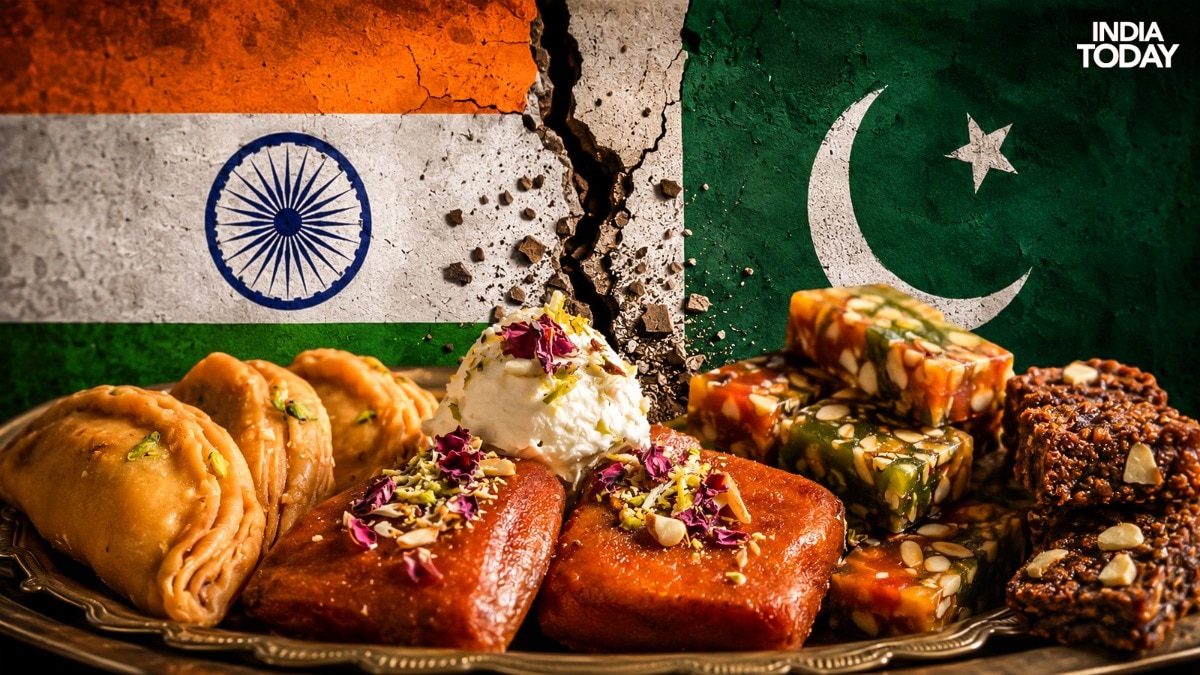
Welcome to the tales of Partition that are served as mithais today. From refugee-camp improvisations to recipes carried across the border, scroll down and find out the Partition stories hiding inside India's sweets.Some sweets were born out of Partition, while others travelled and crossed borders with families (Photo: Getty, Pexels)Quick question: Did you know Dal Makhani has an India-Pakistan Partition connection?The founder of Delhi's iconic Moti Mahal, Kundan Lal Gujral, is credited with the dish. He migrated to India after Partition, carrying his culinary skills and recipes with him and giving them a new life here.Now, this is just one dish. Partition has a plethora of such recipes, including several mithais too.Much like Moti Mahal, Delhi is custodian to more decades-old shops like Chaina Ram Sindhi Halwai that hold recipes from that time. The Dodha (or Doda) Barfi that feels unique in your mithai ka dabba was brought by Partition. There are many more — some famous, some barely remembered. There are multiple old shops across India that still simmer the aroma of sweets that came with Partition or became popular after it (Photo: Ayushi Srivastava) The week leading up to Independence Day has a different kind of ring to it. Social media is filled with black-and-white images of people, headlines attempt to trace the history of everything (like this one!), and people remembering anecdotes from the past, teary-eyed, about what was lost, what was gained and what was preserved.Carrying the sentiment, we decided to look back at a few sweet crumbs of the past – sweets that migrated, mutated and adapted to the displacement. Read on, you might recognise a few. The rest might just surprise you.Here's the interesting part. Some dishes were born in refugee camps, while some sweets travelled through family kitchens and eventually found their way into big and small halwai shops.Story of refugee camps: Bread Halwa and ChuriNow, these are what you can lightly call the classic case of jugaad — when you innovate and make do with the bare minimum you have.Let's start with the popular one that somehow faded away — Bread Halwa.Refugees lived on strict rations of bread, sugar and milk. For many, bread was pretty unfamiliar. So, with limited groceries, they began improvising — crushing or frying bread, adding sugar and ghee, and turning it into a sweet. While bread halwa is a simple, delicious sweet, it evokes memories of sorrow for some people It became common in areas like Amar Colony, Lajpat Nagar and Tilak Nagar.“It was common in schools, especially tented schools where the refugee kids went. Much of it is documented as oral history. It was probably served like a midday meal in schools,” Samira Dewan Suri, food historian and cultural researcher, tells India Today.“The tradition continued in refugee settlements and schools, eventually becoming commercial. But as people prospered, more varieties came in, bread halwa was increasingly seen as a ‘poor man's dessert’ and slowly faded out,” Suri adds.Then comes Churi, or Choori, which also has a similar story of ingenuity born from scarcity.More than 10 camp survivors shared memories with Suri of mothers saving rationed sugar and stale rotis and making a Sunday-special meal. “They would heat and crumble the roti, sprinkle sugar, use Dalda because there was no desi ghee, and then chura-chura karte the with their hands,” Suri explains.Quite an idea to use leftover rotis, BTW.Fading tradition of Rau di KheerIt's not the regular milk kheer but the one where sugarcane does the sweet talking. Rau means sugarcane and this dish gets its sweetness straight from sugarcane juice, which is cooked with rice until it turns thick, glossy and naturally caramel-like.Rau di Kheer, a seasonal dessert made with sugarcane juice and rice, was once a familiar Punjabi treat — something Suri still savours when she goes back to her home in Kapurthala. However, she believes the recipe may die as there is no one to carry it forward.Alongside it, Gurwale Chaaul (Jaggery rice), made with fresh jaggery, belonged to a time when sugarcane, rice and fresh gur were easily available in the rural landscape. Partition took that abundance away for many families who moved to urban refugee settlements, and these labour-intensive recipes slowly slipped from everyday kitchens.Yet, in pockets of Punjab, their memory and aroma still finds you.How Tosha, Dodha Barfi and others crossed the borderDodha Barfi came from Sargodha, while Tosha travelled from Pakpattan, now in Pakistan.The former was actually made for wrestlers by a wrestler. “I think 1912 or something, Lala Hans Raj actually made Dodha for wrestlers. It started from there. Then his family migrated to India post-Partition,” Suri recalls.Why for wrestlers? Dodha Barfi is rich in fat, and is slowly boiled has the nutrients of dry fruits, milk boiled slowly, making it the kind of dense, energy-packed sweet wrestlers of the time could enjoy.She further shares how this dark, caramelised barfi was not in India earlier but now is. “The Om Sweets in Gurgaon also have a link to Partition, and they actually gave new lease to this dish.” Dodha barfi came to India from Sargodha (Photo: Pexels) Coming to Tosha, it's much like a cousin of gulab jamun. Only smaller.Tosha is associated with a place called Pakpattan in Pakistan, and Chef Amninder Sandhu, founder of Kikli, finds this story rather fascinating.Before Partition, Lala Munshi Ram ran a confectionery business in Pakpattan. In 1947, he migrated to Fazilka with his five sons, carrying the business — and its sweet legacy — with him. The Tosha survived as a little taste of the home they had left behind, eventually becoming synonymous with Fazilka. While Tosha is mostly dry form of gulab jamun and slightly cylindrical, this is a reinterpreted version But here's where the story gets a little more complicated.Chef Sandhu's caution is worth sitting with.“I would be careful about calling each of these ‘Partition sweets’ because their histories predate 1947. What Partition changed was where these sweets were cooked, sold and remembered. And that distinction matters. A sweet doesn't have to have been invented in 1947 to be a Partition food. Sometimes its Partition story is simply that the halwai who made it had to leave his shop, cross a border and start again somewhere else.”The sweet history of these sweets is not too sweet after all.Now, apart from these, there are several popular names and significant Sindhi culinary traditions that are now being served in India, all courtesy of Partition. There's Karachi Halwa — the glossy, jewel-toned sweet that jiggles rather dramatically when you lift it from the box. It is often called Bombay Halwa in India. Karachi Halwa is popular in Maharashtra, Hyderabad and other parts of India (Photo: Getty) Then, there are also names like Multan's Sohan Halwa, Patisa, Soan Papdi and a few others that have a rather convoluted history. While some have been mentioned in ancient texts or are rooted in the Mughal era, there's debate around these recipes too. But that's a story for another time.Of course, recipes weren't the only things people carried across the border. They carried what they knew how to do for a living, too.“A lot of mithaiwalas, what are called lala and what are called halwai, many of them Hindu halwais came to India from Sindh and Punjab, and they set up shop in India,” says Prof Kurush F Dalal, archaeologist and culinary anthropologist.The word Karachiwala, Dalal explains, became associated with people who had crossed over during Partition, and for several mithai shops, the story of their original owner arriving in 1947-48 became part of the family's legacy.“So Gheeyar, Majoon, Pragri, Tosha, Singharji Mithai, which is the original name of Sev Barfi — they all came to India with Sindhis. The poppy seed sheera we make, Khus Khus jo Sheero, all came with them thanks to Partition,” Dalal adds. Gheeyar and Pragri are Holi special Sindhi delicacies. Pragri is a crispy, multi-layered sweet, resembling a gujiya, which is often stuffed with mawa, dry fruits, dipped in sugar syrup. (Photo: Khushboo Nagpal/Instagram) To be honest, even these are a very small handful. You speak to the experts and the families that experienced Partition, and you will get to know about more such delicious meals.Aftertaste of PartitionIt's bittersweet.“A border can divide a land. It cannot as easily divide a taste. As a chef, I find mithai particularly fascinating because recipes travel with people. A map tells us where migrants went. A mithai tells us what they remembered when they arrived,” says Chef Mahabir Singh, Aure Heer.And rightly so. Sev badam is made of basin dipped in sugar syrup. Its' another Sindhi speciality. (Photo: afoodiecookie/Instagram) Partition may have redrawn the map, but it left an aftertaste. A recipe that once depended on fresh gur had to contend with rationed sugar. A milk-heavy sweet encountered scarcity. A family halwai who once cooked for a neighbourhood had to find a new counter, a new city and a new clientele.- EndsPublished By: Jigyasa SahayPublished On: Aug 15, 2026 10:00 IST
What Partition left in India's mithai boxes
Full Article
Original Source
Read the full article at Indiatoday →KhanList aggregates and links to publicly available news content. We do not host full articles from third-party sources. Always verify important information with original sources.