
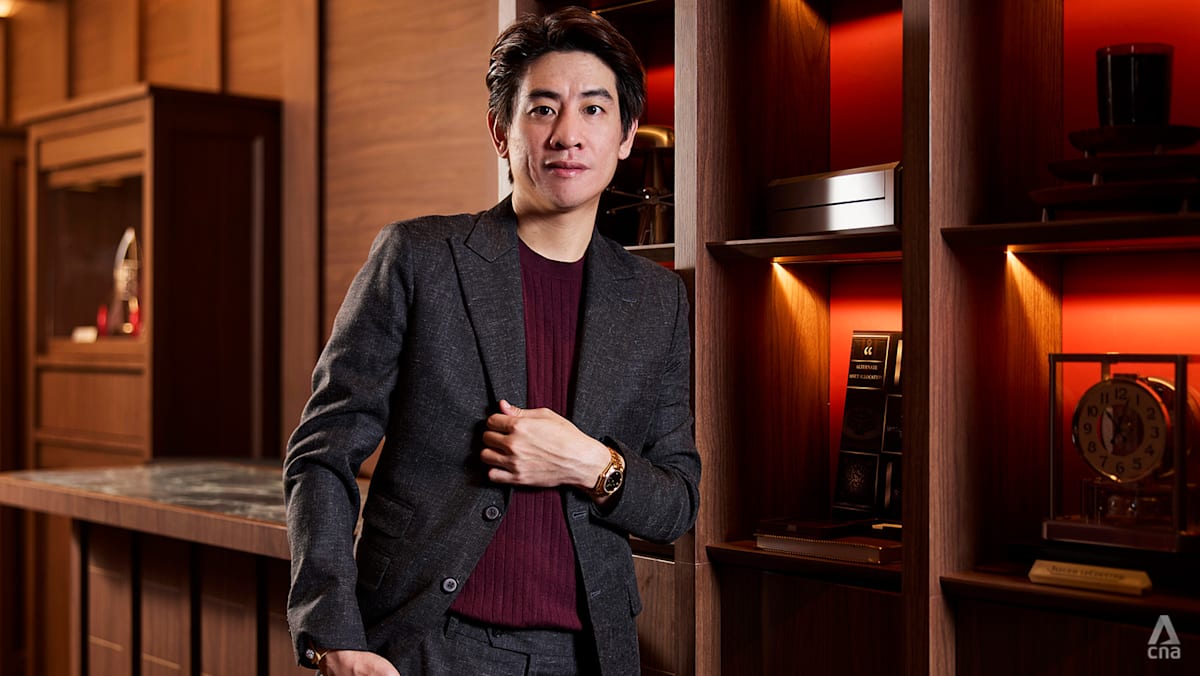
At 43A Craig Road in Tanjong Pagar, a striking red door studded with a gridlike pattern of raised metallic squares offers the first clue that this is no ordinary shophouse.It looks suspiciously like the tapisserie motif of Audemars Piguet watches, you think to yourself. Beyond the threshold, a dramatic flight of wooden stairs leads to the second storey, the passage swathed in the same red hue as the door and accented by spotlights.It’s giving either burlesque club or secret man cave – except the next door you encounter offers another clue: The solid steel monolith sports six porthole-style windows, three on top and three below. An ode to the Harry Winston Opus 3, perhaps? Inside, proprietor Ken Liew greets you warmly. “I’ve just sold three watches and a clock to three different buyers,” he exclaimed. “A [Rolex] Submariner, a [Rolex] Sky Dweller, a Movado, and an MB&F x L’Epee clock.” A seating area at Watch Estate Reserve offers collectors a comfortable setting to appreciate and discuss watches. (Photo: CNA/Kelvin Chia) Liew, 37, is the founder of Watch Estate Reserve, which grew out of his watch trading platform, Watch Estate. He enthusiastically points out other references to watchmaking in the design of his salon, which occupies the second storey and attic of the conservation shophouse.One section of the ceiling features parallel vaults – “Geneva stripes!” he quipped, referring to the wave-like finishing found on high-end Swiss watch movements. Wall-mounted light fixtures have angled, fin-like shades – “I call these my [MB&F] HM5 lights,” a design cue taken from the horizontal slats of the HM5 watch case.Even the bookshelves haven’t been spared. Their edges have been chamfered, just like the sharp edges of movement components that are bevelled at a 45-degree angle for a more refined finish. Liew also proudly showed off his hexagonal coasters – “like the shape of AP screws” used on Royal Oak and Royal Oak Offshore models.Designed by Monocot Studio, the space houses a retail area and a small bar on the second storey, while the attic serves as a lounge. WATCHES AS AN ALTERNATIVE ASSETBeyond creating a welcoming space for collectors, Liew wants Watch Estate Reserve to encourage a different way of thinking about watches. “I feel that watches are growing as a secondary asset class and a store of value, and I wanted to bring that to the forefront in terms of the secondary watch market in Singapore,” he explained.“We started Watch Estate Reserve because we were specialising in higher value – S$50,000 (US$38,850) and above – watches, so we wanted a nice, homely space where collectors can come together and enjoy talking about watches as well as enjoy buying watches,” he added. Watch Estate Reserve offers services ranging from buying, selling and consignment to insurance, storage and portfolio management. “We also have partners doing authentication and servicing. Yeah, we basically cover all bases.”Liew’s aim is to curate a selection of collectible watches with the potential to hold their value over time.His focus is on watches produced before the 2000s, particularly those from the 1980s and 1990s, which he says are in demand. On the day of our chat, he was wearing a Credor GBBD998, an ultra-thin, skeletonised dress watch from Seiko’s luxury watch brand. Introduced in 1996, it was powered by Calibre 6899, which Credor identifies as Japan’s first mass-produced skeleton movement.“I have another two of these going for less than S$10,000 each,” he said. “They’d make a great couples’ watch.” From ceiling details inspired by Geneva stripes to bookshelves with bevelled edges, Ken Liew has incorporated references to watchmaking throughout Watch Estate Reserve. (Photo: CNA/Kelvin Chia) Liew also keeps close tabs on watches from “very collectible” periods, particularly the 1910s through to the 1940s. He admits, however, that well-preserved watches from these earlier eras are difficult to source and can command high prices. He sources his watches mainly from dealers in Japan, Hong Kong and Thailand.Liew has also noticed growing interest among younger vintage watch enthusiasts. “I see an influx of people in their 20s and 30s who are buying watches, which was not the case in the past, when the people buying were in their 40s and 50s.”The cooling of secondary-market watch prices from their peaks during the pandemic and its aftermath may have something to do with it. “It’s almost signalling that we’ve reached the bottom, and I see a lot of potential upside in watches being a serious asset class,” he offered.PASSION PASSED DOWN Ken Liew’s fascination with watches began in his teenage years, when his father, Jeffrey Liew, would take him on visits to watch retailers such as The Hour Glass. (Photo: CNA/Kelvin Chia) Liew’s interest in watches comes from his father, Jeffrey Liew, who founded window and door manufacturing firm Sapphire Windows in 1989. The younger Liew worked as sales and marketing manager in the family business until a few years ago, when he decided to strike out on his own with his family’s blessing.The family connection extends to Watch Estate Reserve, where the windows and doors were made by Sapphire.“My father collected all sorts of things, like antiques, fine pens, and watches, so I grew up around people who appreciated craftsmanship,” Liew said.As a teenager, Liew accompanied his father on shopping trips to watch retailers such as The Hour Glass. A turning point came when he received his first “proper” watch, a Revue Thommen. “Wearing it, I fell in love with the idea that you’re carrying a piece of mechanical art on your wrist.”His first “serious” watch purchase was a yellow gold Audemars Piguet Royal Oak “Jumbo” 5402BA from 1980, which remains in his collection today.“That watch taught me two huge lessons. First, the market can be a wild ride – I’ve seen prices shoot up three to four times and then come right back down. Second, condition is everything. With vintage watches, how sharp the case [edges are] and how much of the original dial remains makes all the difference. That purchase really set the standard for how I inspect and pick watches for Watch Estate Reserve today.”ADVICE FOR WATCH ENTHUSIASTS If you’re buying watches purely in the hope of making a quick buck, Liew has some blunt advice: Don’t.“As much as I would like to say otherwise, if you’re purely looking at capital gains, I wouldn’t advise going into watches,” he said. Instead, he sees watches as a way to diversify one’s assets, with the potential to preserve or increase their value over time.His first rule is simple: Spend only what you can afford. “A watch should suit your life, not stress it,” he said. Before thinking about returns, figure out what you actually like, whether that is sports watches, dress watches, a particular brand or even a certain colour.From there, Liew considers three factors: Brand reputation, condition and rarity. But a collectible watch, he stresses, should never be judged on a single attribute. “It is never just one thing, it’s always a combination. A rare reference loses its financial floor if the case is over-polished, and a pristine watch is useless as an asset if there’s no market demand for the brand.”For Liew, the story behind a watch can be as commercially powerful as its specifications. “People gravitate towards stories, and stories generate culture. Culture generates hype, and hype generates demand.”So where might a value-conscious collector look today? Liew points to Breguet and Credor for their craftsmanship relative to current prices, while independent watchmaker De Bethune stands out for its architectural designs and low production numbers.He also sees potential in less-hyped vintage and neo-vintage pieces from established brands such as Vacheron Constantin and Audemars Piguet, rather than their more fashionable steel sports models.Even among the so-called Holy Trinity of watchmaking – Audemars Piguet, Patek Philippe and Vacheron Constantin – Liew notes that many models trade below their original retail prices, with only some commanding premiums.For prospective buyers, research is essential. Liew recommends finding out when a watch was produced, how many were made, whether it was a limited edition or collaboration, and whether it has historical or horological significance. Provenance, original components and condition also matter.What if you have S$50,000 to S$100,000 to spend on watches? Rather than spreading the money across several less expensive pieces, Liew favours a three-watch strategy: “You get a reliable daily beater, a solid travel companion, and then put the bulk of the money toward one truly significant grail timepiece in prime condition.”Above all, Liew cautions against treating watches like stocks. “A watch isn’t as liquid as a stock,” he pointed out. “You shouldn’t buy them expecting quick trading gains, but rather to protect capital long-term while enjoying what you wear.”SIX VINTAGE WATCHES WORTH KNOWING ABOUT Liew’s collecting philosophy comes into focus as he selects six watches from the Watch Estate Reserve collection. They range from an iconic 1980s Audemars Piguet Royal Oak to a century-old Cartier and some lesser-known models, each illustrating a quality he looks for in a collectible timepiece.Audemars Piguet Royal Oak 5402 (circa 1980s) The Audemars Piguet Royal Oak 5402. (Photo: CNA/Kelvin Chia) Liew starts with the first-generation Royal Oak 5402, the landmark model that helped establish the luxury steel sports-watch category and became an important part of Audemars Piguet’s history during the quartz crisis.He particularly likes the original Royal Oak’s proportions and execution, arguing that later generations lack some of its balance on the wrist. Just 736 examples of the yellow gold 5402BA were sold, according to Audemars Piguet’s archives. This example bears a number in the 600s.He also sees a significant price gap between the Royal Oak and its contemporary rival, the Patek Philippe Nautilus 3700. “It is trading way below its counterpart,” he observed, pointing to the Royal Oak’s design, faceting and bracelet as reasons he considers it compelling at current prices.Cartier Art Deco model (circa 1920) The Cartier Art Deco model. (Photo: CNA/Kelvin Chia) At the opposite end of the spectrum is a platinum Cartier watch dating to around 1920. More than a century old, the Art Deco piece features diamonds and onyx on its case, along with a platinum diamond-set clasp and yellow gold buckle. “Platinum was hugely rare during the time because it was difficult to machine,” Liew explained. The watch is also notable for its condition. According to Liew, it was kept in a safe and remains well preserved for its age.Audemars Piguet Ref 14899BA (circa 1980s–1990s), pictured left From left: The Audemars Piguet Ref 14899BA and Tiffany & Co gem-set bangle watch. (Photo: CNA/Kelvin Chia) The Audemars Piguet 14899BA combines fine watchmaking with elaborate gem-setting. Described by Watch Estate Reserve as a unique piece, it features a 36mm 18K yellow gold case adorned with rubies and diamonds.Baguette-cut rubies and brilliant-cut diamonds are arranged in a contrasting pattern across the case.Tiffany & Co gem-set bangle watch (circa 1990s), pictured above, rightLiew’s wildcard choice is a gem-set Tiffany & Co bangle watch, reflecting his belief that jewellery watches could become an increasingly interesting segment of the secondary market.“Gem-set watches have recently become a thing,” he said. Their appeal, he argues, lies partly in their scarcity, as gem-set versions are often produced in smaller numbers than their non-gem-set counterparts.The watch features baguette-cut rubies and brilliant-cut diamonds, with approximately 15 carats of gemstones in total. Liew believes its unusual design offers good value compared with contemporary gem-set watches.Vacheron Constantin Overseas Ref. 42052 (circa 1990s-2000s) The Vacheron Constantin Overseas Ref. 42052. (Photo: CNA/Kelvin Chia) Launched in 1996, the first-generation Vacheron Constantin Overseas followed the brand’s earlier 222 model, continuing its approach to luxury sports watches with integrated bracelets.This example features a 35mm stainless steel case and a salmon-coloured dial with a sunburst finish, a less commonly seen configuration of the first-generation Overseas.Credor GBBD 987 (circa 1995) The Credor GBBD 987. (Photo: CNA/Kelvin Chia) Finally, there is Credor, the Japanese watchmaker that Liew believes deserves greater recognition. This platinum GBBD987 was reportedly produced in a limited run of 100 pieces, with this example numbered 98. It was also among Credor’s earlier artisanal models, featuring hand engraving and skeletonisation by Japanese craftspeople. Liew particularly values the depth of the engraving on these pieces. “Credor is an understated brand,” he said. “The beauty is in that understated elegance.” For Liew, that combination of limited production, craftsmanship, precious materials and historical significance is what makes an overlooked watch collectible.
What makes a vintage watch worth collecting? This Singapore watch dealer shares his insights
Full Article
Original Source
Read the full article at Cnaluxury →KhanList aggregates and links to publicly available news content. We do not host full articles from third-party sources. Always verify important information with original sources.