
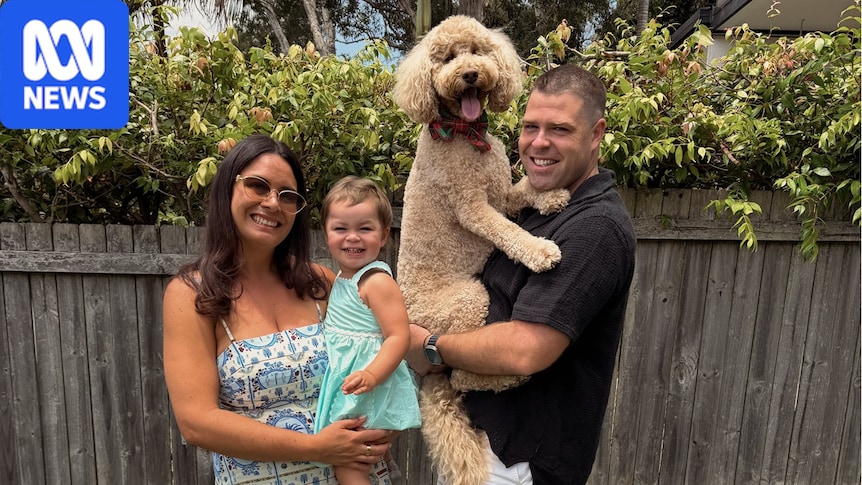
To the outside world, Matthew Wright was a calm, capable and resilient husband, father, friend and senior firefighter.But on the inside, the 35-year-old from Sydney/Gadigal lands says he felt like he was falling apart as obsessive-compulsive disorder (OCD) began controlling his life.He spent more than five hours each day "trapped" in compulsions until he found professional help and a sense of community by speaking about his struggles with OCD, some of which were triggered by the sudden loss of his daughter.These are Matthew's words.Warning: this article contains references to infant death and loss.I needed to keep this from the worldThe first time I ever felt OCD symptoms was back in 2020 when I had a near miss while driving.I had a guy stumble out in front of me on the road. I slammed on the brakes, and he sort of jumped out the way.Matthew says his OCD symptoms began after he experienced a near miss while driving. (Supplied)And that rattled me.From that point on, the obsessions started.In my mind, every pothole in the road was a body I didn't see. Every second I couldn't recall was the possibility that I caused an accident.I avoided driving for months; I was too terrified.Then I bought a dash cam. I couldn't drive without it. It gave me the ability to get in the car again.But then came the compulsions. Every drive I had to watch back, not just snippets, the full drive.I was ashamed, I was embarrassed and I no longer saw myself as a man or a husband.I needed to keep this from the world because I didn't want people to think of me the way I thought of myself.I feared if people knew the truth I'd be treated differently.I can't lose somebody else I loveOur first daughter Mia was stillborn in 2023.It was one of those things in life that changed everything for my wife Jordan and I as we dealt with the grief.We went straight into our second pregnancy within about three months after we lost Mia and our rainbow daughter Willow was born in January of 2024.Despite the earlier onset of my symptoms, everything was going smoothly for about the first six months of her life and then my dog Archie collapsed.Archie was our little saviour through that period when we lost Mia, he sat with us while we cried every night.So, when he had a medical episode, it triggered something in me where I went, "I can't lose somebody else I love so much."I became obsessed with his health and wellbeing.So, I stopped taking him to the park, I stopped taking him on long walks.But the worst of it was when my OCD eventually came for Willow.My whole life became about protecting her from germs and from getting sick.Matthew says that at his worst he was trapped in compulsions for five hours each day. (Supplied)And I was completely obsessed with making sure that she wasn't touching anything and putting her hands in her mouth.I would spend upwards of five or six hours a day in the bathroom washing my hands.I was showering five or six times some days before lunch, changing my clothes just as many times.It just overwhelmed my life, and it felt like it was falling apart.A vision for what my life could look like againWork for me initially became a bit of an escape because I was away from my family during 24-hour shifts at the fire brigade.During those 24 hours, I didn't have that overwhelming pressure and responsibility around keeping Willow safe.But I felt like I was failing my identity, a third-generation firefighter and a peer support officer.I felt like a walking contradiction, calling someone up, checking in on them, ensuring their wellbeing when my own wellbeing was suffering more than ever.One day I just said to my wife, "I need help, I'm broken."I started seeing a psychologist, and initially I had some good insights and improvement.But I ended up being referred to the Clinical Research Unit for Anxiety and Depression, at St Vincent's Hospital in Sydney.My therapist there, she completely changed my life.She took things at my pace, which was the most important thing.We wrote down goals, and she gave me a bit of a vision for what my life could look like again.And I think that, along with my medications, set me up to be able to tackle exposure therapy, which was an important step in my recovery.We just took things at a nice slow pace.So, if it was washing my hands, rather than washing my hands for 5 minutes, we cut it down to 4 minutes one day.And then we sat with that for a week or two.We just worked through each compulsion one by one.By the end of the 16 weeks, I was doing things that I'd avoided for 18 months beforehand.Once I opened up about it, I just felt lighterWhen I was first diagnosed with OCD, I started searching far and wide for information, and there was nothing I could relate to.So, when I got to the point where I was comfortable enough, I wanted to share my story because I knew there were other people out there sitting there in silence or struggling to find the words to describe what they're going through.Matthew is a New South Wales firefighter and peer support officer. (Supplied)One of the first talks I gave was to 25 of my work colleagues.They're firefighters I've known for upwards of 10 years who didn't know my story.I was able to sit there and sort of reveal all of myself to them.Once I did it, it was just a moment of, "wow." I just felt lighter.They said, "we had no idea, but it just goes to show that even the strongest, bravest people are struggling with things."Losing Mia was the saddest thing I've ever been through, but overcoming OCD is without doubt the hardest thing I've ever been through in my life.So, when I hear someone who isn't diagnosed with it say, "I'm so OCD" or "my OCD won't allow that," I challenge them to really understand what they've said.I help them begin to understand what OCD might be costing someone who does suffer from it.And maybe, just maybe, I can help the world to see what it's actually like to live with OCD.
What it's really like to live with obsessive-compulsive disorder
Full Article
Original Source
Read the full article at Abc →KhanList aggregates and links to publicly available news content. We do not host full articles from third-party sources. Always verify important information with original sources.