
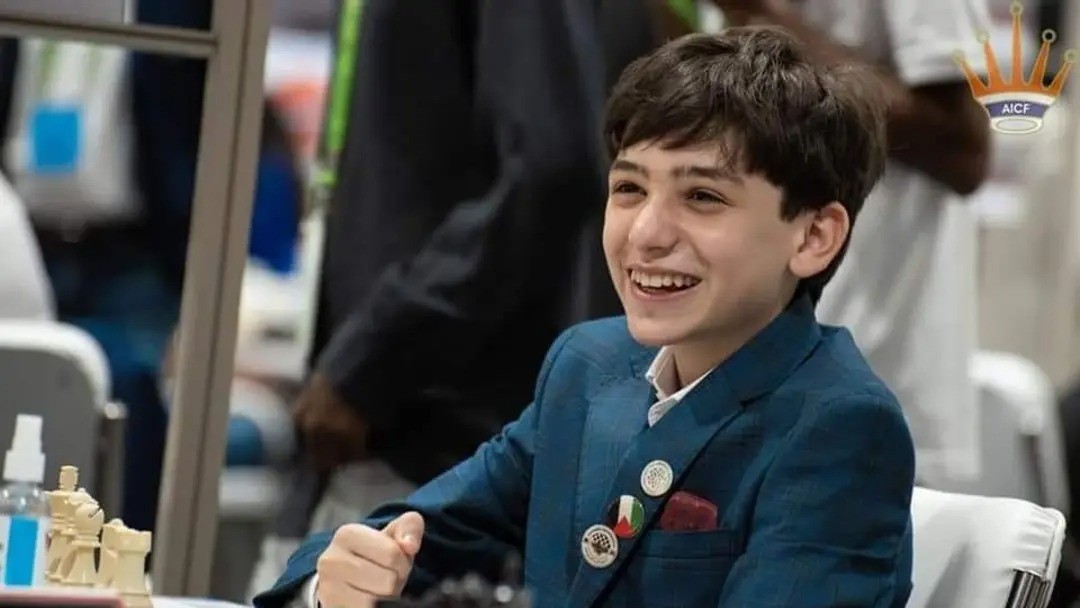
At five years old, when Mohammed Seder came home from school in his native city Hebron in the occupied West Bank, he liked to solve chess puzzles. Seeing his son play chess at a young age, Seder's father and former national Palestinian chess champion Naji Sider began thinking that he might have passed his talent onto his son. He decided to give his son chess training and at age 10, Seder started playing chess competitively. Today, he is 17 years old and Palestine's most high-ranking player. New MEE newsletter: Jerusalem Dispatch Sign up to get the latest insights and analysis on Israel-Palestine, alongside Turkey Unpacked and other MEE newsletters Seder has an International Chess Federation (FIDE) rating of 2235, making him a grand master. The FIDE score measures a chess player's skill based on results against other rated opponents. Seder's chess talent runs in the family: Seder's 12-year-old sister, Randa, is also a notable player and recently won the 2026 Palestine Women's Classical Chess Championship. Seder has twice won the Palestinian National Chess Championship and frequently represents Palestine at international championships and chess olympiads. He has also won the Arab chess championships in the "under eight", "under 10" and "under 14" categories. Middle East Eye spoke to Seder about what it's like to be Palestine's national chess champion at age 17. Representing Palestine Seder's passion and gift has brought him considerable recognition, both locally and internationally. At home in Hebron, teachers in Seder's school already know who he is before becoming his teacher, he told MEE. "A lot of people at my school know me because I take part in a lot of tournaments for my school. When I win it, it is like I have done everything in the world for the school," he said. But his fame reaches beyond Seder's close circle. International chess tournaments and competitions abroad have taken the chess champion to over 20 countries and representing Palestine at competitions is both a source of pride and a responsibility for Seder. "When I travel abroad, I am very proud to represent Palestine. I also feel I have a responsibilty to show the world that Palestine has a lot of very smart and very good people," Seder said. The last FIDE Chess Olympiad took place in September in Samarkand, Uzbekistan, with the Palestinian chess team competing in both the Open and Women's sections. While Seder was unable to participate due to upcoming school exams, his sister Randa travelled to Uzbekistan where she achieved high results. 'When I travel abroad, I am very proud to represent Palestine,' Mohammed Seder tells Middle East Eye (MEE/supplied) At the 2022 FIDE Chess Olympiad in Mamallapuram, India, Randa made history as the youngest ever participant. Taking part in a competition requires meticulous preparation according to Seder, who is now focused on school to finish his final year. Once he knows his opponent, Seder carefully researches and studies the player's profile, including their playing style, openings and how the player deals with problems. He then receives advice from coaches on how to face a specific opponent. Besides training and preparation, Seder says that getting enough sleep and eating the right amount are equally important. "Before competing, I need to get enough sleep. You should also eat lots of carbs but the food shouldn't be too heavy, otherwise you fall asleep," Mohammad tells MEE. Seder believes he once lost a competition in Dusseldorf, Germany, after overeating at lunch in a Turkish restaurant because the food was “too delicious”. 'I feel a responsibilty to show the world that Palestine has a lot of very smart and very good people' - Mohammed Seder, 17, Palestine's national chess champion When he's not able to travel for competitions, Seder plays chess every day, often on open-source online chess platforms like Lichess or Chess.com. Next spring, Seder will pass the General Secondary Education Certificate, known as Tawjihi in Palestine. Palestinian society places a very high value on education, with a youth literacy rate of 99 percent. High academic achievement is a source of pride for students, families and entire communities. Seder is hoping to obtain excellent results to secure a scholarship to study computer science or engineering at a university in the US or in Europe. His top choice is Saint Louis University in Missouri, United States, due to its top-ranked collegiate chess programme. "Saint Louis is one of the best universities for chess players. It has a chess club and a lot of tournaments which would be really good for me. But if they don’t accept me or don’t give me a scholarship, I’ll go to another university, no problem," Seder told MEE. Despite his wish to leave Palestine in search of better opportunities, Seder hopes to return in the future. "Chess doesn't matter to me when it comes to Palestine. My land is much more important to me than chess. If I leave Palestine for some years, I will come back for sure," he said. Limited opportunities While Seder's talent has enabled him to travel the world to compete internationally, restrictions on the freedom of movement for Palestinians in the occupied West Bank and lack of resources and financial support in Palestine's chess scene has limited his opportunities. The high number of checkpoints and military interventions by Israeli soldiers have made travelling from Hebron to other cities in the West Bank to meet with coaches or participate in competitions diffcult and dangerous. "Travelling from Hebron to Ramallah, Nablus, Jenin is about 60 kilometres, which is nothing. But if you go by car it might take more than four or five hours. Sometimes it takes more than 12 hours," he told MEE. 'Chess doesn't matter to me when it comes to Palestine. My land is much more important to me than chess. If I leave Palestine for some years, I will come back for sure' - Mohammed Seder Hebron is also close to many Israeli settlements, and attacks by Israeli settlers as well as violence by Israeli soldiers have intensified in recent years. Over the weekend, the Israeli military has levelled an entire neighbourhood in Hebron, and forcibly displaced at least 2,670 Palestinians from their homes, according to Hebron Mayor Yousef Jaabari, in collective punishment for an attack on an army checkpoint outside the city. Seder has many stories of being prevented or almost prevented from travelling to competitions, both national and international. Once, while en route to a competition in Kuwait, Seder said he was stopped and held at the border because he was not carrying his Palestinian national ID, which, he explained, is usually only useful inside Palestine. "Another time, I was travelling between two cities in Palestine when we were stopped by Israeli soldiers who told us to get out of the car. When we got out, we waited beside our car for two hours for no reason," he told MEE. About two months ago, Israeli soldiers broke into the Seder family home at night and arrested Seder's father. He was released several hours later. Another problem is the lack of financial resources for chess in Palestine. There is hardly any corporate support for chess in Palestine and opportunities for Seder to participate in tournaments that are challenging for him are limited. Seder's next goal is to become a FIDE International Master, for which he must obtain a FIDE score of 2400. To achieve this, he needs to compete against players who already have the International Master title. "It’s not very hard, but I don’t have the opportunity to play in enough tournaments. If you want to become an International Master, you have to play at least three or four tournaments a month," Seder told MEE. "In 2026, I have only played in one tournament. If I continue living in Palestine, my chess career will end."
What it's like to be Palestine's 17-year-old chess grand master
Full Article
Original Source
Read the full article at Middleeasteye →KhanList aggregates and links to publicly available news content. We do not host full articles from third-party sources. Always verify important information with original sources.