
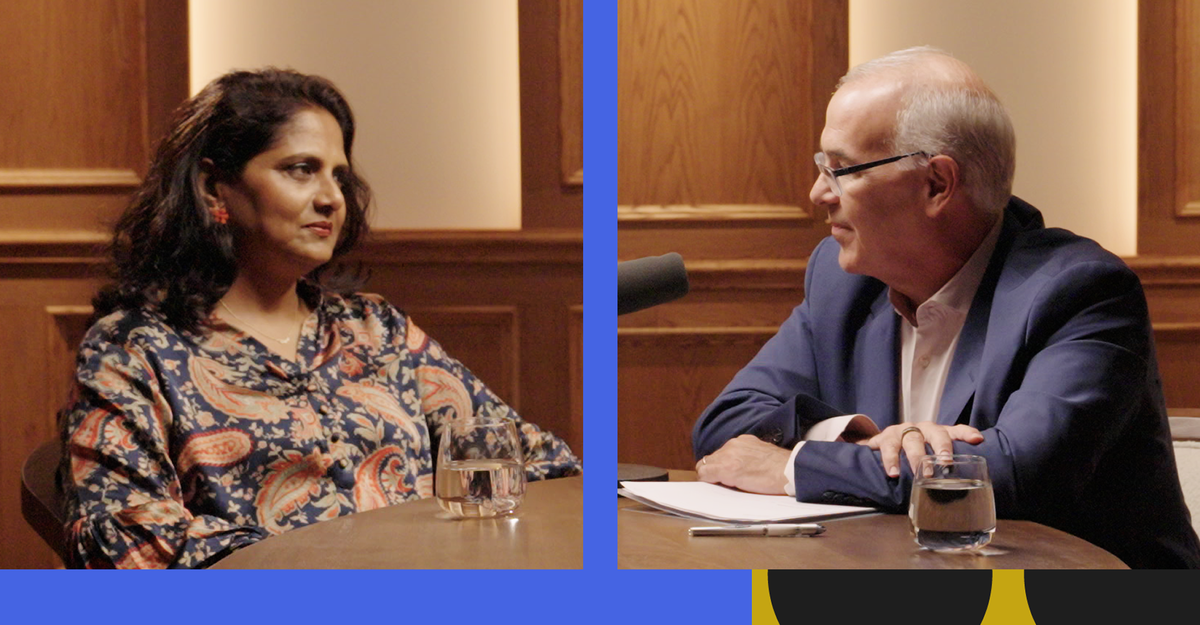
Subscribe here: Apple Podcasts | Spotify | YouTube For all of history, humans have been fascinated by the heavens above us. We’ve used the stars to navigate Earth, to predict the future, and to understand our place in the larger scheme of things. Changes in our view of the cosmos—from the Copernican revolution that “uncentered” the Earth to the discovery of the Big Bang and the recognition that the universe is expanding—have invariably changed our view of ourselves.In this episode of The Permanent Questions, David Brooks speaks with the astrophysicist Priyamvada Natarajan about the latest scientific view of the universe and what it says about humanity’s place in the order of things. Natarajan is a world-renowned theoretical physicist who has made important breakthroughs in the study of black holes and dark matter; she is also a scholar of the history and philosophy of science and the author of Mapping the Heavens: The Radical Scientific Ideas That Reveal the Cosmos.Along the way, David and Natarajan discuss the place of emotion in scientific research, why science alone can’t solve human problems, and the greatest space movie ever made.The following is a transcript of the episode:David Brooks: I was like any other 8-year-old. I looked up into the night sky, and I was transfixed. I put posters of the solar system on my bedroom wall. I taped up photos of nebulae and eclipses. I decided in second grade I was gonna be an astronomer. I think kids like things that are big, like space and dinosaurs, because they feel small. But I think we’re also drawn to space because it’s awesome, and I mean that literally. It evokes awe. It has a vastness, power, and mystery that is both beautiful and terrifying and therefore sublime. Kids are metaphysical creatures just like the rest of us. They wanna know what it all means, what life is for, and why we’re here. And when you’re peering into the depths of the universe, it feels like the answers are out there.Later, I discovered astronomy involves math, and so it was not for me. But I never lost my taste for the poetry of the night sky.So I’m super excited to talk about the existential issues that peering into the universe raises with one of the world’s leading astrophysicists. Priya Natarajan grew up in Delhi, and in high school she developed a method for mapping the night sky over that city.Now she studies black holes and other stuff out there in our ever-expanding universe. But what’s great about her is that she isn’t just a bunch of data and equations. She’s a deeply humanistic thinker who ponders all the existential questions the universe poses and writes about them with lucidity and grace.I’m pleased to welcome Priya Natarajan to this table.Priya Natarajan, welcome to The Permanent Questions. Thank you so much for being here.Priyamvada Natarajan: Delighted to be here. Thank you for the invitation.Brooks: Now, I am fascinated by how scientists find their field. So how did you find the night sky?Natarajan: I don’t have such a dramatic story, but it’s one that’s sort of filled with a lot of wonder and awe because the night sky—you don’t have to go anywhere.It’s there for everyone, right? When I was a young child growing up in India, I was a very curious child, so I was always pestering my parents with questions, and ultimately my parents bought me a telescope and a microscope, and I made my choice.I was always fascinated with stars and the moon, usual kid stuff. I felt attracted much more to the night sky, because you couldn’t reach out and touch. There was something about it being not quite available in the same way that you could make a little specimen in a glass plate and look at it under the microscope.The fact that it was somewhat unreachable and elusive was what sort of seduced me. But I don’t think I actively thought about becoming an astrophysicist at that age. I was clearly interested in science. There was no question about it, and physics. And I think I had a sort of interesting—sort of very blessed in terms of the opportunities that I got.My parents are academics, so I, again, won the birth lottery. A house full of books and people, interesting people. I got a Commodore 64 at home before anybody in India ever had a computer, so I learned to program myself.And there was this fantastic woman scientist, Nirupama Raghavan, who came back from the U.S. to run the Nehru Planetarium in Delhi. I was an amateur astronomer, so I would go there. And when I heard she had come and she was really encouraging young students to read more about astronomy, I showed up, a young teenager.I said, “Well, I have a computer and I can calculate, and I wanna do some research. Can I do some work for you?” And so she said, “Okay, what do you love?” I’ve been obsessed with maps and atlases and cartography my entire life. And even as a child, atlases were sort of my favorite, of the sky and the earth. So she said, “Okay, what’s your favorite?” I said, “I love that sky map that is produced in the newspaper in Delhi monthly—Night Sky: What Can You See?”She said, “Okay, make me a map. Make me the star map.” And so then that was a lot of work. I had to teach myself spherical geometry, and I had to learn to program properly, input a lot of data about the positions of the stars and the planets and their orbits, and finally I did it.Brooks: What’s up with you and maps? You call your book Mapping and there’s a lot of maps in there, and you mentioned as a girl you were interested in maps. Why do you think maps have a special interest?Natarajan: One of the things that always fascinated me was if you look at old maps, especially the voyages of exploration maps, at some point these chaps would map and say, “Terra incognita.”I love the fact that they said, “We don’t know what that is.” And it’s that same impulse that as a child I had to something that’s kind of unknown—had magnetic, seductive value for me. And I was like, Oh, wow, so there are things that are really not known. Some things are exquisitely mapped—land routes, shipping routes are mapped, cities, and down to villages—and then suddenly there’s a terra incognita.Then I went to MIT. But then at MIT, I studied a lot of different things. I was very interested in the philosophy of science. I’d encountered Thomas Kuhn, who had retired at that point, but he would come and—Brooks: Thomas Kuhn wrote the book The Structure of Scientific Revolutions.Natarajan: So at the time, string theory, which is very abstract mathematical theoretical ideas about what happened before the Big Bang, so that’s sort of the domain of string theory. And I was well placed to do that because I had a strong mathematics background, as well as physics. But I was not interested in those ideas, because they were not testable.They were not experimentally testable. And somehow to me, the excitement always was in being proven—make predictions and have them tested. That kind of back-and-forth to me was what was exciting about science.So instead I deferred Ph.D. admissions at MIT in physics and started a Ph.D. in history and philosophy of science. Because I always liked to write, and I’ve—I was slightly torn always also between the humanities and sciences, because I love to read, I love poetry and love history.And I think Thomas Kuhn also influenced me deeply in the sense—his book was something I’d read with great interest. But even then I felt that there were bits in his wonderful book that still missed things, and that’s because he was not a practitioner.Brooks: And the basic idea—correct me if I summarize this wrong—is that science moves forward in paradigm shifts. You’ve got a paradigm, Newtonian physics. It’s working, working, working. Suddenly the data starts not working. And then somebody comes along and chops up the Newtonian paradigm, and we get a new one.Natarajan: Absolutely. And that it’s all revolution. So I think I, even then, felt that that was a simplistic view of how science progresses, because it’s a combination; it’s a complex combination of evolution of ideas and revolutions.And that the practice of science was something that really interested me. And I realized that Okay, now I really need to learn to read and write like a humanist. I was gonna look at simulations. In particular in cosmology and astrophysics because cosmology and astronomy, astrophysics are a very interesting science.They’re not your standard science because you can’t do controlled experiments. The night sky—there’s a supernova that goes off there. That’s all you have. You cannot summon it up tomorrow again, unlike chemistry, where you can keep mixing reagent A and reagent B, like, millions of times anywhere around the world.So that fascinated me, the fact that these fields were somehow kind of edgy in terms of our definition of the scientific method and so on.And so I wanted to understand this process of what the simulation is really doing. Is it actually testing, validating theories? It turned out that took me to Princeton, because there was one person at the time who was alive who knew John von Neumann and all the computational greats, and it was Martin Schwarzschild. Martin Schwarzschild is the son of Karl Schwarzschild, the person who discovered the black-hole solution.While he was a soldier at the front, World War I, Einstein had just given his set of lectures on general relativity in the Prussian Academy of Sciences. He could not be there, but he heard and got a copy of the lectures, and within days he found the first solution—exact solution to his theory. Einstein even didn’t expect there would be an exact solution. Anyway, black holes. So Martin—Brooks: Which was your main field of study, right?Natarajan: Exactly. So during this conversation with him, and he was like, “What are you doing this for? You have to be doing science.”Then I told him what I just told you, that I couldn’t find a thesis problem that I found enticing enough, and that’s why I was kind of exploring other things. And he said, “What do you like?” So I said, “I like building storylines for the universe—how things happen and make predictions. Use all the data we currently have, make a prediction for future data. That’s the kind of thing I like.”So he said, “Well, I know the person you should work with, and his name is Martin Rees, and he’s a professor at Cambridge.” And so I ended up there. I ended up working with Martin, and I am ABD in that Ph.D. still.Brooks: Major career failure. You mentioned earlier in our conversation that you didn’t want the microscope because you didn’t wanna be able to touch the thing you were studying. Well, now you’ve chosen to study something you can’t even see, and that’s black holes. No one has ever or will ever see a black hole. And so what was the interest and obsession with black holes?Natarajan: Well, you can ask any kid what they are obsessed with, what they think is the most enigmatic thing in the universe, and they’ll tell you it was black holes. I also work on dark matter, so all these invisible entities that seem to fundamentally shape our universe. Their true nature is not well understood. So that’s already an invitation to go there and try to understand.And the draw about black holes is really: They have the most bizarre properties. And as you said, you never quite directly see them. You only indirectly infer their presence, just as dark matter. You sort of indirectly infer the presence of vast amounts of dark matter in the universe. Bulk of the matter in the universe, 86 percent is dark matter. And so the only way you infer the presence of dark matter is the gravity that it exerts.Similarly for black holes. So the only way we infer the presence of black holes is because they are places in the universe where there’s extreme gravity, and so they bend light. All matter bends light, but when the matter is very densely, compactly arranged, it very severely and dramatically bends light.So we can actually see that around black holes. But most importantly, what black holes really are—they represent the limits of our knowledge. And I’ll explain what that is.So a black hole is basically a place where matter is so concentrated and gravity so intense that nothing can escape this sort of sacred boundary. It’s called the event horizon. Not even light, if it crosses it, can actually escape it. The gravity is so intense.And they seem to be ubiquitous in nature. Almost every galaxy in the universe, including our own, harbors what we call a supermassive black hole. It’s a million times the mass of the sun that’s sitting at the center.And the question is, why are they there? What are they actually doing? How did they form? How did they grow? So this is the big open questions. And it’s this idea of extreme gravity. And of course it was Einstein who completely reformulated gravity. We moved away from the neat idea of Newton’s gravity—it’s the force between two masses, and it’s mediated by the distance between them, one over R square. Newton was never able to explain: Why? Why do two objects that have mass actually feel this force? How is that force mediated? That’s why Einstein is so—his theory is just so remarkable, and his imagination is just all-making.Brooks: This is a question about the process of scientific discovery. And so Einstein has one year. In 1905, he’s 26 years old, and he publishes four literally universe-shaking papers.How the hell does that happen, where one guy in one year, which he never replicates—what’s going on in the process of discovery? Are there periods where a scientist just goes through some extraordinary burst of creativity the way sometimes artists do?Natarajan: I think it tells you something about the entire nonlinearity of that kind of creative imagination, right? Clearly, he has been mulling over, thinking about these—I mean, each paper was a major conceptual shift. Super radical, complete break from anything that the physicists had been thinking about or mathematicians had been thinking about.And a lot of it—strangely, Einstein was not necessarily a very gifted mathematician. He had enormous physical intuition, but a lot of his work is this deep marriage between mathematics, geometry, and physics.And so I think in a way, when I think about what might have been the extraordinary capacity his mind had was synthesis: synthesis of ideas that seem completely disconnected, and somehow he saw the connections between them, and he was able to use the language of mathematics and physics and articulate them and connect them to reality.Brooks: I wanna get back to black holes. Now, to me they’re, especially reading about them in your book, they’re kind of creepy. They’re the corpses of stars. So they’re corpses that suck everything around them and kill them. That’s kind of creepy. So I’ll just put that out there. But the second thing I wanted to ask you about: You had a breakthrough in the early formation of black holes, which I’m gonna ask you to summarize.Natarajan: So black holes come in a lot of different sizes. Stellar mass black holes are basically the corpses of dead stars. You have a star that is maybe born with eight to 10 times the mass of the sun or higher; it will inevitably live its life out and leave behind a black hole.Those black holes are few times the mass of the sun, and the black holes that we are seeing in the centers of galaxies are millions of times the mass of the sun, to even billions. So the big question is: How do you grow a black hole from that size all the way to the ones that we see ubiquitously in the centers?So then the universe itself—we have a clock. We have 13.8 billion years, so suppose the first stars explode; that’s the amount of time that you have to kind of grow them. And so we built models: How could you grow them?You could grow them—they could collide with each other and become bigger; they could eat a lot of gas around them; they could get bigger. And that was the prevailing idea, that you would grow them from these light seeds, the stellar corpses, and you would make the supermassive black holes.But then something interesting happened observationally. People started finding these billion solar mass black holes further and further back in time, which meant that you did not have enough time in the universe to grow from these little seeds to those monsters. You just did not have time. So there had to be some other way, and that’s what motivated—it was that data from the Sloan Digital Sky Survey. It was a sky survey that was done from the ground, telescopes on the ground. And they were finding these quasars. Quasars are actively feeding supermassive black holes, so just gobbling up all the gas.So basically, the reason you see the light—they’re very bright beacons. You’re not actually seeing the black hole itself. What you’re really seeing is the dying gasps of the gas that is being pulled in by the gravity of the black hole that’s getting heated.Brooks: Even creepier now.Natarajan: Absolutely. Heated and heated, moving faster and faster, and that starts to glow because it’s being heated. That’s the glow that we detect that shows us such a high temperature that it has to be a black hole’s intense gravity that’s pulling it in. So those are the quasars. When a black hole is feeding, you see it as a bright beacon, even out to the largest cosmic distances.But if it’s not feeding and it’s sitting there, you don’t see it at all. So these quasars were being found, and that’s when I thought, Okay, this—and it wasn’t just one freak object. They were finding populations of these guys very early in the universe. So there has to be some solution. How would you make them?I know it sounds really crazy, but I tried to piece together what got me going on a particular line of thinking, and I think I kind of have figured it out.I don’t know if you’ve spent time in England, but the taps are a real issue. They don’t have mixed taps. So if you want hot water and cold water, you basically have to turn both of them, and you have to do this (Gestures as if running right hand under faucet to test water temperature.).They don’t mix the taps.Brooks: Very backward civilization.Natarajan: Marvel, right? They colonized my country and I’m like, What? Really? These people did with their plumbing? So when I was a graduate student in England, I developed a habit and joy of taking baths.So I would take these baths. In India it would be considered, you know, sitting in your own dirty water, but I love baths and when you take the plug out of the bathtub when you’re done, then the water goes in really fast, but it swirls and goes down. But before it swirls, there’s a little bit of water that goes directly in.I noticed that and I thought, Oh, that’s interesting. So that, I think, was something that I thought about, which was: Can we make a black hole from directly collapsing gas bypassing the formation of a star completely? And the question is, could you make a really big black hole, something that’s bigger than 10, 15, 50 times the mass of the sun? And so it turns out the physics actually permits you to do that. If you had a lot of very dense gas, which you do have in the early universe, then it would settle down—typically because it has spin—into a disk.So that’s kind of the configuration you would settle down into, because there’s a lot of angular momentum or spin. And then there are instabilities. It’s a lot of gas, it’s a massive disc, it would get unstable, and stuff would just fall to the center without fragmenting. Because if the gas cools and fragments, that’s the way you form stars. And you wanna prevent the formation of stars, right? So you wanna make it unstable, but very quickly you want it to go so unstable that all the material will go in, and then you would have the bathtub-type situation.You would directly collapse a lot of gas and make a black hole. And so that unlocked the key.Brooks: But the interesting thing to me is, as I understand it, you publish this paper, you get this breakthrough, and it takes another 17 years for it to be verified—fortunately it turned out you were right—by, I guess, the Webb Telescope?Natarajan: Yeah, James Webb.Brooks: What was it like to wait 17 years to be—Natarajan: Oh my God.Brooks: —vindicated, and then what happened the moment you found out you were right?Natarajan: I am not really a usually patient person, but science teaches you that you have to be patient.Brooks: So tell us about—I assume the Webb telescope’s gone up. I assume you know your theory’s about to be tested.Natarajan: Yeah. So 2017 we wrote a paper which made the most clear-cut prediction. Since you can never quite see a black hole, the way you know how a black hole formed is the special relationship that black hole would have to its host galaxy.So if a black hole formed from this heavy seed, then the mass of the black hole would be larger than the mass of the stars at that very early stage. And that is the opposite of what we see in the nearby universe. So the mass of the black hole in the Milky Way is 4 million times the mass of the sun.The stars outweigh it by four orders of magnitude. The stars really rule the day. This would be completely the opposite. So 2017, wrote this paper, and it came out. And I don’t know if you remember, James Webb was canceled so many times because it was budget overruns, technically challenging, all of that.So when we published that paper, actually it was one of those cancellation moments. I was excited that we made these very clear-cut predictions. We predicted a spectrum and said it should look like this on Webb, and the telescope was canceled. I remember being very dejected and then thought, Well, you know, it’s had nine lives. Maybe it’ll come back again.It did come back again, and this object, UHZ1, was found, and it had precisely the relationship that we had predicted in our paper in 2017 between the mass of the black hole, mass of the stars, and the properties of what would be the spectrum and the fact that it should also be seen in the X-rays. It was then detected by the Chandra space telescope, which has X-ray eyes.So that was an unbelievable moment. This is the moment that as a scientist you kind of live for.Brooks: Now you’ve thrown around accurately a lot of big numbers about stars that are orders of magnitude bigger than our own, and the biggest number of them all is, I gather, there are 2 trillion galaxies roughly in the universe. And each one of those has, I don’t know, hundreds of millions of stars—or you could have. So we’re talking about huge spaces and numbers, and this is like the key fact of the universe. It’s just gigantic. And so does this fact make human existence seem insignificant to you?Natarajan: As a theorist, a person who builds models, one of the great capacities I have is to sit on the fence. I can argue both sides, and I will let the data call out, right? So I think humans are simultaneously really significant and insignificant.They’re insignificant, just as you say: In the grand scheme of things, we are one tiny planet, one solar system of billions and billions of them out there. But the way in which we are significant is that with this one kind of cantaloupe-sized gelatinous organ in our heads, we have figured all of this out.And so it’s really hard to say we’re really utterly insignificant. We are significant. And I also like to think, when we think about the big problems that the Earth is facing with catastrophic climate change, I think we are really significant because we can do something about it.I like this idea of cosmic stewardship and agency. I think we do have agency. We are not exercising it enough. So I do not wanna relegate us to being sort of insignificant. I think we’re very significant because we can actually shape our own realm, and we’ve had the intellectual capacity to figure out so much.Brooks: You had a sentence in your book that was startling, surprising, to me. I did not know this, and I’m gonna read it to you, and you can explain it: “All the calcium in our bones, for instance, was once synthesized inside the cores of stars and spat out violently during such supernova explosions on their demise.”So that suggests to me I’m part Ukrainian and part star.Natarajan: Yeah, exactly.Brooks: If the calcium in my bones is like—Natarajan: Exactly.Brooks: And so, how did that work?Natarajan: I think this is what is so remarkable about the universe, right? So in the very early universe, in literally in the first three minutes, all the hydrogen, helium, everything in the periodic table only up to lithium-7 formed. Because the universe is expanding and cooling, so it’s no longer the furnace that can synthesize any of the—fuse or form any of the higher elements.Everything else formed in the center of a star. Everything in the periodic table, including calcium, iron, everything, right? And it exploded, these stars exploded. They literally split and spilled their metals into the atmospheres, and stars formed from that gas in that atmosphere. So the first generation of stars did not synthesize all the heavy elements, right? They were mostly hydrogen and helium. So every subsequent generation gets you further and further out in the periodic table. And that’s because you’re polluting the hydrogen, the gas, the rest of the gas that’s around when a star explodes with these new chemical elements, and you’re enriching them. It’s this cascading thing, too, right? And there’s so many coincidences in this, right? That when you think about, you know, we’ve ended up as humans in this kind of life-form, there’s like so many chains of random things that have happened.Brooks: Yeah. Let me ask you about those random things. So if I talk to a string theorist and ask them, or you, “Well, what happened before the Big Bang?” Would they have an answer?Natarajan: They don’t have quite an answer in terms of a detailed scenario that can be physically validated, empirically validated. But what they could tell you, and especially now because there’s been a real renaissance in the field and lots of progress, they can tell you something about why the specific initial conditions that we need for the Big Bang, we need a very specific setup. And that’s been a kind of a problem, if you need exactly that to get the universe that we have, then why them, right?And so now they can give you an explanation for how to generate a set of initial conditions. So one of the things they’re still grappling with, right, is: Our universe has four dimensions, three spatial and one of time. And so they have to—a theory of before the Big Bang and of the origin of our universe has to explain why we end up with four dimensions.So they’re not there yet. They have theories, which have a larger number of dimensions. So they have to bring them down to four. And but there’s been enormous progress. I think, do we know exactly what happened before the Big Bang? Not quite, but we have some ideas, and the ideas, in my opinion, still have a ways to go, because I think there may be ways in which they can be empirically tested.We just haven’t figured that out. It’s a matter of time, I think. I mean, I’m an optimist, by the way. So I really think that there possibly could be observational signatures that could tell us—Brooks: That would be a big deal.Natarajan: Totally. Totally. Because it also connects onto the idea of whether there could be other universes, et cetera.Brooks: I think the word universe comes from uni and verse, obviously, but: “all united into one.” I think that’s literally what the word means. But so all these coincidences, for us to be here having this conversation, lots of things had to go right, and so, like, gravitational force, molecules had to hang together,we had to have the right kind of—like, we needed liquid water. All sorts of things had to go right, and so the unlikelihood of us being here is super high. And so there’s two theories about this. One is that there’s some element, force in the universe, who’s fine-tuning everything to make the universe friendly for life.And that would be, you could say, a religious belief. The other theory is that there are an almost infinite number of different universes, and we just happen to be the lucky one. We hit the Powerball jackpot. The first time I heard about the multiple-universe theory, I was at a dinner party, and it was astrophysicists telling us this story.And I remember he said, “So there’s an infinity or near infinity of universes, and at one of them, there’s a table just like this filled with people just like us having a conversation very similar to us.” And I remember internally thinking, So you’re trying to provide a theory that’s an alternative to God, and this is the most parsimonious one you can come up with?Do you believe there are multiple universes? Can we ever know?Natarajan: I believe, and the operative word here is believe, I believed in—believe in—the multiverse. Because it’s a very comfortable—I know it sounds really strange—but it’s a very comfortable place to intellectually be, because you have an infinity, and it’s the nature of infinity, right, that it’s so profound and deep that anything and everything is possible, and anything and everything can be produced.So yes, there could be another universe where David Brooks and Priya are sitting, but Priya’s not wearing a blue blouse. She’s wearing a red blouse, and you are wearing a tan coat, right? So every possible kind of instantiation that can happen is allowed to happen. And I think part of why many of us scientists actually find this comfortable, even, is that the kind of fine-tuning—we don’t have an argument for the precise kind of fine-tuning—plus randomness. Plus randomness that is needed, right?I think it was Stephen Jay Gould who argued that even on Earth, if we just turn back the tape of evolution and we run it back forward again, we may not end up with sentient beings that look like us.There’s so much randomness in evolution. Even with the same conditions on Earth, we may not have ended up with the panoply of flora and fauna that you see on Earth, right? So that’s one thing to keep in mind—that there’s a lot of randomness and serendipity in how you end up with a particular kind of life-form.It’s not just the fine-tuning. It’s all the intervention, the intervening random events and occurrences, that occur to produce the universe. So the comfortable position to understand that scientifically is to say, look, there is a probability distribution. You could have any kind of expansion history, and what we have is one draw from that. So all the conditions that we needed are one random draw. And what’s comfortable about that, it gives you the randomness piece also. It gives you the fine-tuning plus the randomness. And so therefore, by construction, you could have an infinite number of universes. Anything is permissible.I know what you’re gonna say because you’re like, You know, you guys are always saying “Occam’s razor” when it suits you. And then you’re like, “I don’t particularly care about parsimony.” Right? So yes. We’re not always consistent.Brooks: So I wanna talk a little more about scientists. And some scientists, one of the most impressive things—I read this in your book, that there was a British pastor in 1783 who founded black holes, who had at least the idea of them.Natarajan: This idea of black holes is not quite, Einstein’s idea, but it came out of Newton’s idea, which is, at that time, light was believed to be particles, corpuscles of light. So he thought, Well, what if you had a body that was so massive that it actually captured all the light corpuscles, which means light would not escape it.And so I think that was the early idea of an object from which light could not escape. Not quite a black hole, but yeah. So what is interesting when you look at the history and sort of the progression of scientific, radical scientific ideas, there often have been people—I don’t even know what these people were thought as in their time. Maybe they were rebels, maybe they were outcasts. Who knows? But they’ve had the most radical kind of ideas for their time. And what we are doing in some strange way is following those very same kinds of traditions, right?So, for example, Indian mathematics and Indian astronomy were very advanced. And already well before Copernicus, in India, astronomy and astrology were related—as was in the West, astrology and astronomy were very deeply related—for the flexibility to make calculations, both a heliocentric and a geocentric universe—”universe” at that time was solar system—Brooks: Meaning sun-centered or Earth-centered.Natarajan: Sun-centered or Earth-centered. So you had both those ideas there. And similarly, even in calendars, you had a solar calendar, you had a lunar calendar. So there was a lot of this idea of many things holding many different potentially contradictory ideas, right?And I think in a way, that is what a scientific temperament is. The ability to hold them and then actually zoom in and figure out, discern on the basis of data, on the basis of empirical data, which one is well-supported and is correct.Brooks: Was there a moment when science was invented? For a long time, as I understand it, people didn’t understand themselves doing science. They were doing philosophy.Natarajan: Doing philosophy, yeah.Brooks: It was like: Everything was philosophy. And then there’s a certain moment in history, and you can tell me when it was, whether it was with [Francis] Bacon or with Copernicus, when science breaks off and says, We’re different. We do empirical, we do data. So did somebody actually come up with the idea of science?Natarajan: I don’t actually think that science was invented at a moment. I think science, as I just mentioned, is a way of thinking. It’s a temperament. And I think that preexists Bacon and Copernicus, and I think that every ancient civilization—not just the West—China, India, all these great old civilizations, Mesopotamia.I would say that this scientific temperament and this way of interrogating the world with questions—I think that predates the Enlightenment, it predates all these guys, and I think it’s human. So I think science probably got invented when humans were able to stop thinking just about survival. And maybe even part of survival was— figuring out strategies is also a kind of a stepping out. It’s a stepping out of your sort of immediate world and worldview and being able to think beyond.Brooks: Yeah, that makes sense to me. I mean, understanding the stars is pretty essential for survival, especially if you wanna go someplace.Natarajan: They were navigating with the stars for a very long time before they were able to actually chart them or make instruments.Brooks: So I wanna follow up on the scientific temperament. And there is a popular stereotype out there that scientists are like these cold computers, and that has sometimes been my experience, but more often the opposite of my experience. And I wanna read you a passage again from our friend Einstein, which—it’s about the motivation about why somebody would become a scientist.And he writes, “Only those who realize the immense efforts and above all the devotion without which pioneering work in theoretical science cannot be achieved are able to grasp the strength of emotion out of which alone such work is possible. The scientist’s religious feeling takes the form of rapturous amazement at the harmony of natural law.”And I like that, because it shows the passion. Like, it’s hard. And so, how would you describe either your motivations or your colleagues’?Natarajan: Scientists have often erred in their post facto accounts of discovery, talking about this sort of cold, objective pursuit of knowledge.And I think that has actually been to our detriment because science is a human endeavor very much like art, like writing, any other creative endeavor. It’s very much the same, and there’s a lot of passion. Scientists bring a lot of passion to what they do. And even the practice of science: What is intriguing is the way in which objectivity and subjectivity get intertwined in the practice of science.I think scientists have been overcareful about pushing sort of objectivity and therefore the privilege of scientific knowledge and what that confers in terms of truth and validity and so on.But what is more amazing to me about science is when you unpack the practice of science, right? It’s this combination of objectivity and subjectivity that actually, with all that mess, there’s rigor. And that is the hallmark of science. That’s what sets science apart. So for example, one part of science that I think that Kuhn, many of the other philosophers of science, have really not paid much attention to, partly because, as I alluded to early on, if you’re not a practitioner and you’re not embedded in doing the science, coming up with a radical idea and witnessing all the obstacles you have to face—the criticism from peers, the waiting for the data to validate, etcetera—until you are really embroiled in there, you don’t actually see it. And that is the process by which a group of scientists who have enormous domain knowledge adjudicate, arrive at a consensus. It’s obviously subjective. But there is a rigor to it.And that rigor comes from the fact, another sort of underappreciated fact, is that science and a scientific idea—there’s the content of the idea and there’s the context of the idea.The context is inseparable from the content. And I think a lot of scientists when they talk about science—they live it because they do the science, right? But when they talk about it, they tend not to recognize. And I think that’s where we opened ourselves up in the ’80s and ’90s to the social-constructivist criticism of science, where you had incredible minds like Latour, like Bruno Latour, who was saying things like, “There’s no content in science. Everything is context,” right? And so that’s a real extreme reduction of science.Brooks: It seems like the verification process of a theory, that seems rational and even linear. But the coming up with the idea in the first place, that strikes me as much more like coming up with a poem. It’s an act of imagination.Now I wanna talk about something you’ve thought and written a lot about, which is the relationship between science and the humanities.And probably viewers and listeners have heard the phrase “the two cultures.” And I’m just gonna give a one-minute history of what that phrase comes from. So after World War II, there’s this guy named C. P. Snow who was trained as a physicist, so he’s trained as a scientist, and he becomes a novelist, and he becomes a very good novelist, and he delivers a paper saying we’ve broken down into two cultures.One of them is the culture of the humanities, and these idiots don’t know what the second law of thermodynamics are. And then there’s the culture of the scientists, and these idiots can’t read Dickens. They are too different. And so it has a lot of resonance with people. It turns into a big discussion thing.And what Snow had said, in addition to the separation, was that the people of science, not his novelist buddies, but the people in science—they were building the future. They were contributing to society, and the humanists were just failing and just being passive.Do you think that “two cultures” applies to our society now, and what has been your experience in bridging this chasm between these two?Natarajan: C. P. Snow’s characterization of the two cultures is of a time. So it was at that particular time, the project of modernity, of science and technology changing the world—this was when the world was starting to get decolonized.There were big problems in vast tranches of societies and cultures. It was poverty. You needed machines. You need—it was in that context that he framed that two-culture debate. And you’re right. It had enormous salience.So I think that what has happened—it’s very unfortunate that the structure, academic structures, the ways in which universities and colleges are set up by virtue of departments and this kind of specialization, sort of hyper-specialization, and this idea of expertise being characterized by hyper-specialization, right?I think that has led to silos of knowledge. And I think what is really damaging is that it’s increasingly becoming very clear that all the global problems, any problem that we as a society face, cannot benefit from just one point of view or one kind of intervention. It requires the combined knowledge across disciplines, a truly multidisciplinary approach to the problem, because the problem itself is multifaceted and has a human part, has a technical part.At MIT, I also had this real pang of—I come from a family with a lot of public service and people devoted to India. And I felt that I was being quite self-indulgentSo I saw this curious article about the World Bank having designed some hand pumps for water. And the result is they had installed them in many, many villages in South India. And they are drought-ridden sort of regions of the country.And the report said that these are not being used. There’s drought, but these hand pumps are not being used. So I said, “I wanna look into this.” So I went to India. It was my first encounter.Actually, I was an urban child. My family’s from South India, although I grew up in Delhi. So I went to this rural university and talked to them about appropriate technologies, and I went to a village to see this hand pump. And I had thought, This is going to be a fluid mechanics problem. There probably isn’t enough water coming in, and I will figure out, I’ll draw the force diagram. I’ll figure out what’s not working, right? So I get up there, and in five seconds I know why it’s not being used.So I pumped it; lots of water came out. So not a technical problem. It’s just the way you had to stand. In India, it’s women who do the bringing water, and they wear saris. And so it was very unbecoming to put your two feet askance like this and then press it out. So no woman wanted to be seen that way. It was sort of an obscene posture. And so I was like, “Oh, that’s what’s happened. That’s why it’s not being used.”Everything is, it’s all mixed up, right? And you can’t say this is purely a scientific issue, that the best computers are gonna solve this. This is going to be a human.And we didn’t even go into AI yet, right? So I mean, all of the big problems—be they intellectual, be they real-world—that we are facing need a flexible mental frame.So we operate, right? We build models as humans with mental frames. We have these frameworks that we carry around in our heads, and each discipline offers you—and this is the way I think about science and the humanities—they offer you different superstructures to sort of view the world, or different lenses to basically view the world.At the end, you need to put all the lenses together. And that’s what gives you not just a richer view of the world itself, but also a richer set of tools and ways to intervene with the world, interact with the world.Brooks: I think it was Ludwig Wittgenstein who said, “When all the problems of science have been solved, the elemental questions of human life will have remained untouched.” And so I think what he meant by that was that questions like “What’s the purpose of my life?” cannot be solved scientifically. But maybe the scientific frame can inform—Natarajan: Yeah.Brooks: Maybe the distinction isn’t as stark as that sentence seems to imply.Natarajan: Scientists are in two camps in terms of this idea, and I fall in the camp where we believe that science can answer certain kinds of questions.There are questions that are within the purview of science. Are there things that are outside the purview of science? Absolutely. And what do we need to think about them? We need other frames, other ways of thinking; that’s how I feel. But then I have scientist friends, very close friends, with whom I have lots of arguments.So for example, the debates really are—so the emotion anger: Something angers me, something completely different angers you. The question is, will we know, will we ever be able to figure out, what is the precise firing of all the neurons that are needed to create anger in Priya, right? Will we decode that?So I have scientist friends who think, Oh, it’s just a matter of time. We will figure it all out. I don’t necessarily think that, because I think that there may be—in this process of figuring out what triggers anger also sits the definition of anger, and it may not be a universal definition.You’re used to universals in science. And so there’s a lot of, to me, there’s a lot of complexity, and not every aspect of that could be answerable in scientific terms. So I think there are many of us scientists, and often it’s people who really try to bridge different ways of thinking and engaging with the world, who feel that, yeah, science does have its limits.There are certain kinds of questions that science can answer, and there’s some that science cannot answer. That’s not a criticism of science. It’s a way of thinking. It’s a way of seeing the world. And, yes, it is incredibly powerful. There’s no question about it.And, and I think I have to say that now because, we are living at a time where the sort of disbelief and mistrust in science is so rampant. Yeah. That is scary. It’s totally unwarranted, and it’s dangerous.Brooks: So I have two random questions that I’m gonna ask you.The first is Elon Musk calls you up and says, “Priya, you’re really into space. I’m sending all these rockets into space. Do you wanna get on one?” What would you say?Natarajan: I don’t think I wanna get on one. Okay, let me preface. That’s not from a lack of adventurousness, okay? It comes from rooted scientific reality. One of the fundamental problems that we have not yet solved is the impact of radiation on human beings. Okay? So even in the International Space Station, which is not far, which is really nearby—and I don’t know if you saw that study with Scott Kelly, the twins?So the twin who was in space, his chromosomes got—the telomeres got altered. And that radiation exposure is a problem that we have not yet solved. And to say that, oh, we can make a colony there or whatever, til we solve that fundamental problem.So my kind of caution of not really wanting to go anywhere, it’s not safe yet. But I think there’s a big—this is the big fundamental problem, and I am interested in this problem and I am gonna spend some time thinking about it, scientifically and intellectually. But I think that you can escape from this mess that you have made and somehow the future of our species is elsewhere.I don’t know. I’m much more optimistic about what we can do here. What more we can do here, and that we can mitigate a lot of the damage that we have already done. Yeah.Brooks: I don’t like cramped spaces, so the idea of living on some little—Natarajan: No, although I mean if—Brooks: —plastic dome on Mars is—Natarajan: You know, if Elon calls me up and says, “Hey, do you want more money to do your basic scientific research?” I will not refuse him.Brooks: Now the final question is what’s your favorite space movie?Natarajan: Interstellar.Brooks: I’m glad you said that, because that’s the only acceptable answer.Natarajan: Are you serious?Brooks: Yeah.Natarajan: I love it. And not just because—I mean, I am a Christopher Nolan fan, as it turns out, but also because one of my friends and colleagues—he incidentally won a Nobel Prize as well—Kip Thorne, was a scientific adviser to that film.Brooks: He wrote a book about the science in the movie.Natarajan: Exactly. And so no physical laws were broken with all of that. But another remarkable thing happened with that, right? So there were calculations that they did in that movie about the ways in which light is warped by black holes. Double Negative, the company that did the visuals, they actually wrote a scientific paper.Talk about the two silos mixing, right? When have you seen a Hollywood studio and a Nobel laureate co-author a paper? They actually found something, because they did the mathematics of all the ray tracing and the light bending. They found an effect that had not yet been scientifically noted before.So they published a peer-reviewed scientific paper. And so for me, that is like the ultimate sort of dream team thing, right?Brooks: Priya, I’ve learned so much from this conversation. Thank you for coming on The Permanent Questions and expanding our minds. Thanks.Natarajan: Thank you so much for inviting me. This was a lot of fun.Brooks: So I just feel like I had a graduate education in astrophysics, and I loved it. And I want to focus especially on one question I asked her: Does all the vastness of space make you think human life is insignificant? And I have to say, having hung around with Priya for the last little while, I feel sort of the opposite. What she does and what humans do in exploring space, in venturing into space, creating maps of space—it makes the case for human significance, to me, almost irrefutable. And so I don’t feel depressed by the fact that there’s all that vastness out there.And I’m sort of mimicking Psalm 8. If you know your Psalms, King David writes this psalm, and he says, God, you put the stars above us. The work of—consider the heavens. There’s all this stuff out there. And then he says, “And you have made us a little lower than the angels.” And I sort of like that sentiment. We’re not quite at angel level for sure, but we’re still kind of impressive. And I leave this conversation filled with gratitude for that.Thanks so much for joining us for this week’s conversation with Priya Natarajan. This podcast is produced by The Atlantic and made possible by support from Yale University. New episodes of The Permanent Questions come out on Sundays. You can subscribe on The Atlantic’s YouTube page, Apple, Spotify, or wherever you get your podcasts. If you wanna support this work and the work of my colleagues, you can subscribe to the publication at TheAtlantic.com/Listener. See you next week.This episode of The Permanent Questions was produced by Rebecca Davis, edited by Christopher Beha, and engineered by Rob Smierciak. Our theme is by Rob Smierciak. Claudine Ebeid is the executive producer of Atlantic audio, and Andrea Valdez is our managing editor.
What Is Humanity’s Place in the Cosmos?
Full Article
Original Source
Read the full article at Theatlantic →KhanList aggregates and links to publicly available news content. We do not host full articles from third-party sources. Always verify important information with original sources.