
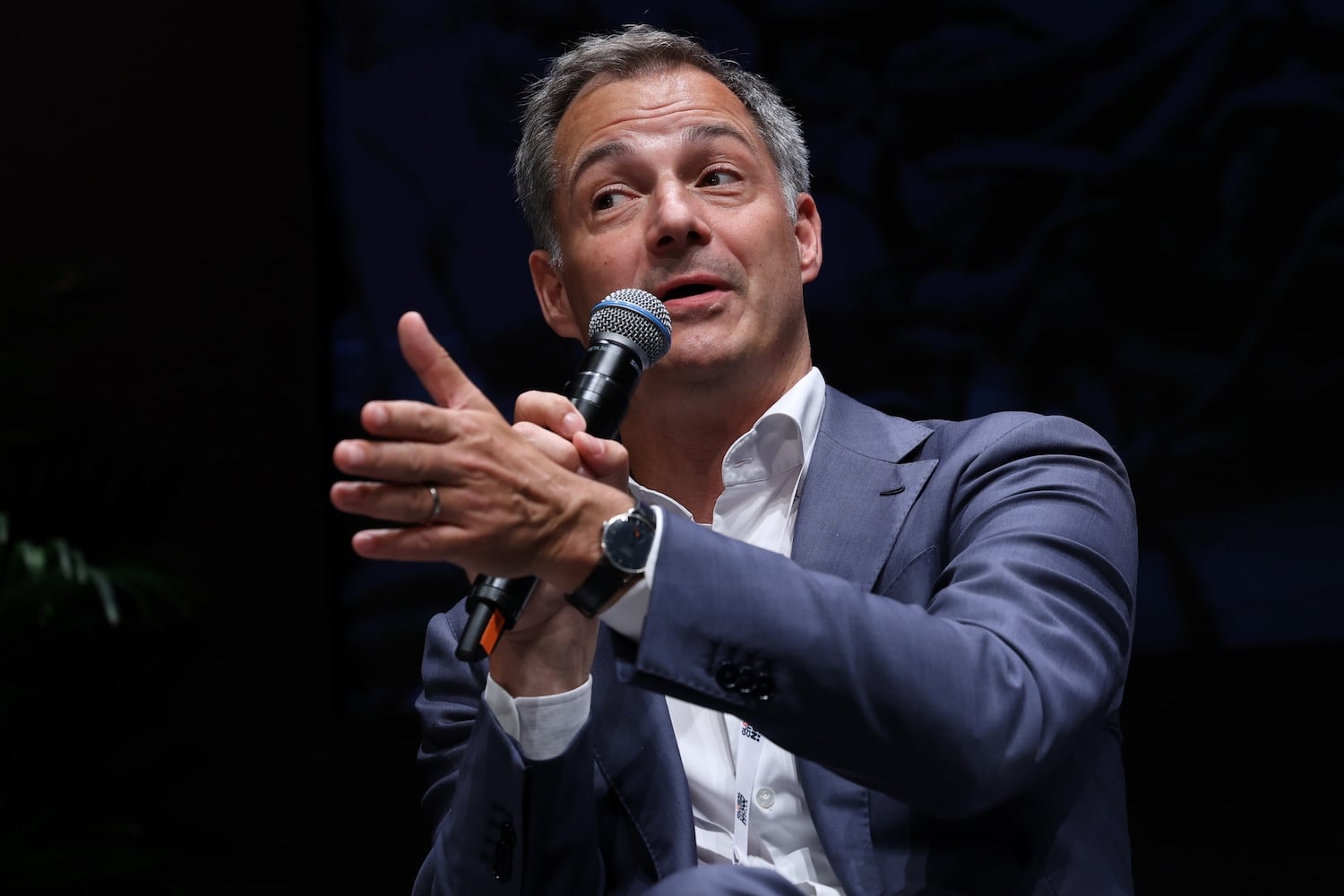
Development work is hard enough on its own, but how does one build infrastructure while a war is raging around you? According to Alexander De Croo, the administrator of the United Nations Development Program (UNDP), “if a crisis is ongoing, it doesn’t mean you should wait for the crisis to end before doing recovery work.” De Croo is a former Belgian prime minister—a role in which he was actively expanding his country’s defense budget—who is now finding ways to raise money for development work in Afghanistan, Gaza, Haiti, Ukraine, and beyond. I spoke with De Croo in front of a live audience at FP’s Development Forum, held last week on the sidelines of the U.N. General Assembly. The full interview is available in the video box atop this page or on the FP Live podcast on Spotify, YouTube, or Apple. What follows here is a lightly edited transcript. Ravi Agrawal: You just got back from Ukraine. Russia is hitting civilian and energy infrastructure regularly. How do you think about development in an environment where the very opposite is still ongoing—and could be for months and years to come? Alexander De Croo: Let’s first hope that it will not be ongoing for months and years to come. This is the majority of our work. The UNDP delivers about $5 billion in aid per year. Sixty percent of that work happens in conflict zones and fragile environments. This is, unfortunately, the state of the world we live in. We try to give the Ukrainian population a chance of having a decent life, and we do recovery work. People often have the view that recovery efforts happen once a crisis is over. That’s not how we work. In circumstances such as the one in Ukraine, you need to provide lifesaving aid, but you also need to focus on future-building from the start: making sure that the private sector can still function, that people have shelter, that healthcare and education systems keep functioning. If a crisis is ongoing, it doesn’t mean you should wait for the crisis to end before doing recovery work. RA: Give me some details on the work you are doing in Ukraine. Where can the UNDP be most helpful? ADC: The largest part of the work we do in Ukraine is on energy infrastructure. Today, energy security and security in the classic sense are intimately linked. No access to electricity means no schools, hospitals, water, or sewage. Available electricity, especially as it gets closer to winter—winters in Ukraine are not easy—makes the difference between surviving or not in a particular location. Today, 6.6 million Ukrainians are dependent on the work we do to continue providing them with electricity. The needs are gigantic. Half of the country’s generation capacity has been destroyed. We are building the energy infrastructure of the future. Classic energy grids are very vulnerable in a period of war, because if you target the chokepoint, the whole grid goes out. We are now building decentralized grids using renewable energy. This has advantages in many domains, such as on the cost side. But these are also grids with much more redundancy. We also build a lot of passive protection around this infrastructure, which the world has never done. In the past, electricity grids did not have to be built to be drone-resistant. This is, unfortunately, the new face of war. The face of war in Ukraine itself has dramatically changed. The front line used to be the “contact line” in eastern Ukraine. Today, the whole country is the front line. Civil infrastructure and civilians are being targeted. This is energy infrastructure, but it’s also shopping malls, buses, and border crossings. We are here in the context of the U.N. General Assembly; all of these things that are happening are the reason why we built the U.N. after World War II: to say these things should not happen again. Unfortunately, we’re in these circumstances again. The escalation of the war over the past weeks is a very dangerous evolution. There are many dimensions; you are sometimes inches away from an accident happening, and a whole sequence of things that could happen after that. RA: These new jet-powered drones, especially, are deeply worrying. I want to move to a different arena that is not in active conflict, though it has been for decades. You travel a lot. You have been to Afghanistan in recent months. I want to contrast this with Ukraine, because in Ukraine, you are working with a government that I imagine is simpatico, that has similar goals and objectives to what you do at the UNDP. In Afghanistan, of course, you have the Taliban now, which has a very different understanding of women’s rights, for example, than you do at the UNDP. Give me a sense of what development work in a place like Afghanistan means. ADC: We carry out our development work with local authorities—we are in discussions with the Taliban, but we don’t work together with them. In Afghanistan, we have almost completely eradicated the production of poppies, which are essential for opium production. Ninety-five percent of that production has been terminated. We have worked together with farmers on alternative livelihoods in typical agricultural and fruit production. We used a systems approach. We worked with the farmers to increase their productivity. Then we worked with food-processing companies and helped them raise capital—not public money, mostly private capital. Then we worked with those food-processing companies to raise and meet export standards. We helped them establish long-term contracts with buyers, which gives the farmers a certain level of stability. That has worked extremely well. Thousands of farmers today are part of that value chain. RA: And the Taliban did not interfere? ADC: No, they’re actually a partner in this. There was a drug production problem in Afghanistan; there was also a huge drug usage problem. So they’re a part of what we do. You mentioned the rights of women and girls. This is a gigantic issue—girls cannot go to school beyond the age of 12, which is totally unacceptable, but is also, from a development point of view, very poor policy. In a country like Afghanistan, the needs are gigantic; if you want to address those needs, and half of the population’s talent is not being used, that’s just really poor policy. This is a discussion we have on an almost daily basis. We have been successful in supporting women’s entrepreneurship. We have tens of thousands of women that we helped, in really small investments, to get their businesses going. That is more acceptable [to the Taliban] because it is being done at the regional level. So there are many challenges, but there are things that are working. We have very difficult conversations with what we call the de facto authorities in Afghanistan, and we know that U.N. member states very often have the same concerns. But we do not think turning our backs on Afghanistan today is a good idea. This is a country that has been in conflict for decades. If we turn our backs on it, you can almost guarantee that we will bear the consequences five, 10 years down the road. Despite all the differences of opinion, we need to engage with a country that is at the crossroads of almost every problem a country can have: an economic contraction of almost 20 percent; the impacts of climate change—natural disasters and last year’s heavy earthquakes; conflicts with neighbors; and, over the last year and a half, almost 5 million returnees from Iran and Pakistan. No country in the world—not even the most prosperous and stable—can say that they could deal with a 12 to 15 percent population increase because of returnees. This is extremely hard to manage. RA: So we’ve talked about Ukraine, we’ve talked about Afghanistan. Let me take you to another conflict arena that I’m afraid is much more polarized as an issue at the U.N. and among its member states: Gaza. You’ve also visited there recently. Give us a sense of how you work there, especially in the face of severe disagreement among your member states about the role of U.N. bodies there. We all know how U.N. bodies have been accused of being, in some cases, in cahoots with Hamas or involving Hamas operatives. There have been a lot of allegations of antisemitism hurled at the U.N. How do you navigate all of that in what is still, I’ll remind everyone, an active conflict zone, where many Palestinians have died this year, even after the cease-fire? ADC: I was in Gaza a few months ago. This is one of the most disastrous places I’ve visited, and I have been in many desolate places as the [Belgian] minister of development [cooperation] for six years. Gaza today is a place where you would wish every person, especially children, to not have to live. It’s dangerous everywhere, not just because of the attacks—more than 2 million people are being squeezed together in 30 percent of the territory. It’s a very dangerous place with gigantic hygiene and sanitation problems. We are active there, as are a few other U.N. agencies. We have proven over the past years—unfortunately it’s already been years—that we are capable and efficient, and we have earned the trust of all parties in that conflict because our priority is helping the population of Gaza, but we’re not deaf to the security concerns being voiced by Israel. We have proven that we are a partner that can be trusted. That doesn’t mean that we don’t have requests. Request number one is for more access. There’s so much more that we could do, and I think that we have proven that we can be trusted in this dual-use discussion. The second element is that there is a need for Palestinian leadership in Gaza. Today, Palestinian leadership is not authorized to be there. You cannot have—even if that zone is smaller now—more than 2 million people living without any type of political leadership. If you create that type of void, then something else comes in the middle. The third element is the need for security, for the inhabitants of Gaza, but also our staff. We need that violence to end. Yesterday, there was a meeting based on the Board of Peace, and there’s a list of projects coming out of that. There is a perspective of saying, look, moving forward, there needs to be governance reforms taking place in Gaza. My answer is, game on. Let’s go. We are ready to do that. We have the capability to achieve those governance reforms. But please—let’s not wait. Twenty-two thousand children have been killed in that conflict, and tens of thousands have lost their parents, a brother, friends. We cannot have a generation lost, and I don’t think we’re far away from that happening. We discussed a bit about what works, but we also have to be very clear on what isn’t working: the geopolitical power play and the conflicts that come out of that, with increasing energy prices, the increasing cost of living, and development gains that have taken decades to build being wiped away in just a few weeks. We cannot accept that, and we do not talk often enough—and I don’t want to sound all “flower power” here—about peace. Peace, and the end of conflict, is the basis of human progress, and unfortunately what is happening today isn’t human progress. What is happening today is development in reverse, and that isn’t just heartbreaking for us at the UNDP; it should be heartbreaking for all of us. RA: I couldn’t agree more. I want to ask you about how to raise funds for all of these things that you do. And the last time you and I spoke, you were wearing a different hat. You were the prime minister of Belgium. And when you were wearing that hat, quite understandably so, you were among a group of European leaders who were calling for more defense spending, for what is a very obvious reason, a massive threat from Russia. Now, you are calling for more development spending. Where is it coming from? How does it all add up? ADC: First of all, I still stand behind what I said years ago. There was a need in Europe to increase defense spending, and there is a good reason for that. At the UNDP, we don’t contest that. The financing of development is more than just public spending. We can have a long discussion about overseas development assistance going down; this is a fact. But the financing of development is way broader than public money. You also have financing by international financial institutions and regional development banks, private investment, remittances, and domestic resource mobilization. That is the full picture. If you look at the least developed countries throughout the world, more than half have a public budget that is less than 15 percent of GDP. Most of the developed countries have a budget between 40 and 50 percent. I’m not saying you should be jumping to that, but if you’re only raising 15 percent of GDP, then you shouldn’t be surprised that it’s hard to develop. Thirty percent of what we do at the UNDP is government development finance, which means we work in a country with their own money. Many people don’t know that helping governments is a big part of what we do—making sure that, in any place in the world, there are people making money. There is no problem with making money; I have no problem at all. But pay some taxes. I said some taxes—I didn’t say to the level of certain European countries. But paying a decent contribution when you are making a profit or having value added in a country is a logical thing to do. On raising taxes, many government leaders would say, “Oh, but it’s very different in my country.” But the basics of collecting taxes efficiently are actually quite textbook. For example, we do that with the Organization for Economic Cooperation and Development through a project called Tax Inspectors Without Borders. It’s a bit like Médecins Sans Frontières, but it’s not the doctor. It’s the tax collector man. RA: You’re being such a European in New York right now. ADC: I know, I am! But collecting taxes in an efficient way is a good way of financing your own development. RA: We’re almost out of time. Just very quickly, I have to ask you about the United States, which many of us have begun to see as the “wrecker in chief” of the liberal international order. How are you navigating the Trump era with reduced funding and also nodding to the fact that you want there to be fewer wars, but the United States has contributed to at least one more this year? ADC: The United States has been a contributor to the UNDP. They’re not anymore. At the same time, we have to acknowledge criticism of the U.N. Can we be more efficient? Yes. Is there too much overlap? Yes. Do we have to show more voluntarism in being the moral authority in the world, the one that is always looking to try to find a solution for conflicts? Yes, we need to improve these things. The United States has actually disbursed large amounts in humanitarian and other operations; not in development for the moment, but they have launched an initiative called Trade Over Aid, which we support at the UNDP, because if the United States says that trade is an important element of development, we agree with that. Trade, of course, goes in both directions, and trade is one of the things which can lead to better development outcomes—job creation, capacity building, and so on. The United States is one of 193 member states of the U.N. The political choices that are determined by domestic democracies are something we respect. Besides that, just give us a fair chance in showing what we are capable of. I think we are capable of providing quite some value in countries that believe in economic growth, which is to the benefit of populations throughout the world. If that’s the objective, we have something to offer.
‘What Is Happening Today Is Development in Reverse’
Full Article
Original Source
Read the full article at Foreignpolicy →KhanList aggregates and links to publicly available news content. We do not host full articles from third-party sources. Always verify important information with original sources.