
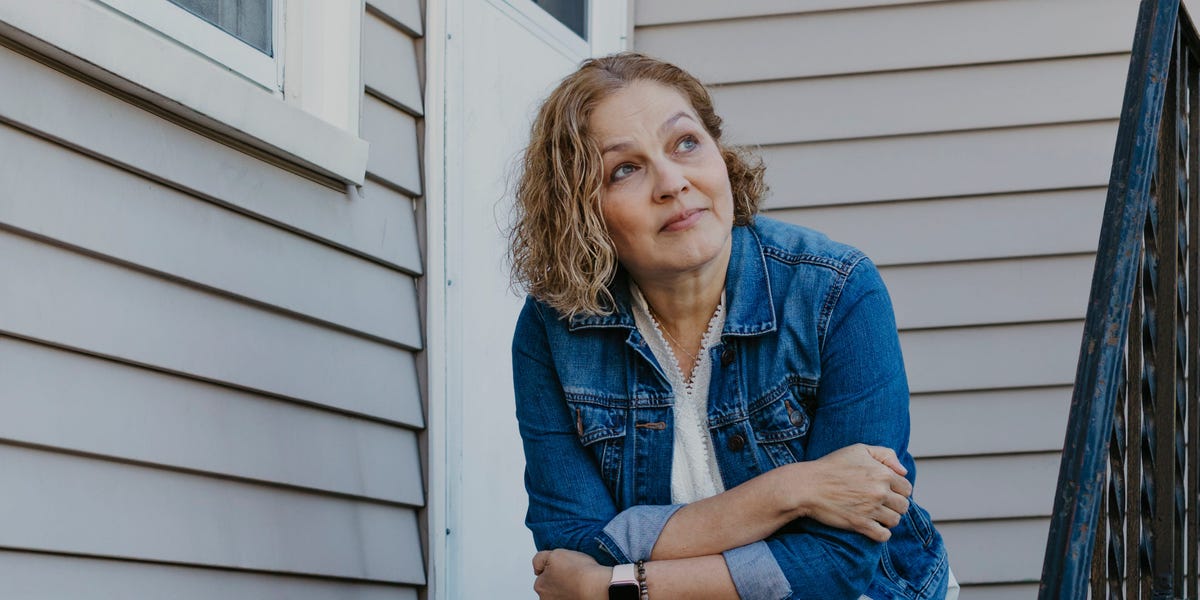
Maritza Ciliberto, 57, has been on anti-amyloid treatments for over a decade. Can they prevent her from developing dementia? Hannah Latham for BI What if we could stop Alzheimer's before it ever starts? Maritza Ciliberto, 57, has been on anti-amyloid treatments for over a decade. Can they prevent her from developing dementia? Hannah Latham for BI Growing up in Guayama, a town nicknamed "witch city" in Puerto Rico, Maritza Ciliberto heard the rumors that her family was cursed.She didn't believe in curses, rejecting the idea that anyone could ever deserve to get sick, but she did believe there was something lurking in her relatives' brains — a "sleeping, giant monster" waiting to emerge.First, it came for her grandmother, who struggled with daily chores. Then her mother, who began repeating the same questions over and over. Eventually, her mother, two of her aunts, and one uncle died from a rare and inherited form of early-onset Alzheimer's disease due to a genetic mutation.Ciliberto knew she could be next.Now 57, she's lived past the age when her relatives began experiencing cognitive decline. And for more than a decade, she's been trying an extraordinary treatment, hoping to keep her mind intact. Ciliberto is a retired school principal who speaks three languages. Hannah Latham for BI Every two weeks, a nurse comes to her home to administer an experimental Alzheimer's drug intravenously, a process that takes about three hours. It's a lifelong therapy routine with serious potential side effects, including the possibility of brain bleeding.The technique, still under investigation, requires a big commitment from people who show no outward signs of decline. She's endured migraines, anxiety, and years of medical monitoring, all in the hope of preventing the illness that has afflicted her family for generations.Ciliberto is part of a small cohort of people helping scientists explore a provocative possibility: What if Alzheimer's could be stopped in its tracks before symptoms set in?Over 50 years and billions of dollars have been poured into Alzheimer's research, and still, there are no great treatments. Even the best drugs have only modest benefits, slowing the progression of the disease. Now researchers are testing whether those same treatments could prevent the dementia "monster" from ever waking up by clearing out the amyloid plaque that seems to propel Alzheimer's.Ciliberto doesn't know yet whether the drugs are working. Neither do her doctors. Still, the implications are huge, and not just for people like her with a genetic predisposition. Several new and unconventional clinical trials are testing preventative treatments in people who have no symptoms yet but appear to have Alzheimer's related changes in their brains.The new research raises an existential question: If a treatment could reduce — or wipe out — your risk of developing dementia, how much would you risk to get it? Every two weeks, Ciliberto sits down for an intravenous infusion of anti-amyloid drugs. The whole process, which includes bringing the chilled fluid up to room temperature, takes about three hours. Hannah Latham for BI Scientists are shifting from treatment to preventionFor more than 120 years, doctors have tried to treat Alzheimer's disease after symptoms appear with barely any success.The best doctors could do was prescribe drugs that helped temporarily manage symptoms, like antidepressants for agitation or neurotransmitter-boosting drugs for confusion. Then, a few years ago, doctors started prescribing a new generation of treatments designed to attack the disease itself by flushing out amyloid plaques that clog the brain.The first, Aduhelm, was controversially approved by the FDA in 2021 at a speculative stage, and was later taken off the market after disappointing results. Two newer amyloid-clearing drugs have since been approved, using the same technique but with stronger clinical data.Experts are still torn about the utility of these treatments. A recent independent analysis of the available evidence published in the gold-standard Cochrane Review generated a ton of heated discussion in the field when it found the dementia-slowing effects of these new anti-amyloid therapies to be "trivial" at best, while still increasing the risk of potentially deadly brain bleeds. Still, what if the drugs weren't working well because they were being given at the wrong time? By the time people with Alzheimer's are showing the first signs of memory loss, forgetting where they put their keys, missing appointments, or getting confused while doing everyday chores, their brains have been quietly changing for decades. Scientists are investigating whether the real reason that amyloid-clearing drugs haven't worked very well yet is because they're being given to people too late.Ciliberto and 39 others like her are among the first patients to help test this theory. And doctors say that after a decade of monitoring, their data looks promising."When you look at them, the earlier the person was when they started that treatment trial, the better off they did," Dr. Randall Bateman, the neurologist running the DIAN clinical trial that Ciliberto is part of at Washington University School of Medicine in St. Louis, said. "That's an arrow. It's saying: Go earlier. Go earlier!'" Dr. Randall Bateman directs the Dominantly Inherited Alzheimer Network (DIAN) trial that both Ciliberto and Heinrichs are in at WashU Medicine. Matt Miller/ Washington University School of Medicine It's still too early to be sure, but by 2030, if the results still hold, "it will be incontrovertible proof that we can delay the onset of dementia," he said.Ciliberto has re-molded her life around taking this drug. First, she did it quietly while still a busy public school principal, a mom, and a student finishing her doctorate degree. Now retired, she fits the twice-monthly treatments around a less stressful, but ever-busy schedule.Could this work for the rest of us?Ciliberto's genetics make her an unusually clear candidate for preventive treatment. For most people, the calculation is less straightforward.New blood tests can find out if amyloid is building up in your brain, but that alone doesn't mean you'll have dementia. Neither does the presence of genetic markers like APOE4, which is associated with a higher risk of Alzheimer's.That hasn't stopped drugmakers from exploring repurposing their existing drugs to test if they can be used as preventive treatments. Both Eli Lilly and Eisai, the two drug companies with anti-amyloid therapies on the market, are testing their infusions in people who have no outward signs of dementia, but who have high levels of amyloid in their brains. Initial results are expected in 2027 for Eli Lilly, and 2028 for Eisai.If it works, Alzheimer's — a disease that's long been considered a slow, heartbreaking and inevitable march toward death — could be relegated to the category of chronic, manageable age-related conditions, like high blood pressure, high cholesterol, diabetes, or arthritis. It's a huge gamble to make, but if the bet pays off, it would be transformative, arresting a disease that hits 1 in 9 Americans over 65."Nobody cares how much amyloid is really in your brain," neuropsychologist Laurie Ryan, chief of the clinical interventions and diagnostics branch at the National Institute on Aging, said. "You care if you get dementia, right? That's really what we want to stop."Leading neurologist Richard Isaacson, who's been focused on treating and preventing Alzheimer's for decades, is skeptical. He said there's no way this treatment is going to solve Alzheimer's."In the right person, at the right dose, and used for the right duration of time, I believe that anti-amyloid drugs could be a really important additive treatment for people at risk for developing dementia," said Isaacson, who wasn't involved in any of these anti-amyloid trials.As a doctor, he is both excited and extremely cautious about where these treatments are headed. He's seen, over the past five years, how well some patients do on these new drugs, but he's also seen patients with lots of amyloid plaques who don't ever develop signs of dementia, while in other cases, "you could do everything right," and yet "these drugs don't help them.""I go back to the old saying: Once you've seen one person with Alzheimer's, you've seen one person with Alzheimer's," he said.For some patients, this trial has given them hope to make plans Initially, the anti-amyloid medication triggered migraines in Ciliberto, and she would get anxious about her appointments. Now, she says, it's like "nothing." Hannah Latham for BI Ciliberto is confident the strategy is working for her. She said she has regular consultations with an independent neurologist and neuropsychologist, tracking her brain data. She needs that reassurance, the flood of information suggesting that what she's doing, and the energy and stress she's taken on, is really worth it.She knows lifestyle plays a role, too. Already fluent in three languages, she's back in school, earning a master's degree in theology and working toward a lifelong dream: becoming an ordained minister at her church."I just don't want the stress of the type of high-demanding job that I had before, because I also know that stress was not helping me," she said.Like Ciliberto, Jake Heinrichs has remolded his life around the idea that the amyloid-clearing drugs he's been taking for more than a decade are working. They've convinced him to become something he never thought he would: a father. Jake Heinrichs is a theater electrician on Broadway. Marcus Madoxx for BI Heinrichs' dad developed Alzheimer's when he was still a little boy, and had died by the time he was 14. His older brother, David, died from Alzheimer's several years ago, at age 49. He knew if he was going to get this disease, he didn't want to give another generation this pain.Heinrichs is 52 now, already three years older than his brother was when he died of Alzheimer's, and he's showing no signs of cognitive decline."In Jake and other people's cases, they are discovering that Alzheimer's is going to be a chronic condition — potentially — rather than a fatal condition," his wife, Broadway producer Rachel Chavkin, said after dropping off their son at soccer practice. "It will be about prevention, not about treatment."That conceptual shift, from helplessness to empowerment, has been the shift that Heinrichs needed to become a father."We decided that this is something that we can do with our future: to make a family and not live in terror of passing that part of my gene on to my kid," Heinrichs said. "In my life, my kid is the physical embodiment of my hope." Heinrichs lost his dad to Alzheimer's when he was a teenager. Marcus Madoxx for BI Every year, Heinrichs heads to Washington University in St. Louis to check his progress, with three days of brain scans, blood draws, a painful lumbar puncture to tap into cerebrospinal fluid, which can reveal the buildup of Alzheimer's-related proteins, including amyloid. He also sits for some interviews to test his memory."You did good," Chavkin said, eyeing him across the coffee table, remembering their most recent visit."I did all right," he said, smiling. "But I was cheating."Heinrichs said he employed what's called a "memory palace" technique to remember some of the details on his mental exam. The visualization strategy can be a tool to aid memory and recall, but it requires building an imagined physical space to place objects or facts you need to remember inside your head. It's certainly not a technique someone with dementia would be very good at.Already, wealthy clients are pressing their doctors for early access to these drugs, an elite trend Bateman said he is aware of, though he insists he's not participating in it. It's not only an ethical principle that keeps him from prescribing the drugs prophylactically, but it's a scientific one as well.Bateman knows there is no way to pinpoint precisely which patients with high levels of amyloid will develop Alzheimer's. With familial Alzheimer's, disease progression is a given. For the rest of us, there's the possibility you'd take a medication with real, serious side effects, and get no upside."I'm not ready to do that," Isaacson said of using anti-amyloid drugs preventatively. Heinrichs didn't think he'd ever want to have kids, but being in the trial changed his mind. Marcus Madoxx for BI 'It's just like sitting at a spa'Early trial results have encouraged Cilberto, especially when she thinks of her kids, who are now starting their careers and settling down. "The science, now more than ever before, it's projecting a very hopeful future," she said.Twice a month, she hosts a little tea party. She brings out cookies and warm Irish tea and invites just one special guest into her living room. It's her nurse, who will deliver the IV infusion of anti-amyloid therapy she hopes will protect her mind. The whole process takes about three hours, including time for warming up the infusion, taking anti-nausea medication, and plugging it into her arm. Often, there's a nap in the middle of the party.Teatime helps Cilberto remain calm. She used to get migraines and had anxiety about the appointments. "Now it's like nothing. It's just like just sitting at a spa," she said.Back in Brooklyn, Heinrichs also opens the door to a nurse every two weeks to dispense his drug. It's a bit like welcoming in an old friend who happened to be in the neighborhood."He's my age, and we get along very well and we hang out," Heinrichs said. When his young son wonders what's going on, the responses are simple: doctors are studying dada's brain, and dada's getting some medicine. He thinks of his older brother David, who died of Alzheimer's in 2019, and was only four years older than him."The difference in the outcome of those four years has been everything," he said. "It's given me a family. It's given me hope." Longevity Most popular Business Insider tells the stories you want to know about the world of business, technology, and finance Business Insider tells the stories you want to know about the world of business, technology, and finance Business Insider tells the stories you want to know about the world of business, technology, and finance Business Insider tells the stories you want to know about the world of business, technology, and finance Business Insider tells the stories you want to know about the world of business, technology, and finance Business Insider tells the stories you want to know about the world of business, technology, and finance Hilary Brueck is a Health Correspondent at Business Insider, where she covers longevity and the quest to improve human aging. She also writes regularly about the complexities of diagnosing and treating cancer, the evolving landscape of GLP-1 drugs, new developments in exercise science, and expert-backed nutrition advice. In general, she relishes any opportunity to unpack scientific discoveries or examine the latest consumer trends. Her reports have ranged from exploring how sherpas effortlessly climb into the thin air 29,029 feet above sea level to summit Mount Everest, to trudging along a Jersey shore beach with scientists fighting killer pandemic flu viruses by studying bird butts.She spoke with Dr. Anthony Fauci about his vitamin and supplement routine over a cold slice of pizza, and chatted with the world's oldest Nobel Prize winner in his basement solar lab. She also went an entire month without eating any ultra-processed foods (yes, it was time-consuming and challenging). A graduate of Columbia Journalism School and former Peace Corps Volunteer, Hilary speaks English, French, and Malagasy. Previously, Hilary reported for ABC News Radio, Fortune, Forbes, and Al Jazeera America. In her spare time, she likes to run, hike and she is also an aspiring (but very bad) surfer. If you've got a pressing health question, tip, or concern, reach out to hbrueck@businessinsider.com
What if we could stop Alzheimer's before it ever starts?
Full Article
Original Source
Read the full article at Businessinsider →KhanList aggregates and links to publicly available news content. We do not host full articles from third-party sources. Always verify important information with original sources.