
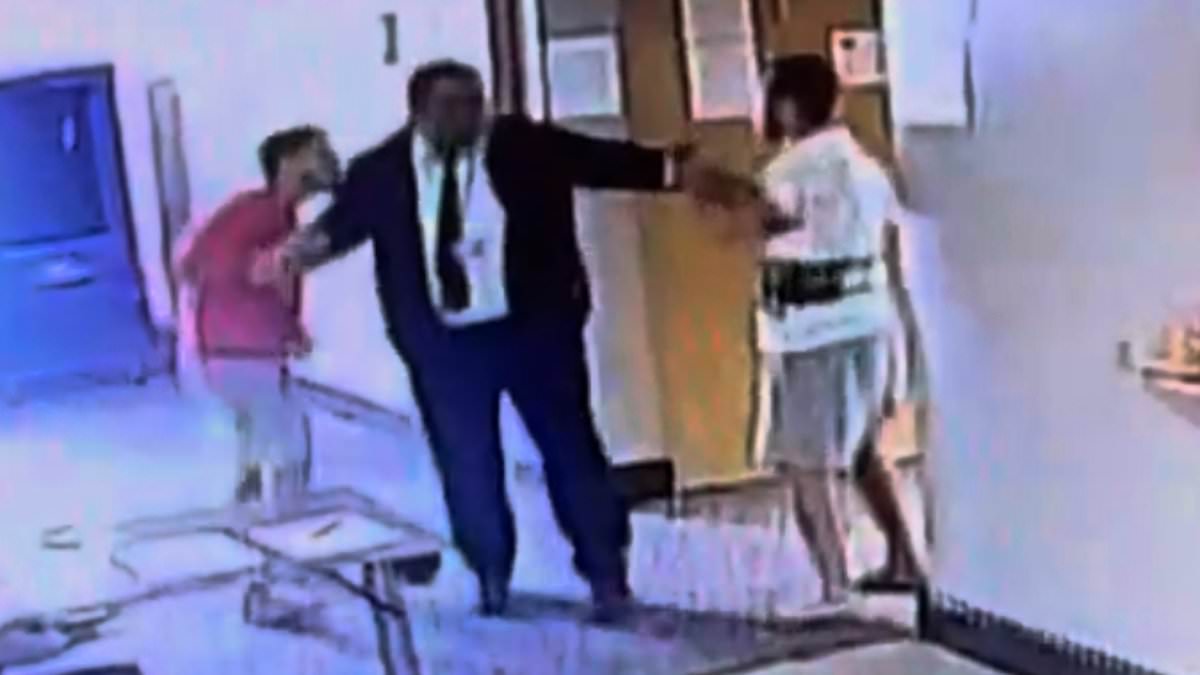
Among the most chilling aspects of Kieran Chamley's new job at the four-star Manchester Airport Stanley Hotel was an instruction issued to staff.After the hotel had taken on what was described only as a 'private contract', his employers told him and his colleagues to keep a hammer and towel behind reception.Should they find themselves in danger, they were to lock themselves in the back office, smash the window with the hammer and drape the towel over the broken glass before clambering out to safety.Those briefed on this chilling escape procedure included women as young as 18, earning the minimum wage in their first jobs in hospitality.They were also told to carry what Kieran describes as 'rape whistles', for it turned out that the hotel would be catering not for holidaymakers or business travellers, but for male illegal migrants staying there at taxpayers' expense.Many of the men had come from poor, chaotic countries with failed governments, where violence is a normal part of everyday life and disputes are settled with fists or knives rather than by the police or the courts.Add to that the boredom and frustration of months spent in enforced idleness and the presence of some individuals capable of extraordinary violence, and the staff were dealing with situations for which nothing had prepared them.Over the next two and a half years, they would discover knives in bedrooms and witness bloody fights between residents. Kieran Chamley has revealed what he saw during his time as a manager at the Manchester Airport Stanley Hotel, which was hosting male illegal migrants Kieran revealed that bloody brawls between the residents were a regular occurrence The staff were dealing with situations that they were largely ill-prepared for, such was the challenge inside the hotelSome of the young female employees became so frightened that they had to be accompanied on their cleaning rounds and escorted home from work. Residents would return late at night drunk or apparently high on drugs. Kieran recalls men smoking cannabis, while white powder and drug paraphernalia were left openly displayed in bathrooms when staff came to clean.'Every single day you would see that,' he says.These shocking revelations come in an exclusive interview for my YouTube channel, which explores the untold stories behind Britain's immigration debate.Such first-hand accounts are extremely rare, perhaps because staff at Britain's migrant hotels fear being branded racist for speaking out.But, like many people, Kieran feels a growing sense of unease as Labour moves to end the use of migrant hotels, more than 400 of which were in operation at their peak in 2023.That would be something to applaud if ministers had the stomach for the radical measures necessary to secure the removal of those with no right to be here – leaving the European Convention on Human Rights and scrapping the Human Rights Act.Instead, they are simply moving asylum seekers into alternative accommodation. Some will be transferred to large-scale centres, often on former military sites, such as the recently approved one less than half a mile from the quiet Oxfordshire village of Piddington (with a population of just over 300).Others will be housed in residential streets in our towns and cities, and Kieran worries that the dangers he and his colleagues faced will simply be foisted on unsuspecting communities, despite official reassurances to the contrary.In September last year, the Home Office insisted that the safety and security of hotel employees, asylum seekers and local communities was 'of paramount importance'.Yet less than a year earlier, in October 2024, Rhiannon Whyte, a 27-year-old mother-of-one, had been murdered on her way home from work at the Park Inn hotel in Walsall. Her killer, Sudanese asylum seeker Deng Chol Majek, was a resident of the hotel. In January this year, he was jailed for life with a minimum term of 29 years.'I'm not surprised that an incident like that has happened because [these hotels] are not secure,' Kieran told me. 'It's just a bedroom factory, really. And in terms of some of the mental state of the users that we had, over 50 per cent of them would be a worry to you.'It was not the future he had envisaged for a hotel he knew well. Formerly known as the Belfry House, the 88-bedroom establishment in Handforth, Cheshire, had undergone an extensive refurbishment and was latterly part of Best Western's Signature Collection.Having previously managed its spa, Kieran was delighted to be offered employment there again as Britain emerged from the pandemic, joining as front-of-house manager in September 2021 and rising to become the hotel's deputy manager. Female staff were warned to carry 'rape whistles' as they went about their duties at the Manchester Airport Stanley Hotel Kieran recalled seeing police officers attend perhaps only one in four fights - with the culprit returning to the hotel within hoursWhat particularly disturbed Kieran was how little he and his colleagues knew about the backgrounds of the men in their care.One openly claimed that he had fled his own country after killing his wife. Far from being a secret divulged in a moment of confidence, it was a story the man seemed happy to repeat.'Everybody in the team had heard that story from him, which is why we thought, why is he so blasé about it?'Kieran had no way of telling whether the man was a murderer or merely trying to intimidate staff. He thinks a colleague may have reported the matter to Serco, the government contractor responsible for accommodating the men, but has no idea whether any action was taken.Initially, there were security guards stationed on every floor but these were subsequently withdrawn, according to Kieran, leaving a couple on the entrance doors and sometimes only three or four hotel employees on duty.Cleaning the residents' bathrooms could be a particularly unnerving task. 'In two or three rooms, we found knives,' he recalls. They also came across bricks in bedrooms, the purpose of which he could only guess at.Little wonder that some of the female employees were apprehensive about entering the rooms, particularly those of men they had seen being brought back to the hotel in handcuffs following fights in Manchester city centre.So concerned was Kieran about their safety that he and other male colleagues devised a buddy system, accompanying them on their cleaning rounds.On one occasion, Kieran caught a resident filming a young female employee on his mobile phone and intervened to make him delete the footage. Other women complained of being followed on their way home, prompting him either to accompany them himself or arrange taxis for them.Adding to the nightmare was the surreal experience of having to complete online courses in how to run a bar and manage hotel staff, as if it were business as usual. What the staff desperately needed, of course, was training for the job they were actually doing.'No one from Serco came in to train us,' says Kieran.Quite what they were up against is apparent from CCTV footage I have obtained of some of the fights at the Stanley. The men tended to congregate according to nationality and, although staff knew little of the underlying rivalries, something as innocuous as someone jumping the queue at mealtimes could provoke a brawl involving a dozen or more people. 'Every day would be an exaggeration, but it was not rare that fights would break out,' says Kieran. 'They would be really, really violent.'Bloodied faces and knuckles became familiar sights. When fighting erupted in reception, staff would lock themselves in the back office and watch events unfold on their security cameras.With Serco responsible for reporting incidents to the police, Kieran recalls seeing officers attend perhaps only one in four fights. 'It was a tough job': The manager recalled how there was a high turnover of staff at the hotel as they struggled to deal with multiple issuesEven when they took away the principal culprit, he says the man could be back within a couple of hours. There were times when he was tempted to call the police himself but he worried about jeopardising his job, having been instructed to leave such matters to Serco.He suspects that some of the Serco staff were themselves intimidated, preferring to ingratiate themselves with residents by giving them extra toiletries, rather than risk confrontation. When manning the reception desk late at night, he was acutely conscious of how quickly an aggressive resident might reach him before security could intervene.'That was in the back of your mind every single shift,' he says.In one particularly unnerving incident, a man apparently under the influence of drugs threw himself against his bedroom walls, head-butted his television and ripped off a glass door. His face was covered in blood and police had to wrestle him to the ground before taking him away.Other times, carpets were burned and wardrobes smashed. One resident spray-painted graffiti all over his accommodation. 'Damaging the rooms would be a daily occurrence,' says Kieran. 'Unfortunately, it just became normal.'Those responsible often escaped with little more than a verbal warning, only to repeat their behaviour a few days later.'Serco wanted an easy life,' he says, recalling how hotel staff were told to stop getting involved when they asked for action.The bills for repairs were passed to Serco, adding to the already substantial cost to the taxpayer of accommodating the men.That included the £87,000 paid to the hotel each week, even though he claims it was rarely full.On top of that were the costs of laundering the men's clothes (everything was dry cleaned and ironed for them weekly), which ran into thousands of pounds, he says. Then there were toiletries, clothing and footwear, taxis to medical appointments and generous meals three times a day, courtesy of a good chef.'The food they get is unreal, and there's a lot of it,' he adds.Yet even attempts to reduce the number of chocolate bars or pieces of fruit available to each resident could provoke hostility.Kieran recalls one man threatening to smash a jug of milk over his head when he tried to prevent him taking the entire supply intended for that particular meal up to his bedroom.Such incidents were galling for minimum-wage employees who might have washed a thousand pots in the course of a day's food service. 'It was a tough job,' he says. He believes that the disparity between their circumstances and those of the people they were employed to look after contributed to the high turnover of staff. Some of the men at the Stanley appeared to be in genuine need of asylum, including Iranian Christians fleeing persecution. But other residents gave different reasons for coming to Britain.Others allegedly spoke of coming to Britain for access to the NHS or of eventually living on benefits and bringing their families over.Kieran left the Stanley in February 2024. In response to his allegations, Serco said there were strict Home Office procedures for reporting incidents and that training hotel staff was the responsibility of their employer.It said it needed more details to investigate specific incidents and declined to disclose commercially sensitive costs.As for the hotel, that has reverted to its former use under new ownership, with rooms costing about £80 a night. When I visited it recently, the car park was full of vehicles left there by people flying out of Manchester Airport. There was little to suggest its previous incarnation.But what about the men whose behaviour had caused Kieran and his colleagues such concern?When the Stanley housed migrants, there were at least security guards, CCTV cameras and staff on hand to summon the police. Who will monitor the behaviour of known troublemakers once they are dispersed into residential neighbourhoods?'I wouldn't be comfortable if they were living next door to me with my children in the house,' says Kieran.A responsible Government would heed his warnings and deport those who entered Britain illegally, starting with those with a record of violence.But my fear is that Labour's ideological obsession with international law and so-called human rights will take precedence over the safety of the British public – and that the price will be the loss of yet more innocent lives.Watch Inside The Migrant Hotel, a film by Steven Edginton on his YouTube channel. Visit stevenedginton.com
What I saw as a migrant hotel manager: Drugs and knives stashed in rooms, bloody brawls between 'residents', female staff leered at - and staff given training in how to flee to safety. A whistleblower tells all to STEVEN EDGINTON
Full Article
Original Source
Read the full article at Dailymail →KhanList aggregates and links to publicly available news content. We do not host full articles from third-party sources. Always verify important information with original sources.