
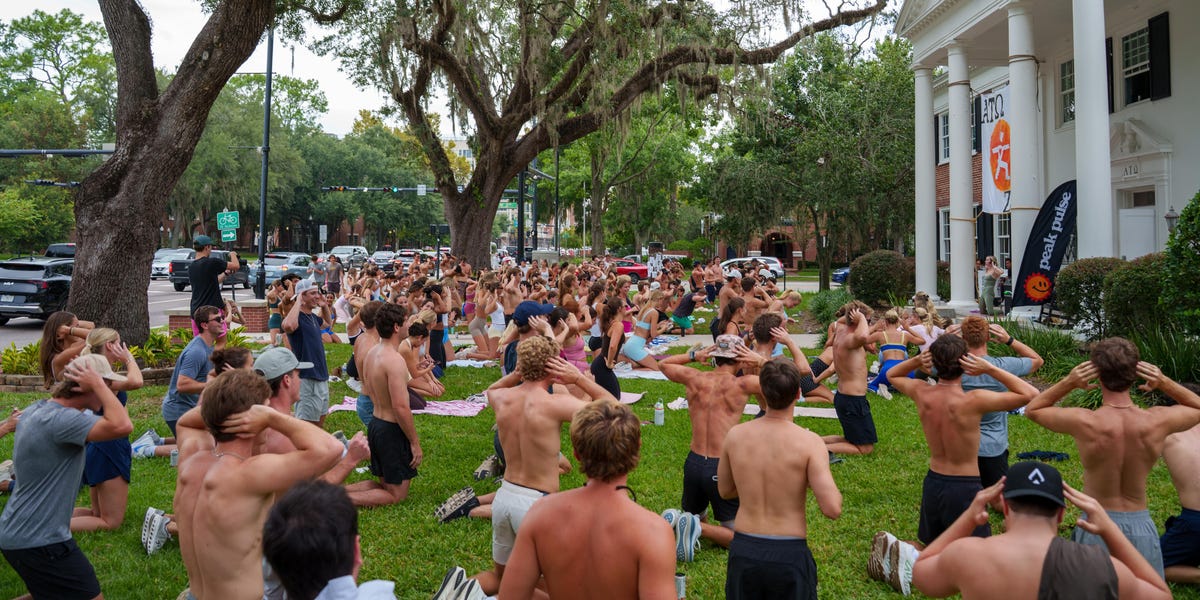
At the University of Florida, Saturday morning now has its own kind of party. Peak Pulse, a Gainesville run club founded by lifelong runner Aydan Child, has drawn hundreds of students to events where the miles come with DJs, cold plunges, coffee, matcha, and plenty of hanging around afterward.Naturally, the internet already gave it a name: the “wellness darty.” Think of it as a daytime college party (darty) that’s stripped of the booze-first premise and rebuilt around exercise, recovery, and actually remembering the afternoon activities.Child started Peak Pulse after graduating because he wanted more ways to meet people without making drinking the default social plan. As a lifelong runner, he started there. Maybe 10 people came at first; before long, more than 100 were showing up regularly, enough for Child to try something bigger.He paid for the first larger wellness event out of pocket and kept it free. For the next, he charged $10 to test whether people would actually pay for the whole experience—and about 300 people did. “That was a big moment for me because it proved people weren’t just coming because it was free, [and] there was real demand for this kind of social wellness experience.”UF student and Peak Pulse ambassador Jocelyn Riley has been going for a little over a year, usually at least once a week. She ran in high school and liked carrying that part of her life into her college social circle.And Riley was there well before “wellness darty” became the internet’s shorthand for what Peak Pulse was doing. “I was at both of the ‘wellness darties’ that ended up going viral even though we didn’t call it that, and the internet seems to think they are one event,” she said.At one of them, sorority members walked over to a fraternity house in groups, laid out their mats and started catching up before anything resembling a workout began. Riley says Child often waits about 20 minutes after the posted start time before getting everyone moving. “You’re kinda ‘forced’ to chat before the running starts,” she said.Peak Pulse | Ari Meyerowitz | Davis ChandlerPeak Pulse runners stack some miles around Gainesville.For all the extras surrounding the run, Riley says the workout is still what pushes her out the door. “The run gets me there, and the people are what keep me there after the run,” she said. The DJ, plunges, and whatever comes next are the “treat” after putting in some work.Child’s own relationship with running helps explain why he built Peak Pulse around the activity.“I love running—and running can suck sometimes—but that’s also part of what makes it so great,” he said. “There’s something about doing something hard alongside other people that naturally brings you together.”He also likes how little the sport asks of someone trying it for the first time. No membership is required, and you don't need much equipment beyond shoes and somewhere to go. Walking groups are welcome, and one of Peak Pulse’s mottos since the early weeks has been, “Run, Walk, or Crawl—All Levels Are Welcome.” Child says he hated hearing “I’m not a runner” when he invited people out, because showing up was supposed to be enough.Peak Pulse | Ari Meyerowitz | Davis ChandlerAn attendee attempts a cold plunge belly flop.Peak Pulse | Ari Meyerowitz | Davis ChandlerNo beers here. Just prebiotic sodas.The club is much less interested in another trend attached to run clubs lately: dating. Riley calls Peak Pulse “the antithesis of a dating scene” and says Child avoids dating-themed programming.“I have a boyfriend, but even if I didn’t, I wouldn’t show up to a run club with the idea of dating,” Riley said. She has no interest in turning up feeling obligated to wear her most expensive workout set, do her hair, and put on a full face of makeup. “At my core, I am a runner, so I go to a running club.”Riley connects some of the appeal to something one of her UF professors, sociologist William Marsiglio, calls “we-ness”: the pull toward group belonging after people have done something difficult together. By the time the run is over, everyone has already shared something before the rest of the morning gets going.For Child, that sense of connection doesn’t have to come at the expense of a Friday night. Peak Pulse—which also has chapters in Tallahassee, Orlando, Boca Raton, and the Florida Keys—isn’t trying to “replace partying or tell people how they should spend their weekends,” he said. “We’re just creating another option for community and connection.”He thinks younger people are becoming more comfortable taking care of themselves now instead of postponing it until some hypothetical responsible-adult era. Peak Pulse was seeing that appetite well before “wellness darty” entered the vocabulary, and fraternities, sororities, bars, and other organizations have since approached the club about hosting events of their own.That still leaves the question underneath all those viral clips: What happened to college kids drinking and partying? Riley calls UF the “work hard, play hard capital of the SEC.” Students might go out earlier in the week, keep Friday quieter for Peak Pulse Saturday, rally after a friend’s birthday, or just skip a week and come back later.“To all the adults and UF alum out there reading this, fear not, we are still having a great time at Midtown bars and going crazy on game days,” Riley said. “I just think there is a push to find social outlets that don’t completely revolve around drinking.”And as it turns out, there’s room in the weekend for both.Find Your Next Running PlaylistSean Abrams was the Senior Editor, Growth and Engagement at Men’s Health. He’s a former hip hop dancer who likes long walks on the beach and large glasses of tequila. You can find his previous work at Maxim, Elite Daily, and AskMen.
What Happened to the College Party? On Some Campuses, Gen Z Would Rather Run.
Full Article
Original Source
Read the full article at Runnersworld →KhanList aggregates and links to publicly available news content. We do not host full articles from third-party sources. Always verify important information with original sources.