
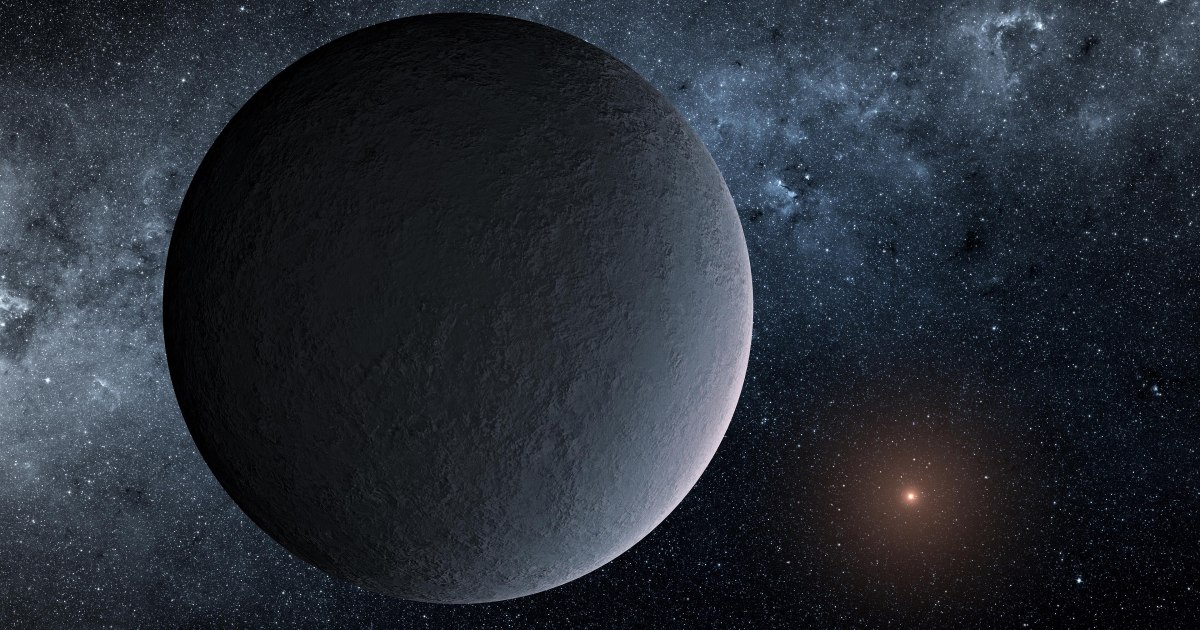
Astronomers can use lensing to learn about everything from the makeup of the universe to the nature of extrasolar planets. | Published: October 12, 2026 While gravitational lensing supplies astronomers with a variety of details about massive objects such as galaxies and clusters, microlensing allows them to discover much smaller objects — like planets. Nearly 13,000 light-years away, icy OGLE-2016-BLG-1195L b was the lowest-mass planet discovered through microlensing when the Spitzer Space Telescope sighted it in 2017. Credit: NASA/JPL-Caltech What information is obtainable through gravitational lensing and how? Patrick A. CloughWichita, Kansas Gravitational lensing is the effect by which comparatively nearby objects, such as clusters of galaxies, can bend and focus the light of other objects that are more distant. Lensing is only possible because highly massive, and therefore gravitationally powerful, objects distort the space-time continuum around them. Astronomers can glean various types of information from this distortion. For instance, since lensing focuses and therefore intensifies the brightness of galaxies from the early universe, it enables astronomers to study them in greater detail. Another application involves measuring the amount of distortion caused by the lensing in order to estimate the mass of the celestial objects responsible for it: the greater the distortion, the higher the mass. And by comparing the degree of lensing caused by foreground objects with the amount of lensing that the visible matter present in the same region would cause, astronomers can also map the distribution of dark matter within these objects. Microlensing, which is caused by considerably smaller celestial objects such as stars and planets, enables astronomers to find exoplanets that are in orbit around remote stars, such as those around the galactic center. If a star appears precisely behind another star from our perspective, the light from this background star will pass along all sides of the intermediate, or “lensing,” star; the lensed star will appear to suddenly brighten to hundreds of times its original brightness. If a planet is in orbit around the lensing star, it will produce another spike in brightness through its own lensing effect, and the planet’s presence will be revealed. Microlensing can also enable astronomers to find rogue planets, or planets that are not gravitationally bound to a star. A rogue planet can be detected if it moves directly in front of a distant star and distorts its light. Its size can be estimated by the duration of the lensing event: the larger the planet, the longer the distortion. An exhaustive list of gravitational lensing applications would exceed the space available here, but the above are examples of the common ways in which astronomers can use the space-time-bending properties of matter to both analyze highly massive structures such as galaxy clusters and discover micro-objects that could not be discovered by any other known means. Edward Herrick-GleasonAstronomy Educator, St. John’s, Newfoundland and Labrador
What can we learn from gravitational lensing?
Full Article
Original Source
Read the full article at Astronomy →KhanList aggregates and links to publicly available news content. We do not host full articles from third-party sources. Always verify important information with original sources.