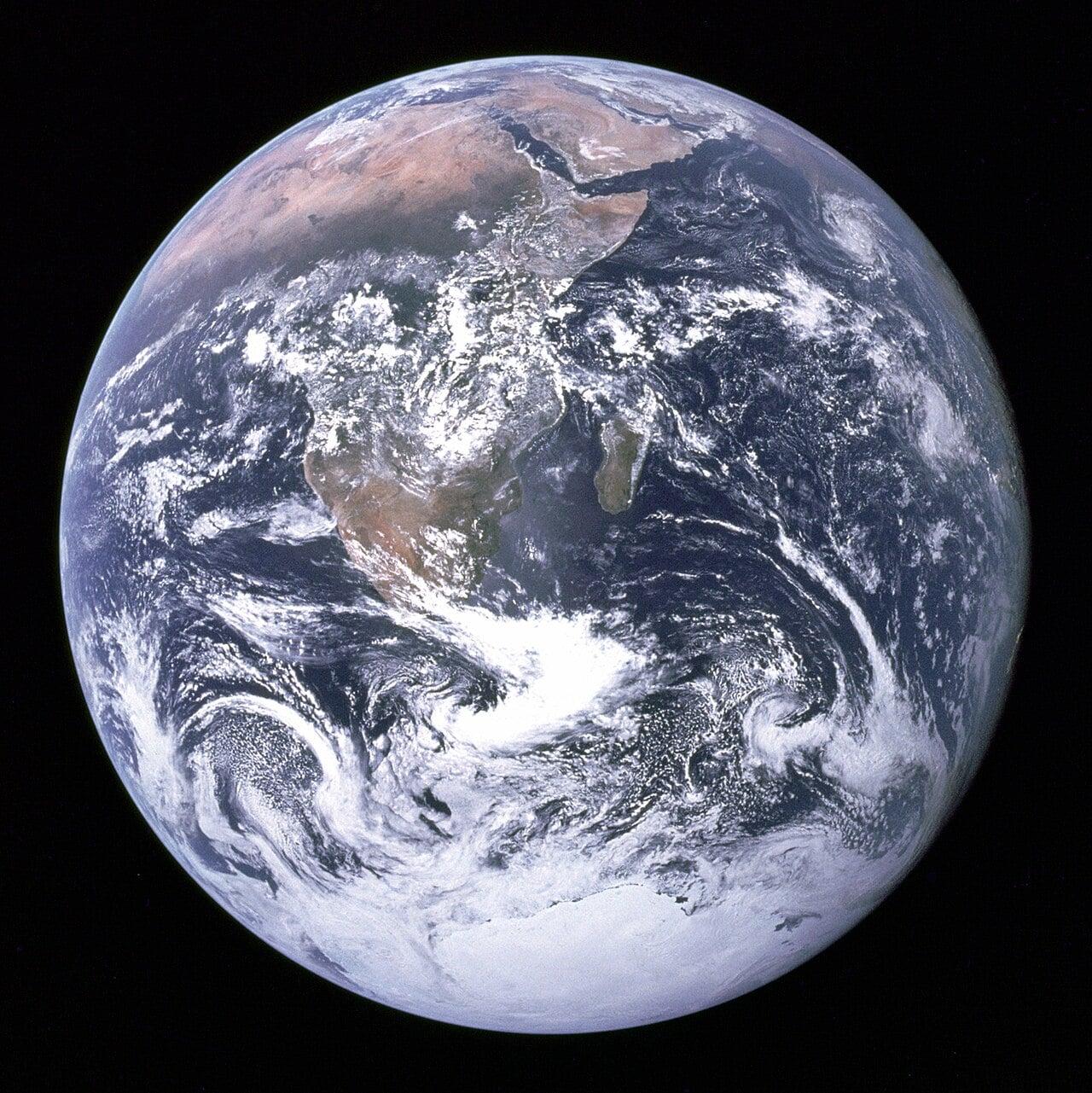
(This is Part 3 of a series on what we can actually find on an exoplanet. Read Part 1 and Part 2 first.) Oh, it's enough. It's never enough, of course, but it's enough to justify building this monstrous planet-hunting telescope, because a single pixel gives you far more than you'd think. That dot has a color, maybe even a pale blue one. It has a spectrum. And it changes brightness as the planet spins on its axis and swings through its orbit. The HWO is our first purpose-built biosignature machine. If life is common, meaning present on some meaningful fraction of habitable-zone rocky planets, the HWO will find it. And if it doesn't, that tells us life is much rarer than we hoped. Either answer is worth having. It helps that, to gather enough light, the HWO will have to stare at each planet for days to weeks. Every planet becomes its own project: months of preparation and planning, then weeks of observation, then a lifetime of analysis. That's why studying just 25 worlds will take a decade. But because we watch each planet for so long, by the time we've built up a decent signal it has a lot to tell us. A lot more than atmospheres. Back in 1990, Carl Sagan and colleagues talked NASA into pointing the Galileo spacecraft, then on its way to Jupiter, back at Earth for a look. The resulting 1993 paper, "A Search for Life on Earth from the Galileo Spacecraft," is a classic. They deliberately analyzed the data as though they had no idea what planet they were looking at, treating Earth as an unknown target. They found oxygen and methane together, that classic cocktail in disequilibrium; an unexpectedly sharp jump in reflectivity at red wavelengths (hold that thought, it's going to be fun in a minute); and a spray of narrow-band radio signals that no natural process could explain. That last one was us, blasting away across the radio dial. That kicked off a whole tradition of using Earth as a test case, either by repurposing distant probes or by taking nearby ones and deliberately degrading their data, to see what Earth would look like to alien astronomers of various skill levels. And the theorists haven't been sitting idle either. Bored theorists get creative, and they've dreamed up all sorts of ways to wring every last drop of information out of a bare pixel. If you've ever seen sunlight bouncing off a lake at sunset, you've seen glint. It's the mirror-like flash off a smooth, flat surface, technically called specular reflection, as opposed to the diffuse, matte scattering off dirt or sand or grass, which throws light in every direction. Water does the mirror trick. Land does not. Which means an ocean-bearing planet, seen from the right angle, should sparkle in a way a dry rocky planet simply can't. The right angle turns out to be crescent phase, when we're seeing the planet mostly from its night side with just a thin sunlit sliver showing, the way we see a crescent Moon. In that geometry, sunlight skips off the ocean at a steep grazing angle and heads more or less straight back at us, and the whole crescent lights up like a mirror. Simulations show that ocean glint can nearly double Earth's total brightness at crescent phase. That's the difference between a wet world and a dry one, sitting right there in how the planet's brightness changes as it goes about its business. Better still, the glint isn't steady as the planet turns. When a continent rotates into view it interrupts the mirror bounce and the glint dims; when ocean swings back around, it brightens again. The planet appears to blink. And that blinking is a fingerprint of a partly oceanic surface that you can't fake with clouds or ice caps alone. Push it further. If you can watch an exoplanet through one full rotation, one of its days, however long that lasts, and track how its total brightness changes as different parts of the surface turn into view, you can mathematically invert those brightness swings to reconstruct a rough map of what lies at which longitudes. Bright deserts, dark forests, blue oceans, white ice caps: each reflects differently, and each rotates into view at a different moment. Measure the brightness changes precisely enough and you can back out where each kind of surface sits on the globe. From brightness alone. Without ever resolving the planet as anything more than a single point. Stretch the same technique across months and multiple orbital phases, so the tilt of the planet's axis brings different latitudes into view at different times, and you can start recovering crude two-dimensional maps, latitude and longitude both. This too has been done for Earth, using data from a let's-pretend-this-is-a-distant-alien-telescope satellite, and the recovered maps show recognizable continents. From a single pixel. So we can pull out oceans, continents, shapes. And vegetation. Chlorophyll, the molecule that makes plants green, absorbs red and blue light greedily (that's the light it eats) and reflects green (which is why leaves look green: the green bounces back to your eye). But something remarkable happens just past the red end of the visible range, in the near-infrared. Plant leaves suddenly become extremely reflective. Not for photosynthesis, since near-infrared photons don't carry enough energy to power the chemistry anyway, but as protection, so leaves don't soak up too much heat and cook themselves. The switch from absorbing red to reflecting near-infrared happens across a very narrow band of wavelengths, right around 700 nanometers. Plants go from absorbing most of the red light that hits them to reflecting most of the near-infrared, a jump of a factor of five or more, across a stretch of the spectrum narrower than the width of a laser pointer. This feature is called the vegetation red edge, and it is genuinely bizarre. Nothing else in nature, no rock, no mineral, no ocean, no cloud, no atmospheric molecule, produces a step this sharp at this wavelength. Which means that if we ever spotted a red-edge-like feature in the reflected light of an exoplanet, a sudden sharp jump in reflectivity at a specific wavelength, we'd have compelling evidence for surface photosynthesis. Forests. Or the alien equivalent. The catch, and it's a real one, is that even on Earth the red edge is only a few percent of the total reflected light, because plants cover only about 60 percent of the land, land covers only about 30 percent of the surface, and clouds blanket about half of everything at any given moment. The signal gets badly diluted. But it's still there, and the HWO would be sensitive enough to catch it on a nearby world if plant-like life is abundant. The really fun part arrives when you add seasons. On a planet with axial tilt like Earth's, covered in deciduous forests, the strength of the red edge should rise and fall over the year, growing as leaves come out in spring and summer, weakening in fall and winter. A world whose red edge swelled and shrank in step with its orbit would be a world whose surface was thriving in summer and hunkering down in winter. That would be one of the most stunning biosignatures imaginable: not a static chemical fingerprint, but a dynamic one, keyed to the planet's seasons. Of course, alien plants don't have to be green. Plenty of photosynthesis on Earth is done by red algae, so we don't have to fixate on this exact wavelength. But if we see sharp features in the spectrum shifting as the planet moves through its seasons, that is big. In Part 4, we go looking for something even bolder than life in that single dot: the smokestacks of an alien civilization.
What Can We Actually Find on an Exoplanet? Part 3: Reading the Face of a Planet
Full Article
Original Source
Read the full article at Universetoday →KhanList aggregates and links to publicly available news content. We do not host full articles from third-party sources. Always verify important information with original sources.