
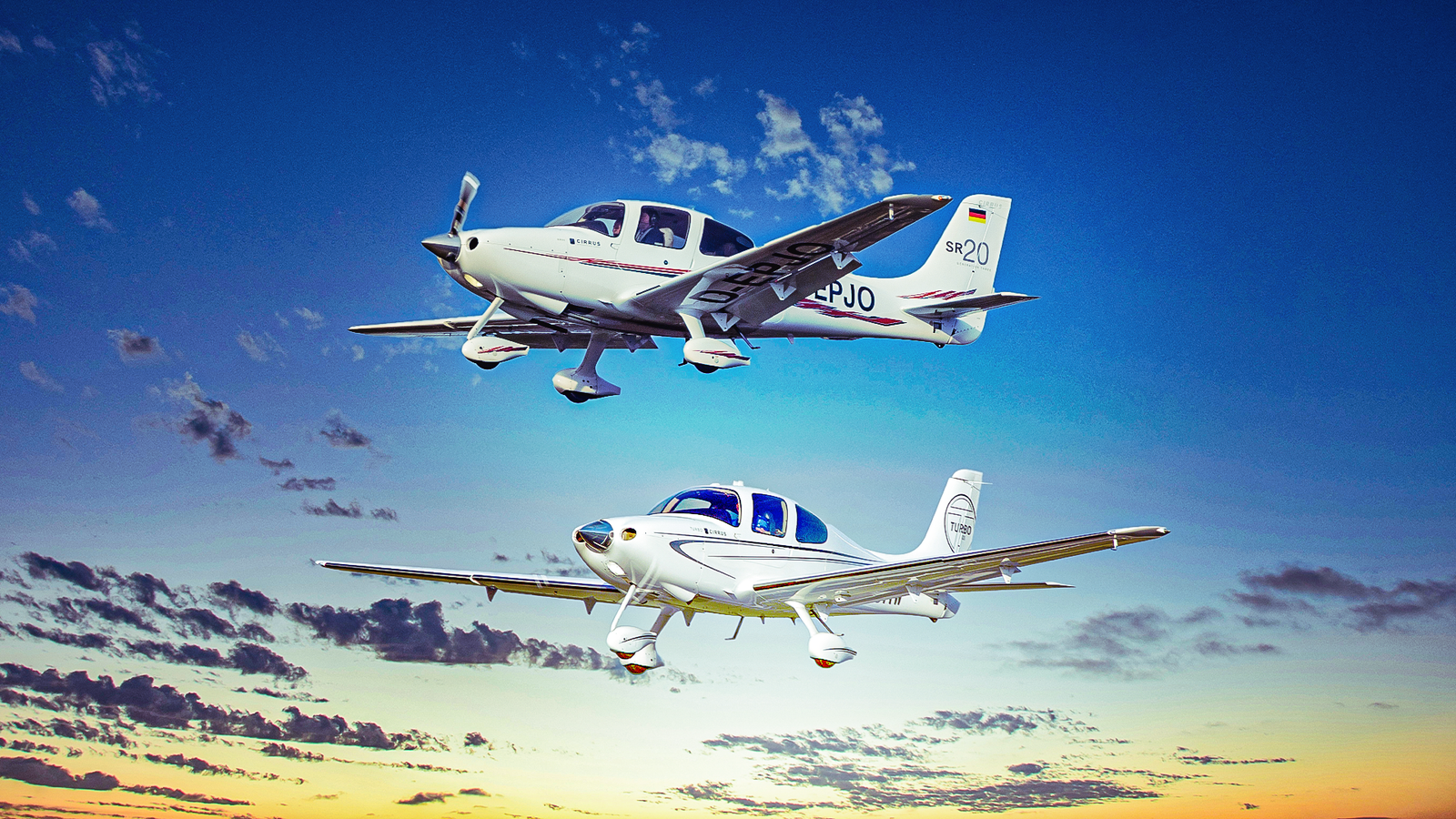
Credit: Kevin Hackert | Philip Pilosian | Shutterstock | Simple Flying Published Oct 16, 2026, 4:00 AM EDT Experienced ICAO English Language Proficiency Instructor for pilots and ATCOs and conference interpreter who is passionate about facilitating effective communication within aviation-related businesses. Possess a deep understanding of the aviation industry, including aviation regulations, terminology, and industry-specific communication protocols. Has been working at numerous airshows across Europe since 2014. Being an ultralight pilot in her free time, she also promotes safety and efficiency in aviation operations. Based in Italy and Malta Sign in to your Simple Flying account Choosing between the Cirrus SR20 and SR22 can look like an easy choice. Both aircraft come from the same family, share the distinctive Cirrus composite design and cabin layout, and reflect the company's emphasis on modern avionics and safety. But for a prospective owner, the difference is significant: the SR22 has substantially more power, speed, range, and payload capability, while the SR20 is the more accessible, less performance-oriented member of the family, according to Cirrus SR family description. Buying a private piston aircraft involves many steps and a careful evaluation. Factors such as performance, cabin capacity, range, operating requirements, and purchase price can all influence which model makes the most sense for a particular owner. With two aircraft sharing so much of the same design philosophy, prospective buyers find it especially important to understand where the SR20 and SR22 differ. Here is how the two Cirrus compare, including other comparable aircraft, and which one makes more sense for different types of owners. The SR22 Is The Bigger & Faster Cirrus Credit: LB Houston | Shutterstock The simplest way to distinguish the two aircraft is to look at their engines. The current SR20 is powered by a 215-hp Lycoming IO-390-C3B6, while the SR22 uses a 310-hp Continental IO-550-N. That gives the SR22 95 hp, or roughly 44% more power, and the difference shows up immediately in the aircraft's performance. Cirrus quotes a maximum cruise speed of 155 KTAS (178 mph/287 km/h) for the SR20, compared with 183 KTAS (211 mph/339 km/h) for the SR22, as per Cirrus SR20 and SR22 specifications. The difference becomes even more important when the aircraft are loaded for travel. The SR20 has a published useful load of 1,003 lb (455 kg), while the SR22 can carry 1,328 lb (603 kg), giving the larger model another 325 lb (147 kg) of useful load. The SR22 also has a maximum range of 1,169 nautical miles (2,165 km) at 55% power, versus 709 nm (1,313 km) for the SR20. Those numbers make the SR22 considerably more suited to serious cross-country work. Importantly, the SR20 is not a stripped-down SR22. It retains the fundamental Cirrus philosophy, including the composite airframe, modern glass avionics, and Cirrus Airframe Parachute System (CAPS). Cirrus says CAPS is standard throughout its certified aircraft range, while the SR20 and SR22 also share a 49-inch (124-cm) cabin width and 50-inch (127-cm) cabin height. The real dividing line is performance and the price the owner is willing to pay. What Factors Influence The Difference? The Engines Explain Most Of It Credit: Kevin Hackert | Shutterstock The engine is the starting point because the two aircraft have been designed around different performance levels. As described above, the SR20's Lycoming IO-390-C3B6 produces 215 hp, while the SR22's Continental IO-550-N produces 310 hp. The difference is reflected in takeoff performance as well: Cirrus lists a takeoff distance of 1,685 feet (514 meters) for the SR20 and 1,082 feet (330 meters) for the SR22, although real-world performance varies with runway, temperature, altitude, loading, and wind. Climb performance shows an even clearer separation. The SR20 climbs at a published 781 feet/min (3.97 meters/sec), while the SR22 is rated at 1,270 ft/min (6.45 m/s). That extra performance can matter far more than the difference in cruise speed when an aircraft operates from a high-density-altitude airport, carries several occupants, or needs to climb rapidly after departure. For an owner who regularly flies in mountainous terrain or hot conditions, that additional power is more than a way to save a few minutes in cruise. The aircraft also differ in weight and loading limits. The SR20 has a maximum gross weight of 3,150 lb (1,429 kg) and a base weight of about 2,147 lb (974 kg), while the SR22 has a maximum gross weight of 3,600 lb (1,633 kg). That means the SR22 is substantially heavier overall but has considerably more room for useful load. In practical terms, Cirrus gives the SR22 more flexibility to carry people, fuel, and baggage on longer missions. Specification Cirrus SR20 Cirrus SR22 Engine Lycoming IO-390-C3B6 Continental IO-550-N Power 215 hp 310 hp Maximum cruise 155 KTAS / 178 mph / 287 km/h 183 KTAS / 211 mph / 339 km/h Maximum range, 55% power 709 nm / 1,313 km 1,169 nm / 2,165 km Useful load 1,003 lb / 455 kg 1,328 lb / 603 kg Maximum gross weight 3,150 lb / 1,429 kg 3,600 lb / 1,633 kg Takeoff distance 1,685 feet / 514 meters 1,082 feet / 330 meters Climb rate 781 feet/min / 3.97 meters/sec 1,270 feet/min / 6.45 meters/sec Maximum operating altitude 17,500 feet / 5,334 meters 17,500 feet / 5,334 meters Cabin width 49 in / 124 cm 49 in / 124 cm Cabin height 50 in / 127 cm 50 in / 127 cm The numbers also illustrate why SR20 can make sense for a different buyer. If most flights involve one or two people and relatively short distances, its 155-knot cruise is still respectable, and its modern cockpit makes it far more sophisticated than the basic trainers many pilots start with. Paying for 310 hp makes little sense if you rarely use extra payload and range. The SR20's lower performance is part of the reason the model works as the entry point into Cirrus ownership. What Do Pilots And Training Organizations Say? Mission Matters More Than The Badge Credit: Vidit Luthra | Shutterstock Pilot discussions about the SR20 and SR22 tend to reach a similar conclusion: neither aircraft is universally better. Owners who primarily fly shorter recreational trips often find the SR20's performance sufficient, while pilots carrying more passengers or making longer trips tend to value the SR22's additional power and payload. Discussions among Cirrus pilots often return to the same basic question: what does the owner actually intend to do with the airplane? That distinction matters especially for training. Cirrus has developed the TRAC20, based on the SR20 platform, specifically for professional flight training. The company has also supplied SR20 aircraft to major training organizations, including United Aviate Academy, demonstrating that the smaller Cirrus can serve demanding professional training missions rather than merely being an entry-level private aircraft. The financial argument behind that choice is equally important. Cirrus' 2026 North American price list puts the SR20 Premium at $754,900, while the 2026 SR22 starts at $937,900, before optional equipment and applicable market considerations. That makes the factory-new difference roughly $183,000. The used market complicates the decision. Current asking-price data from Hangar67 puts the average price for SR20 listings at around $288,000, although its broader SR20 family data, which includes later G2, G3 and G6 aircraft, produces a higher average of around $366,000. The SR22 family has a much higher average asking price of approximately $574,000, reflecting its broader range of generations, equipment, and performance levels. That spread shows why used-aircraft buyers shouldn't compare model names. An early SR20 and a recent SR20 G6 can have dramatically different avionics, interiors, maintenance histories, and prices. The same is true of an early SR22 compared with a recent G6 or G7. How Does The Cirrus Compare With The Alternatives? Credit: Antonio Di Trapani | Simple Flying The Cirrus models occupy an interesting part of the piston market because they combine relatively high cruise speeds with modern avionics and a whole-aircraft parachute. But buyers have several alternatives, and some can make more sense depending on priorities. The Cessna 182 Skylane, for example, is slower than either Cirrus but offers a conventional high-wing configuration, a useful load of 1,110 lb (503 kg), a maximum range of 915 nm (1,695 km) and a 145-KTAS (269-km/h) maximum cruise speed, according to Cessna official website. The Beechcraft Bonanza G36 is a more natural competitor to the SR22 in terms of positioning, offering a traditional high-performance single-engine platform. Its appeal is more about providing a mature, conventional aircraft for owners who prefer the Bonanza's handling, cabin, and systems philosophy. The trade-off is that the Bonanza does not offer the Cirrus CAPS system as standard, and its traditional control and cabin philosophy differs markedly from the Cirrus approach. The Cessna TTx, formerly known as the Corvalis 400, is another particularly interesting alternative. It is no longer in production, meaning buyers enter the used market, but it was designed as a fast, high-performance composite piston aircraft. The Van's RV-10 occupies a different part of the market altogether because it is an experimental/amateur-built aircraft rather than a factory-certified Cirrus. AOPA's direct fly-off between an RV-10 and an SR22 found remarkably close performance, with both aircraft reaching 178 KTAS during the test. Aircraft Current/new or used pricing* Maximum cruise Useful load Cirrus SR20 New: $754,900; used average: $287,606 155 KTAS / 178 mph / 287 km/h 1,003 lb / 455 kg Cirrus SR22 New: $937,900; used family average: $574,105 183 KTAS / 211 mph / 339 km/h 1,328 lb / 603 kg Cessna 182 Skylane Used family average: $289,280 145 KTAS / 167 mph / 269 km/h 1,110 lb / 503 kg Cessna TTx Used average: $704,633 235 KTAS / 270 mph / 435 km/h 1,070 lb / 485 kg Van's RV-10 Kit: $89,600; QuickBuild: $116,300; completed aircraft: ~$325,000–$495,000 ~175–180 KTAS / 201–207 mph / 324–333 km/h ~1,050–1,100 lb / 476–499 kg Price source: Hangar67 The comparison shows why the SR22 sits in a particularly interesting position. The Cessna 182 offers a more conventional route into four-seat ownership, while the RV-10 can provide impressive performance for considerably less money if the owner accepts the experimental-aircraft route. AOPA's test showed the RV-10 and SR22 reaching the same speeds under the test conditions, despite major differences in weight and construction. The SR22's differentiator, then, is not simply speed. It combines speed, useful load, modern systems, and the Cirrus safety philosophy in a factory-certified package. The SR20 offers much of that same philosophy at a lower performance level and acquisition cost, which is exactly why the two models can appeal to very different buyers. What Are The Drawbacks? Where Other Aircraft Can Beat The Cirrus? Credit: Antonio Di Trapani | Simple Flying The SR22's biggest advantage is also its main drawback: performance costs money. Its 310-hp Continental IO-550-N gives it considerably more power than the SR20's 215-hp Lycoming, but that extra capability comes with a higher purchase price and potentially higher operating costs. For a pilot who spends most of the year making short local flights, paying for the SR22's additional speed, range, and payload may therefore make little financial sense. The SR20 has the opposite limitation. Its 1,003-lb (455-kg) useful load can become restrictive when passengers, baggage and fuel are combined, while its 709-nm (1,313-km) maximum range leaves less flexibility for long-distance flying than the SR22's 1,169 nm (2,165 km). Buyers also have alternatives: the Cessna 182 Skylane offers a conventional high-wing design and strong utility. The RV-10 provides perhaps the most striking and cheapest alternative, although its experimental status makes it a fundamentally different ownership proposition. The RV-10 and SR22 produced similar performance and high-speed figures, showing what a lighter experimental airframe can achieve. Used Cirrus aircraft also require careful scrutiny, since age, avionics, engine hours, maintenance history, and CAPS status can make two aircraft of the same model dramatically different purchases. Which Cirrus should you buy — the SR20 or SR22? The answer ultimately comes down to the mission. The SR20 is the better choice for pilots who primarily fly locally, use the aircraft for training or recreational flying, usually carry one or two passengers, and do not need maximum cross-country performance. Its 155-KTAS (178-mph/287-km/h) cruise speed remains substantial for a four-seat piston aircraft, while it retains the modern cockpit and CAPS system that define the Cirrus family. The SR22 is the more compelling choice for an owner who sees the airplane as a serious transportation tool. Its 183-KTAS (211-mph/339-km/h) cruise speed can significantly shorten longer journeys, while its 1,169-nm (2,165-km) published range and 1,328-lb (603-kg) useful load provide considerably more flexibility with fuel, passengers and baggage. Its 1,270-ft/min (6.45-m/s) climb rate, compared with 781 ft/min (3.97 m/s) for the SR20, also gives it a substantial performance advantage when operating with heavier loads or in demanding conditions. Price is ultimately where the decision becomes personal. Cirrus' 2026 North American price lists put the SR20 Premium at $754,900, compared with $937,900 for the SR22, a difference of about $183,000 before options. That premium is hard to justify for a pilot who rarely needs the extra performance, but it can be worthwhile for someone regularly flying long distances with several passengers; ultimately, the smartest purchase is the aircraft whose capabilities match most of the owner's missions.
What Are The Differences Between The Cirrus SR20 And The Cirrus SR22?
Full Article
Original Source
Read the full article at Simpleflying →KhanList aggregates and links to publicly available news content. We do not host full articles from third-party sources. Always verify important information with original sources.