
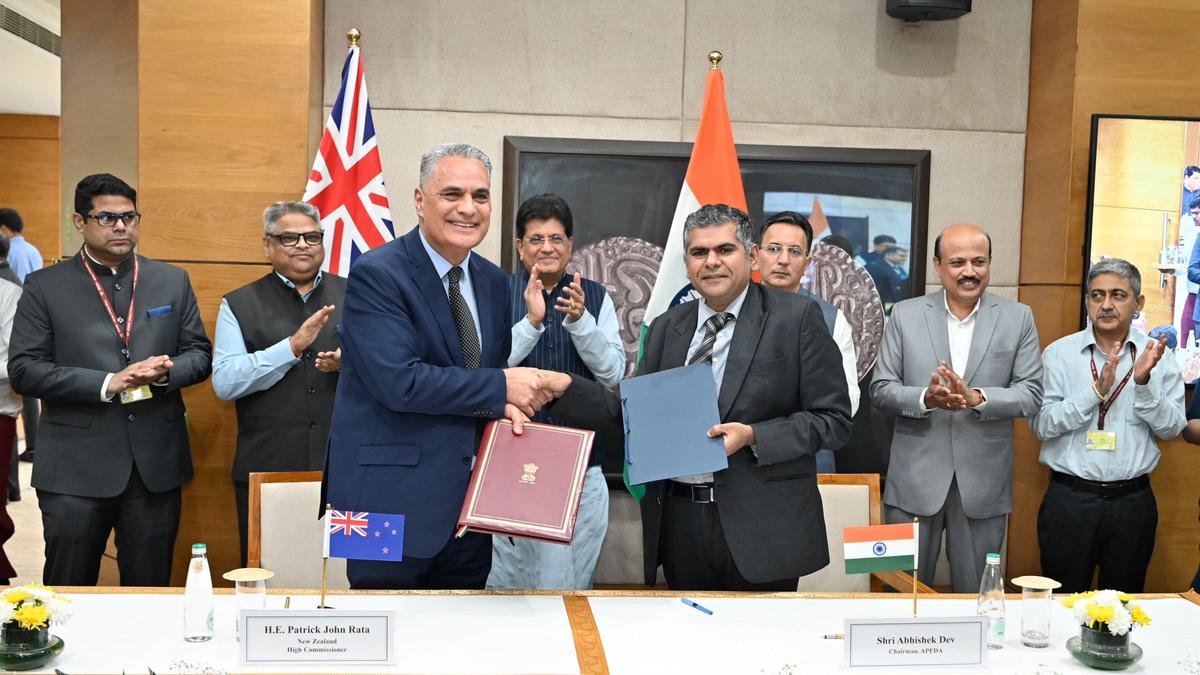
The story so far: After coming into force on October 20, India’s trade deal with New Zealand became the seventh such agreement to take effect in the last five years. The deal with New Zealand is special not only for India’s trade gains but also because of how the investment is set to benefit. There are also several other provisions, such as those related to mobility, that make the deal stand out.What does India gain in trade?The India-New Zealand Free Trade Agreement (FTA) provides India with duty-free access to 100% of New Zealand’s tariff lines. This is one of the elements that makes the deal stand out. While all other deals India has signed so far have granted partial or substantial duty-free access, with some countries such as the U.K. offering more than 99% of their tariff lines duty-free, and a 100% duty exemption on all tariff lines has so far not come to pass in a full trade deal.The India–Australia Economic Cooperation and Trade Agreement (ECTA) provides India with duty-free access on 100% of tariff lines, but so far it is an interim or limited-scope trade agreement. The two countries are working to broaden the ECTA into a Comprehensive Economic Cooperation Agreement (CECA).Before the implementation of the deal, New Zealand levied a 10% tariff on imports from India related to textiles, apparel, leather and footwear, engineering goods, plastics and rubber, and electronics. Each of these sectors is an area where India has substantial export capacity, and all of them stand to benefit.Further, sectors such as pharmaceuticals, agriculture and allied services, marine products, and chemicals have seen their duties fall from 5% to zero.What does the investment commitment involve?As per the official text of the agreement, New Zealand “shall promote foreign direct investment (FDI) from investors of New Zealand into India with the aim to increase such investment by U.S. dollars 20 billion within 15 years” of the agreement coming into force.Editorial | Trading smart: On the India-New Zealand FTAThis commitment to promote FDI within a set time frame, however, comes with some minor caveats. The agreement says that both sides recognise that India’s economic development over the last two decades has been accompanied by an increase in FDI. New Zealand’s aim to strengthen its FDI presence in India is based on this observation, “and on the estimated nominal GDP growth rate of India over the next 15 years, in line with the past growth rates”. That is, it is implicit in the deal that, should India not grow in the future as it has done in the past, New Zealand is not under an obligation to go on trying to promote FDI in India. The agreement further states that investments into India from outside New Zealand shall be taken into account if it can be shown that these investments are made by New Zealand investors.However, investments routed through New Zealand by foreign investors not established in New Zealand or established there without substantial NZ business activity shall not be considered investments from New Zealand into India.What are the gains for Indian students and workers?According to the agreement document, the FTA includes two new Temporary Employment Entry (TEE) visa categories, wider post-study work rights for Indian graduates, commitments around work rights for Indian students during their study period, and a new working holiday scheme.The new TEE visa categories are for highly skilled occupations and a small number of professions considered iconic to India. These will allow up to 5,000 TEE visa holders in New Zealand at any given point in time. These visas, however, will be valid for three years and do not provide a pathway to residence.From November 16, 2026, Indian graduates who have New Zealand PhDs will become eligible for post-study work visas of up to four years, up from the current three years.Currently, all eligible students in New Zealand from all countries can work up to 25 hours each week while studying. The FTA says that, even if New Zealand changes this rule in the future, Indian students will be guaranteed an allowance of 20 hours of such in-study work each week.The deal also introduces a new working holiday scheme for Indian nationals aged 18 to 30 within two years of the FTA entering into force. Under this scheme, up to 1,000 successful applicants can spend up to 12 months in New Zealand without work.What has New Zealand gained from the deal?India has extended market access on 70% of tariff lines in a phased manner, with 30% of the tariff lines excluded from the deal to protect India’s sensitive and strategic sectors.India has agreed to zero-duty imports from New Zealand on 30% of its tariff lines, including wood, wool, sheep meat, and raw leather hides, among other items. Another 35.6% of the tariff lines, covering items such as petroleum oils, vegetable oils, malt extract, and selected electrical and mechanical machinery, will see duties eliminated over four phases: three, five, seven, and 10 years after the entry into force of the deal.Tariffs will be reduced but not eliminated on 4.37% of tariff lines, including pharmaceutical drugs, polymers, and aluminium and iron and steel articles. A further 0.06% of items — such as Manuka honey, apples, kiwifruit, and albumins — will receive tariff reductions up to a certain import quota.Finally, 29.97% of the tariff lines have been excluded from the deal, including dairy such as milk, cream, whey, yoghurt, cheese, and butter, animal products other than sheep meat, agricultural products such as onions, chana, peas, corn, almonds, etc., sugar, artificial honey, vegetable fats and oils, and arms and ammunition.
What are the deal contours of India-New Zealand FTA?
Full Article
Original Source
Read the full article at Thehindu →KhanList aggregates and links to publicly available news content. We do not host full articles from third-party sources. Always verify important information with original sources.