
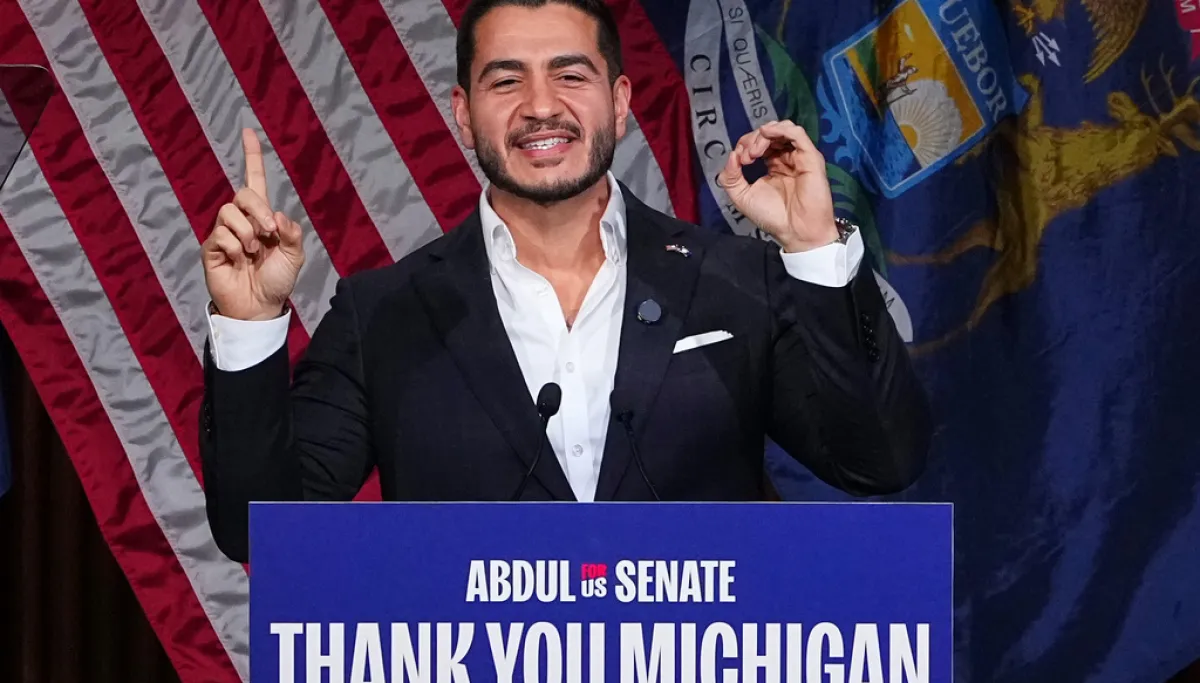
DEARBORN, Michigan — Sen.-elect Abdul el Sayed’s (D-MI) victory in Michigan will test whether Democrats can accommodate a progressive insurgent who has repeatedly challenged the party establishment or whether his combative style will make him a headache for current Senate Minority Leader Chuck Schumer (D-NY).El Sayed’s election has given progressives a significant new voice in Washington. But his election-night victory speech, which at times sounded to some more like a taunt than a call for unity, coupled with a contentious exchange with a Sky News reporter earlier in the night, has raised questions about whether his pugilistic instincts will help him legislate or leave him perpetually at odds with colleagues.His victory could complicate Schumer’s efforts to keep the Democratic caucus together. It also signals to party leaders that challenging the establishment is not necessarily a liability at the ballot box. Michigan Democratic Senate nominee Abdul el Sayed speaks at an election night event on Wednesday, Nov. 4, 2026, in Detroit. (AP Photo/Julia Demaree Nikhinson) Yet el Sayed’s victory was not quite as commanding as that of another Michigan Democrat.With roughly 96% of the expected vote counted Wednesday morning, el Sayed had received approximately 2.48 million votes, or 52.4%, to Republican Mike Rogers’s 45.6%, according to Associated Press results. Gov.-elect Jocelyn Benson (D-MI), whose race had reached 97% counted by a later Wednesday morning update, had won approximately 2.59 million votes, or 54.5%, to Republican John James’s 43.7%.The roughly 2-point difference between the Democratic candidates’ statewide percentages is a reminder that el Sayed’s victory does not necessarily amount to a sweeping endorsement of his political approach. Benson’s stronger performance fractures the argument that Michigan Democrats’ success was driven exclusively by the progressive movement.Rusty Hills, a former Michigan Republican Party chairman who now lectures at the University of Michigan’s Gerald R. Ford School of Public Policy, sees a politician more complicated than his critics suggest.“El Sayed will not back down from a fight,” Hills told the Washington Examiner. “But he very much plans to deliver results,” beginning with efforts to lower gas and grocery prices and expand access to healthcare.Hills, who previously served as el Sayed’s colleague at the Ford School, described him as deeply policy-oriented, arguing that his willingness to challenge political opponents should not be confused with an unwillingness to govern.“He can walk and chew gum at the same time,” Hills said. “So both things can be true.”Jason Palmer, a Democratic strategist, offered a sharper assessment of the senator-elect’s temperament.“There’s a big difference between being a fighter and being a bully,” Palmer told the Washington Examiner. “Abdul is a fighter, but sometimes he picks unnecessary fights. He needs to learn that winning an argument isn’t the same as winning people over.”Palmer nevertheless rejected the idea that el Sayed is destined to become an obstructionist.“Don’t underestimate Abdul,” he said. “He’s a provocateur, but he’s also a builder.”Palmer pointed to el Sayed’s record in Detroit and Wayne County as evidence that he understands how to translate ambitious ideas into programs. His challenge in Washington, Palmer said, will be knowing when to confront opponents and when to build coalitions.Republican strategist Josh McConkey sees a potential problem.“Democrats spent this campaign condemning political bullying, hostility, and divisive rhetoric,” McConkey told the Washington Examiner. “Yet Abdul el Sayed frequently struck a tone on the campaign trail that critics, including me, found condescending and combative.”McConkey, who is running for lieutenant governor of North Carolina in 2028, argued that the transition from campaigning to legislating would test el Sayed’s ability to work with people who disagree with him.“You can win applause by attacking your opponents, but you don’t pass legislation with applause,” he said. “You pass it with votes.”Schumer’s pain? El Sayed’s arrival could complicate Schumer’s efforts to manage a Democratic caucus divided over the party’s direction and approach to President Donald Trump, although the size of the party’s win in the Senate may blunt potential tension. As of this writing, Democrats had at least 54 seats and were ahead in the final two uncalled states, Alaska and Mississippi.His opposition to American military assistance for Israel could create difficult negotiations over defense spending and foreign aid, and his support for Medicare for All could put him at odds with Democrats who favor more incremental approaches.Geopolitical analyst Irina Tsukerman told the Washington Examiner that el Sayed’s victory gives him influence beyond what is typically associated with a freshman senator, especially because he defeated an establishment-backed primary opponent and showed that progressive candidates can win competitive general elections.“El Sayed’s opposition to American military assistance for Israel could create difficulties when the Senate considers defense appropriations and foreign assistance legislation,” Tsukerman said.She added that his victory could encourage progressives to press for votes on Medicare for All and restrictions on military assistance to Israel. If el Sayed repeatedly threatens to withhold his vote unless leadership accepts his demands, Schumer would have to decide whether to offer concessions or seek support elsewhere.Palmer believes Schumer should view the senator-elect’s confrontational approach as an opportunity rather than an obstacle.“Sometimes a headache is needed to shake up a stagnant institution,” Palmer said. “Schumer would be wise to let Abdul be himself, and try to harness his energy to get things done.”Palmer described el Sayed as a “Rand Paul of the Left,” someone willing to challenge both parties and articulate positions establishment politicians might prefer to avoid.McConkey, however, warned that el Sayed’s political associations could create additional friction within the Democratic caucus.Is the Senate a stepping stone? El Sayed’s victory has also fueled speculation about whether he could become a national progressive figure ahead of the 2028 presidential election.Tsukerman said his campaign established a fundraising network and recognizable political message that could support future national activity, including participation in debates over the Democratic Party’s direction. But a presidential campaign launched soon after he enters the Senate could raise questions about whether he is prioritizing legislative responsibilities.Palmer was reluctant to speculate about el Sayed’s ambitions.“I wouldn’t pretend to know what’s in Abdul’s head,” he said. “But ambition isn’t the problem. Putting personal ambition ahead of public service is.”Palmer argued that el Sayed’s best route to national prominence would be to serve at least one full term in the Senate, demonstrate leadership on a handful of national issues, and deliver results for Michigan.McConkey was more dismissive of the speculation.“Before we start talking about the White House in 2028, let’s see what he accomplishes in Washington in 2027,” he said.Hills likewise does not expect el Sayed to enter the presidential race immediately, noting that other progressives are already positioning themselves for the nomination.The test begins in Washington Palmer said the senator-elect’s greatest strength could ultimately become his greatest weakness.EL SAYED PUTS HIS HANDS ON SKY NEWS REPORTER IN HEATED EXCHANGE: ‘STOP CHASING ME AROUND’“Movements reward confrontation, governing rewards persuasion and coalition-building,” he said. “If he learns when to fight and when to build bridges, he could be a consequential senator. If not, he’ll generate more headlines than results.”Hills offered a more optimistic assessment, arguing that el Sayed’s policy focus and willingness to challenge political opponents could coexist with a practical approach to governing.
What Abdul el Sayed’s victory could mean for Chuck Schumer and Senate Democrats
Full Article
Original Source
Read the full article at Washingtonexaminer →KhanList aggregates and links to publicly available news content. We do not host full articles from third-party sources. Always verify important information with original sources.