
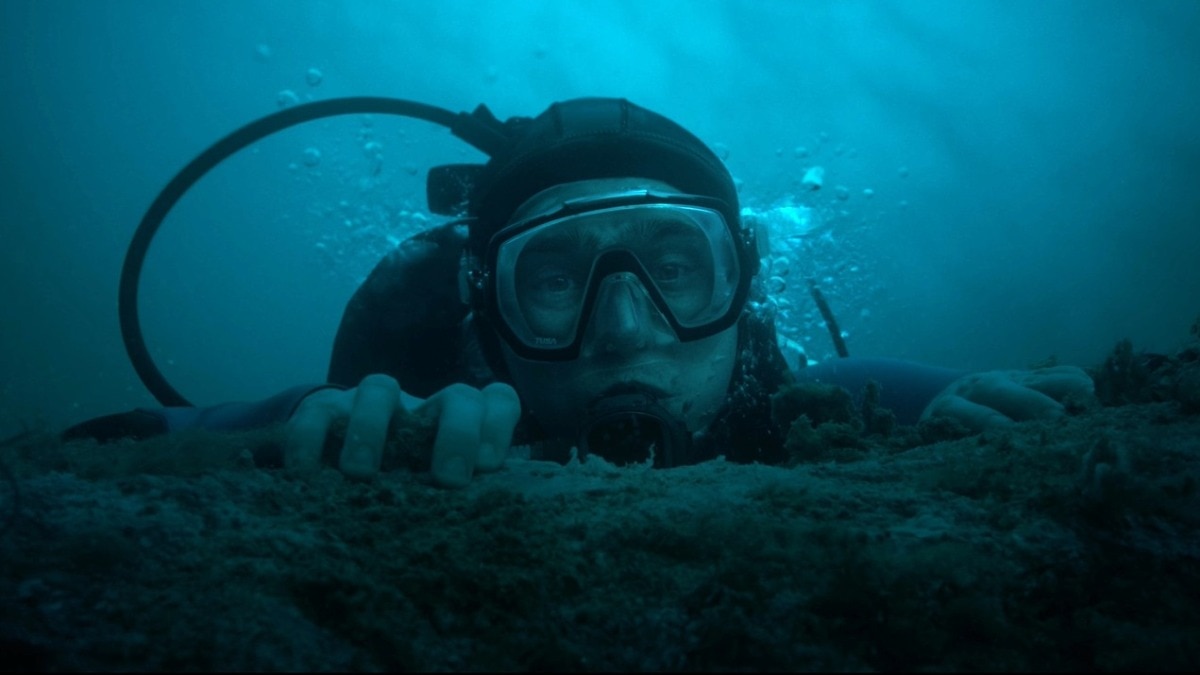
A young man gets swallowed by a whale while trying to recover his dead father’s remains. If that sounds like a rather extreme way to deal with unresolved family trauma, Whalefall has a whole ocean of complications waiting for him. Brian Duffield’s survival thriller takes an outrageous premise and turns it into a story about grief, inherited masculinity and the difficult business of escaping a parent’s shadow. It is equal parts nerve-racking and emotionally messy, even if the film doesn’t always know when to let one side breathe.Austin Abrams plays Jay Gardiner, a young diver whose relationship with his father, Mitt (Josh Brolin), was marked by cruelty, intimidation and the exhausting expectations of a man who believed toughness was the only acceptable form of masculinity. After Mitt dies by suicide, Jay returns to the waters off the California coast to search for his remains. Instead, he finds himself trapped inside a sperm whale, with a dwindling oxygen supply and very little time to figure out an escape.The predicament is absurd, but the film commits to it with surprising conviction. Inside the whale, Jay must navigate a gut that is slippery, grotesque, acidic, and increasingly hostile. The production design makes the creature’s insides feel like a nightmare of digestive chambers, suffocating spaces and unexpected dangers. Every attempt to move forward carries the possibility of another injury. The ocean, which once offered Jay a way to get away from his father, becomes a place where he must confront everything he has spent years avoiding.Abrams does much of the heavy lifting, often with little dialogue to help him. His performance relies on physical distress: laboured breathing, panic, exhaustion and brief moments of desperate ingenuity. It is a demanding role, and he gives Jay’s struggle a convincing immediacy. The film’s strongest sequences are those in which survival itself becomes the entire story. A dwindling oxygen supply is a more effective source of suspense than almost any speech about the meaning of life. But Whalefall is not content to remain a survival thriller. As Jay fights to escape, memories of Mitt begin to surface, and the film shifts between the present ordeal and the relationship that brought him here. The father is dead, but his voice continues to occupy his son’s mind. Jay may be physically trapped inside a whale, yet the emotional confinement is older and considerably harder to escape.The irony will not be lost on Indian filmgoers and watched Animal. Both films explore the damage a father’s idea of masculinity can inflict on his son, and the peculiar hold that a difficult parent can retain long after the relationship has turned destructive. But where Animal allows its protagonist to embrace the very traits that make his inheritance toxic, Whalefall is more interested in the possibility of breaking away. Jay’s struggle is not about proving that he can be as tough as his father. It is about deciding which parts of that inheritance deserve to survive. There is an affecting idea here: escaping a parent does not necessarily mean forgetting them. Jay has to reckon with the lessons Mitt taught him, even as he recognises the harm those lessons caused. The film understands that grief is rarely straightforward, particularly when love, resentment and guilt exist together. You can mourn someone and still be angry with them. You can miss a parent without wanting to become them.Unfortunately, the flashbacks sometimes interrupt the very tension they are meant to deepen. Just as Jay faces a fresh physical obstacle, the film returns to another painful memory or imagined conversation. Some of these moments enrich our understanding of their relationship; others feel too insistent, spelling out emotions the performances have already conveyed. Brolin is convincing as a man whose version of love is inseparable from control, but the film occasionally makes Mitt’s cruelty so emphatic that it leaves little room for ambiguity.Duffield, who co-wrote the screenplay with Daniel Kraus, is more assured when he trusts the imagery. The whale becomes both a terrifying physical space and a metaphor for the past swallowing Jay whole. The film’s visual imagination is its greatest asset, though its emotional ambitions sometimes threaten to overwhelm its survival mechanics.Whalefall is an unusual, often gripping film that makes a meal of an outrageous premise. It occasionally gets carried away with its own symbolism, but Abrams’ performance and the visceral underwater sequences keep it afloat. The final struggle is not simply about getting out of a whale. It is about finding a way to live without allowing a parent’s damage to become your destiny.Some inheritances take a lifetime to escape. Jay gets an hour of oxygen.Whalefall releases in Indian theatres on October 16.- Ends
Whalefall review: Austin Abrams' inventive thriller occasionally loses its breath
Full Article
Original Source
Read the full article at Indiatoday →KhanList aggregates and links to publicly available news content. We do not host full articles from third-party sources. Always verify important information with original sources.